

Part of the guide: Network Marketing Lead Generation
Sales qualification is supposed to protect you from wasting a call on someone who can’t buy. Most people learn it as BANT, Budget, Authority, Need, Timeline, four boxes to tick before you’ll spend an hour with a stranger. Here’s what nobody tells you about that framework. It was built for enterprise software reps filtering out tire-kickers, not for a human being trying to decide if a high-ticket offer actually fits their life. Used the way most people use it, BANT filters for desperation. It rewards the person who says “yes, I have the budget” out of fear, and it screens out the person who’d be a genuinely good fit but hasn’t fully decided yet. I want to show you the reframe that fixed this for me, and the one story that taught it to me the hard way.
Here’s the story first, because the principle only sticks once you’ve felt it.
In this guide
The Same Script, Three Years Apart
In 2006 I had a phone script. Stack of leads, dial in order, loose talking points, the same words every time. I needed sales that week. Not “wanted.” Needed. Rent was due, the team was watching, and every dial carried the weight of that need. The script bombed. People I talked to could feel it, even over a phone line, even before I’d said anything specifically wrong. Something under the words was off, and they backed away from it the way you’d back away from someone standing too close.
Three years later I ran the exact same script, word for word, from a house in Hawaii. Nothing about the questions had changed. What had changed was me. I wasn’t dialing out of need anymore. I was dialing to find out who fit and who didn’t, and I was genuinely fine either way. Most of those calls landed. Same script, same questions, opposite result, and the only variable that moved was whether I was qualifying the prospect or begging them to qualify me.
That’s the thing traditional BANT hides from you. It looks like a checklist. It’s actually an emotional broadcast. If you’re running it to fill a quota, the prospect feels a closer trying to survive the call, and the people with real money and real decision-making power, the ones you actually want, get quietly repelled by that energy while the desperate ones lean in, because desperate people recognize desperate energy and it feels like company.
What Traditional Sales Qualification Optimizes For, By Default
Walk through the four boxes the way most reps run them and you’ll see the problem plainly.
Budget: “Do you have the money?” Answered under pressure, on the spot, this question rewards whoever says yes fastest, not whoever actually has the money without wrecking their month. Authority: “Are you the decision maker?” Answered under pressure, this rewards whoever’s ego won’t let them admit they need to talk to a spouse or a partner. Need: “Do you need this?” Almost everyone will manufacture a need in the moment if the alternative is admitting they don’t. Timeline: “When would you start?” Under pressure, this becomes “whenever gets you off the phone.”
Run it this way and you don’t filter for fit. You filter for compliance under social pressure. The person who’s the best fit for a high-ticket offer is often the person who says “let me think about the budget honestly” or “I need to check with my partner,” which is exactly the answer that gets coded as a soft no and discarded. You just talked yourself out of your best prospect because their honesty didn’t match your script’s rhythm.
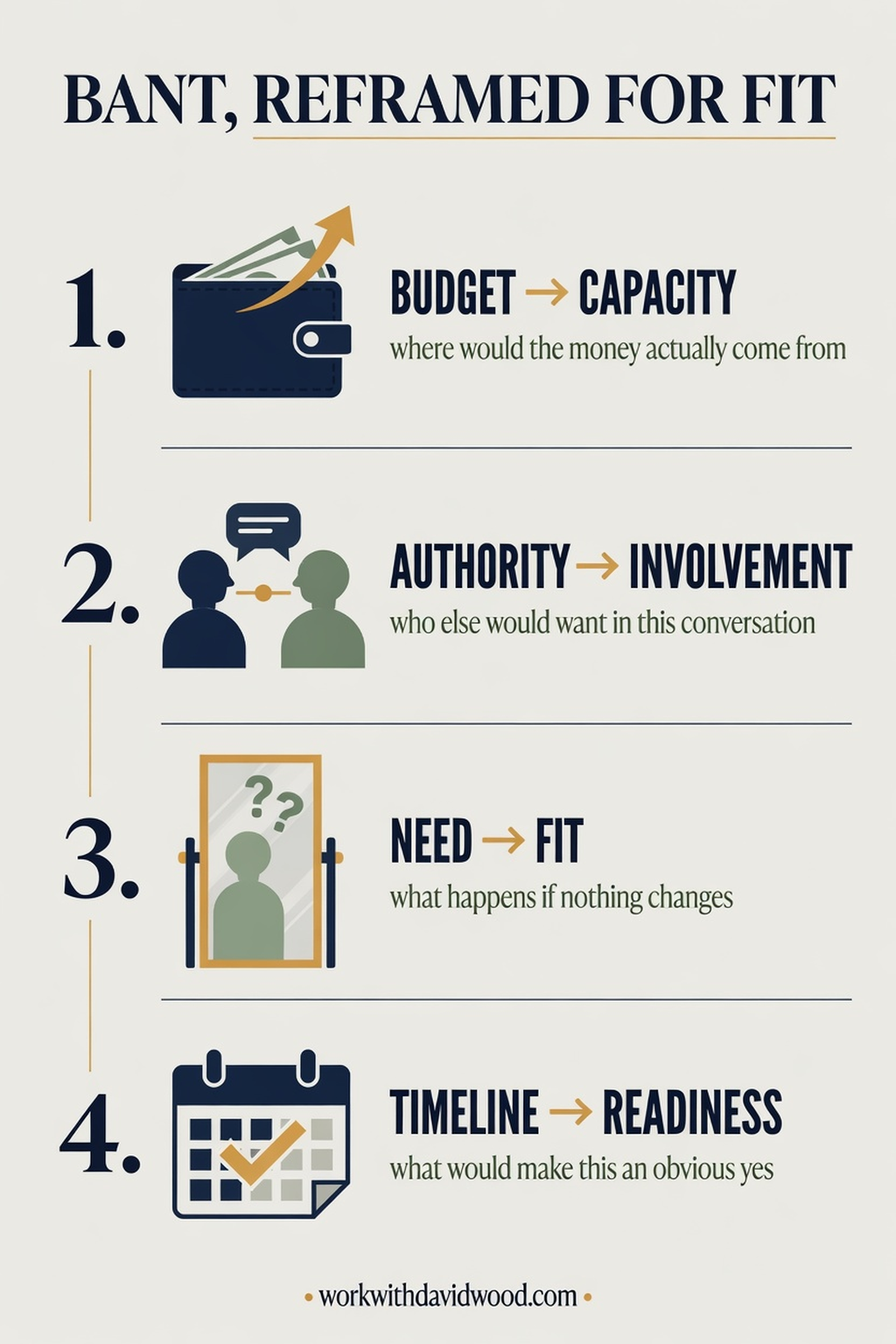
The Reframe: Four Questions About Fit
Here’s what I changed, and it’s a shift in what each question is actually trying to learn, not just softer wording on the same four boxes.
Budget becomes capacity, asked as a real number. Not “do you have the money,” which invites a performance. Instead: “If this were a clear yes for you, where would the investment realistically come from, savings, monthly cash flow, something else?” That question can’t be answered with a reflexive yes. It forces a real number to show up, and the silence while they think is doing your qualifying for you.
Authority becomes involvement. Not “are you the decision maker,” which is a status question people will lie to protect. Instead: “Who else, if anyone, would want to be part of this conversation before you move forward?” You get the honest answer because you removed the ego trap. Half the time the honest answer surfaces a spouse or a business partner you now know to loop in before you waste a second call pretending they don’t exist.
Need becomes fit. Not “do you need this,” which anyone can fake in thirty seconds. Instead: “Walk me through what happens if nothing changes and you’re having this exact same conversation with someone else, a year from now.” That question surfaces the real cost of inaction in their own words, and if they can’t articulate one, you’ve learned they’re not a fit yet, and that’s useful information, not a loss.
Timeline becomes readiness. Not “when would you start,” which invites a placeholder answer. Instead: “What would have to be true in your life for this to be an obvious yes instead of a maybe?” That answer tells you whether you’re looking at a near-term buyer or someone you should stay in touch with for six months. Both are fine outcomes. Pretending the second person is the first is what wrecks your close rate and their trust in you.
I watched this exact reframe change a producer’s income in real time. A guy named Paul, a former MMA fighter, came to work with us and could close, but he was pitching everyone the same way regardless of what they actually said they wanted. We got him on stage and fixed one thing: build the close around the specific needs and desires the prospect had just told you, not the script you’d memorized. His income moved immediately, from the one change. Nothing about his voice or his hustle changed. What changed was that he started listening for fit instead of listening for the moment to pitch.
Running It On an Actual Call
Ask the four reframed questions in order, and do the thing most people skip. Stop talking after you ask one. Let the silence sit. The honest answer usually needs three or four extra seconds to surface, and if you fill that silence with reassurance or another question, you’ve just taught them to give you the fast answer instead of the true one.
Write down the actual words they use, not your summary of them. When you get to the close, you’ll use their language back to them, the exact phrase they used for what happens if nothing changes, and it will land harder than any line you could have written in advance, because it’s theirs.
And build in a real exit. Tell them, early, that a “not yet” is a completely acceptable answer and that you’d rather know now than have them regret a decision made under pressure in three weeks. That single sentence does more to surface the truth than any clever question, because it removes the exact pressure that made the old BANT questions lie to you in the first place.
Why This Matters More at High-Ticket
At a low price point, a bad-fit yes costs you a refund request and a bruised week. At high-ticket, a bad-fit yes costs you a relationship, a testimonial you’ll never get, and a client who churns out angry and tells three people why. The math only works if the people who say yes are the people who were actually going to thrive with what you sell. Qualifying for fit instead of filtering for desperation isn’t a softer way to sell. It’s the only version of selling that survives contact with a real high-ticket business over years instead of months.
If you’re still building the qualifying muscle from scratch, start here before you run this on a live call, and keep the tools I actually use to run these conversations close by so you’re not building the system from memory every time.
The qualifying conversation only works if what you’re qualifying people into can survive honest scrutiny. The system I run pays 100% of every commission on a public smart contract, settled in the same block as the sale, about twelve seconds, so you’re never asking someone to trust a pitch. You’re asking them to read a contract. Drop your name and I’ll send you the walkthrough.
Show me a system built on fit, not pressure →Most participants earn little to nothing. No income is guaranteed. You can verify every payout on the public smart contract.
The Test That Tells You It’s Working
You’ll know the reframe is working when a call ends in a genuine, unhurried “not right now” and it doesn’t feel like a loss. That reaction, the calm instead of the flinch, is the tell. Desperation can’t tolerate a no. Fit-based qualifying expects some of them, plans for them, and gets better at reading real intent every time one shows up. The old scoreboard was close rate at any cost. The new one is close rate among people who were always going to stay closed, which is the only number that actually compounds.
Go back through your last ten “yes” answers and ask, honestly, which ones came from a real fit question landing, and which ones came from someone answering fast just to get off the phone. That audit will tell you more about your current close rate than any script rewrite will.
If your close rate depends on people saying yes under pressure, it isn’t a close rate. It’s a countdown to refunds. I’ll show you the exact on-chain system I use, where every commission is public and verifiable before anyone has to take my word for anything. Enter your name and I’ll send you the walkthrough.
Show me the walkthrough →Most participants earn little to nothing. No income is guaranteed. You can verify every payout on the public smart contract.
See also: the tools and systems I actually recommend, and start here if you’re new.
Three posts a day. One email a day.
Everything I publish, in one short daily email. Real numbers, no hype, unsubscribe in one click.




This sent me somewhere adjacent, which is probably not the point, but here we are. I spend half my week in a bike shop watching people talk themselves into the wrong frame because they are embarrassed to say the budget is the wrong size for their actual riding. Same social pressure, different product. The old BANT boxes reward the fast yes. The reframe questions — where would the investment realistically come from, who else needs to be in the conversation, what happens if nothing changes for a year, what would have to be true for this to be an obvious yes — those are the questions that surface the spouse and the real cash-flow source instead of the ego answer. I will try to stop filling the silence after I ask. That is the bit I usually wreck.
Small terminology note, Declan: classic BANT is Budget, Authority, Need, Timeline — the article has that right — but in a lot of enterprise training the framework was always meant as qualification before a long sales cycle, not a pressure script on a single call. The misuse is the target here, not the original IBM-era intent. On the substance I agree: “who else would want to be part of this conversation” removes the ego trap that “are you the decision maker” creates.
Look, same script three years apart is a tidy story. Does month-two still have the Hawaii calm, or are we naming the destination and calling it the method?