

Part of the guide: Affiliate Marketing
An application funnel asks a prospect to answer real questions, in writing, before they ever land a slot on your calendar. The first time you build one it feels backward, like you’re turning business away. Do it right and the opposite happens. Fewer people book. More of them buy. I learned the underlying lesson watching a friend build a team of 5,000 active people inside one of the largest juice companies in the world and still barely clear $4,000 a month, while a system built to filter instead of flood produced ten times that from a fifth of the people.
That friend is Aaron Rashkin, and he wasn’t lazy or unskilled. He built a genuinely large organization the hard way, one conversation at a time. The problem was never his effort. It was that every lead who showed interest got the same open door: the same calendar link, the same thirty minutes, no matter what they could actually invest or how close they were to a decision. Open doors feel generous. They also mean you spend your best hours explaining the basics to someone who was never going to buy.
In this guide
The Calendar Link Is Lying to You
Most high-ticket sellers run a version of the same funnel. An ad or a post drives traffic to a page, the page says “book a free call,” and a calendar widget hands out slots to anyone who clicks. It looks efficient. It is actually the opposite of efficient, because a calendar link makes zero distinction between a buyer and a browser.
I ran a version of this mistake for years without knowing it had a name. In 2007 I built my first real team the old fashioned way, home parties, three-way calls, hotel meetings, and got it to around $3,000 a month. Then someone sold me a “secret to duplication” on a conference call, and I turned into a full-time phone answering service. The phone rang from 8:30 in the morning until 11:30 at night. I was doing roughly 150 calls a day and the income barely moved, about $5,000 a month for a schedule that owned every hour I had. I answered every call because I hadn’t yet learned that answering everyone is not the same as answering the right people.
I quit answering every call the day a friend I’ll call by his first name, Tom, got looped into a three-way call about his “Aunt Mary” at 11:33 at night, mid video game, and told me flatly that no amount of money was worth what I’d just put him through. He was living in a refrigerator box in the back of a store at the time. If the grind was breaking a guy with nothing left to lose, it was going to break everyone under me too, and it did. The whole team burned out inside 90 days. That day I stopped treating the phone as a volume tool. These days I take a handful of calls a week, calls I chose, and they produce more than the 150-a-day version ever did.
Why Friction Filters, It Doesn’t Cost You Leads
The instinct to protect is that adding a form kills conversion. Fewer steps, more submissions, that’s basic funnel math and it’s true for a lead magnet. It stops being true the moment the thing on the other side of the click is your actual time. A free ebook should have close to zero friction. A forty-five minute conversation where you’re going to open your calendar, your energy, and your best thinking for a stranger should have some.
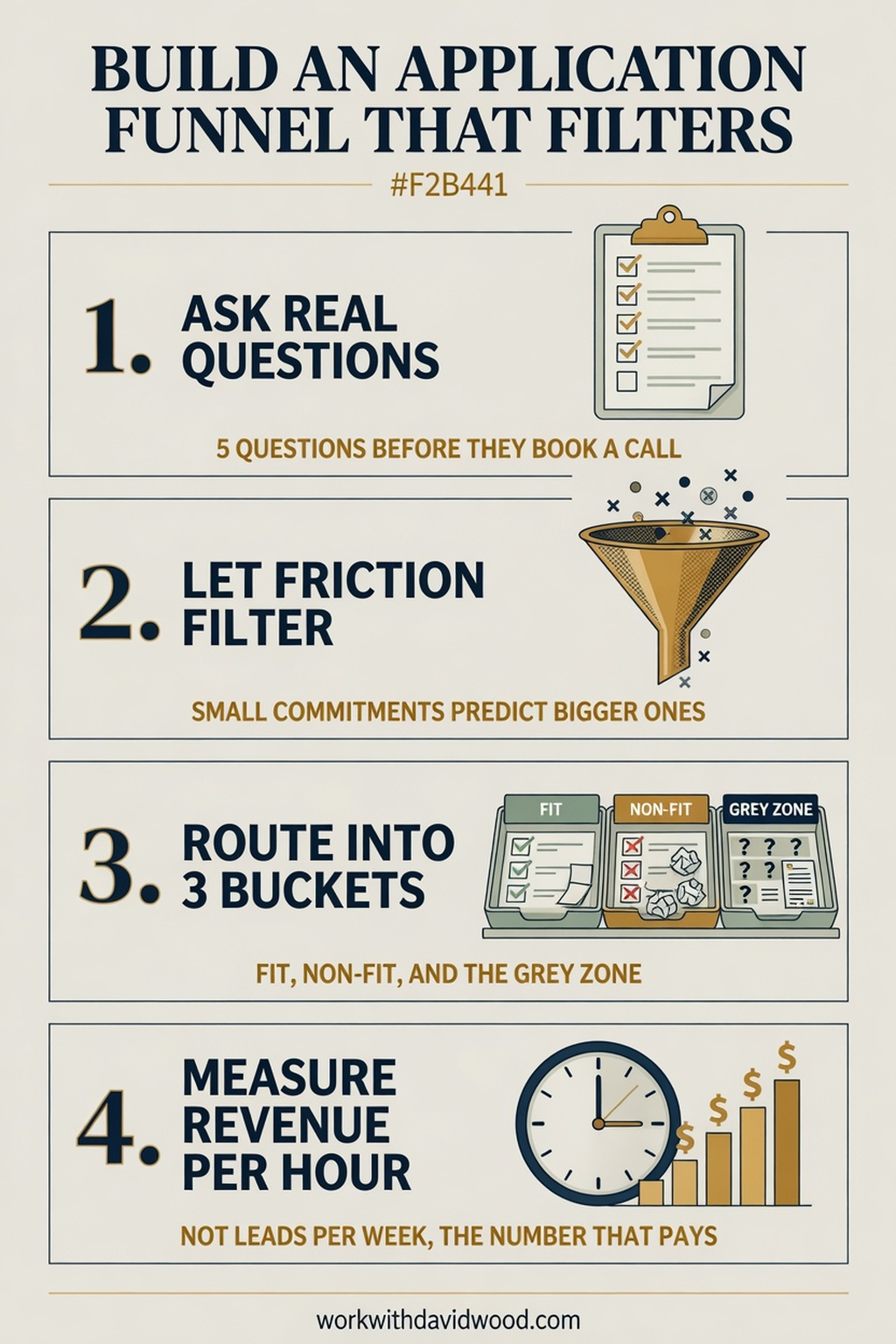
Here’s the mechanism. When someone answers five real questions about their situation, their budget, and their timeline before they book, two things happen at once. The unqualified self-select out, because a tire-kicker won’t finish a form that asks what they’ve already invested trying to solve this problem. And the qualified self-select in harder, because writing the answers down is a small commitment, and small commitments predict bigger ones. You are not filtering people out with an application. You are asking them to start selling themselves before you ever get on the phone. There’s a feeling most people don’t expect once this is running: for the first time, your calendar reflects your standards instead of your anxiety.
Wealth Transformation, the on-chain affiliate program I point people toward, is built on exactly this logic before a single sales conversation happens. It sorts new people into one of three paths right at the door: buy the product only, want to earn and are ready to build, or want to explore earning without buying first. Nobody gets the same pitch. The path someone picks tells you more about how to serve them than a twenty-minute discovery call ever could, because they told you the truth in writing before there was a person on the other end of the line to perform for.
Curious what a real self-selecting funnel looks like from the inside? Wealth Transformation sorts every new person into the path that actually fits them, buy, build, or explore, before any pitch happens. Drop your name and I’ll send you the walkthrough.
See the three paths →Most participants earn little to nothing. No income is guaranteed. You can verify every payout on the public smart contract.
What Actually Belongs on the Application Funnel
Five questions is enough. More than seven and you’ll lose people who would have been good fits but got impatient. Fewer than four and you haven’t actually filtered anything. Here’s the shape I use and teach.
1. What are you doing right now, and where is it not working? This tells you their starting position and gives you their own words to reflect back on the call, which is worth more than any script.
2. What have you already invested, in money or time, trying to solve this? Not to shame anyone. A person who’s spent nothing has different urgency than a person who’s spent $3,000 and is still stuck. Both can be great fits. You just talk to them differently.
3. What’s your timeline for making a decision? “Whenever” is a perfectly honest answer, and it tells you this call is a discovery conversation, not a close.
4. If this looks like a fit on the call, are you in a position to move forward that day? This is the question doing the heaviest lifting. It doesn’t ask for a yes. It asks them to be honest with themselves before they’re sitting across from you, which is a kindness to both of you.
5. In one sentence, why now? The answer to this question is usually the real reason they’ll buy, and it rarely matches what you’d have guessed from the ad they clicked.
Route the Answers Into Three Buckets
Automate the routing if you can build the logic, do it by hand if you can’t yet. Clear fit goes straight to your calendar. Clear non-fit gets a kind redirect, maybe to a lower-priced offer or a piece of free content, never silence. Everyone in the middle gets a shorter call or a quick reply before they get a slot, because that grey zone is where most of the real conversions are hiding, and most open funnels throw it away by accident.
Why This Matters More the Higher You Price
I spent years selling $20 to $100 products at roughly 40% commission, working twelve-hour days to clear five figures a month, which meant moving hundreds of thousands of units to get there. The math only worked with volume, and volume meant taking every call that showed up, qualified or not, because I needed all of them. The moment I moved the same information into a $1,000 to $3,000 offer, the entire equation flipped. I needed a fraction of the buyers to hit six figures, and a fraction of the buyers means every single conversation has to count.
That’s the part people miss when they hear “application funnel” and picture a gatekeeping gimmick. It isn’t optional once your price point rises. If you’re closing $47 products, an unqualified call costs you twenty minutes. If you’re closing $3,000 offers, an unqualified call can cost you the best hour of your day, the one you needed for the prospect who was actually going to say yes. The conversation itself, once someone qualifies, is its own subject, and I’ve laid the full framework out in The Close, my framework for selling high-ticket without pressure. The application funnel is what makes sure the person sitting across from you when you use it is worth the framework in the first place.
The Objection You’ll Hear From Yourself First
Every person who builds one of these tells me the same thing in month one. The numbers dropped. Fewer form fills, fewer booked calls, a smaller funnel on paper. Give it sixty days and look at the number that actually pays your bills, which is revenue per hour spent selling, not leads per week. That number goes up almost every time, because you stopped paying full attention price for conversations that were never going to close.
The honest caveat, because I’d rather you hear it from me than learn it the hard way: an application funnel does not fix an offer that isn’t working, and it will not save a funnel with no real traffic behind it. It’s a filter, not a fountain. You still need people finding the page in the first place. What it does is make sure that once they find it, the ones who show up on your calendar are the ones actually capable of saying yes.
Build Yours This Week
You don’t need a developer for this. A free form tool with five questions and a redirect based on the answers will outperform a wide-open calendar by the end of the month. If you want to see the exact tools I run mine on, including the form and calendar software, they’re listed on the recommended products page. And if you’re brand new to building any of this, the on-ramp is start here, which walks you through the order to build things in so you’re not adding this step before you have an offer worth filtering for.
Here’s the actual assignment. Write five questions tonight. Put them in front of your existing booking link tomorrow. Watch what happens to the quality of the people who show up on your calendar next week, not the quantity. Quantity was never the number that paid you.
Want to see a funnel built on this exact principle, live? Wealth Transformation routes every person into the path that fits before any sales conversation starts, and every commission on the back end settles on a public contract you can verify yourself. Enter your name and I’ll send you the walkthrough.
Show me the self-selecting model →Most participants earn little to nothing. No income is guaranteed. You can verify every payout on the public smart contract.
See also: the tools and systems I actually recommend, and start here if you’re new.
Three posts a day. One email a day.
Everything I publish, in one short daily email. Real numbers, no hype, unsubscribe in one click.




Small terminology note first: what is described here is closer to a qualification or application gate than a ‘funnel’ in the classic sense of a multi-stage conversion path — the word is doing a lot of work. That said, the substance holds. Five questions, three routing buckets (clear fit, clear non-fit, grey middle), and the warning that a filter is not a fountain are the parts worth keeping. Question four — whether they can move forward the same day if it is a fit — is doing the heavy lifting, and stating it as honesty rather than a hard close is the right framing.
Priya, catching the terminology without scoring points, then engaging the five questions — that is clean. The courtesy carried the correction.
I can already see myself building a twelve-question masterpiece and never putting it in front of the booking link. The assignment is write five tonight and ship tomorrow. That is aimed at people like me. I will over-prepare the wording of ‘why now’ for three days if I let myself. Noticing that. Five questions, three buckets, live by Friday, even if the copy is slightly embarrassing.