

Part of the guide: Affiliate Marketing
You’ve been told that high ticket sales require pressure. Urgency stacked on urgency, a script that doesn’t let go until the prospect gives in from exhaustion. I spent years believing that too, and it cost me. Here’s what I actually learned selling everything from soap out of a car trunk to nine-rung education programs: raise the price and, done right, the sale gets easier, not harder. This is the framework, built from live results, not theory.
Let me start with the version of me who didn’t know this yet.
In this guide
- Why Pressure Kills High-Ticket Sales
- The Reversal Nobody Believes Until They Test It
- The Math That Makes High-Ticket Obviously Right
- The Producer’s Framework for Closing Without Pressure
- A Worked Example: The Discovery Call, Start to Finish
- What Real Risk Reversal Looks Like
- The Cost of Pressure You Don’t See on the Spreadsheet
- Why You’re the One Holding the Price Down
Why Pressure Kills High-Ticket Sales
For years I sold low-ticket products the hard way. Twelve-hour days, sometimes longer, moving $20 to $100 items at roughly 40% commission. To clear five figures a month at that price point, you need volume most people can’t sustain. Hundreds of thousands of units, hundreds of conversations, hundreds of small closes that each require their own little push. I was tired all the time and I told myself that was just what selling felt like.
Then I ran the numbers on the exact same information sold at $1,000 to $3,000 instead. Same knowledge. Same value delivered. A completely different income, arriving in a fraction of the conversations. That gap is not a coincidence, and it’s not magic. It’s math. You can sell a thousand people a small thing, exhausting yourself and your list in the process, or you can sell a hundred people something that actually solves their problem, at a price that reflects what solving it is worth.
Here’s the part that trips people up. The instinct, when a price gets higher, is to push harder. More urgency, more scarcity, more “act now.” That instinct is exactly backwards, and it’s the reason so many capable people avoid high ticket sales entirely. They’ve watched someone do it badly, with a countdown timer and a voice that won’t stop talking, and they’ve decided that’s what the price point requires. It isn’t. Pressure is what you reach for when you don’t have a framework. The framework is what replaces it.
If you’ve felt that discomfort, the sense that charging real money for real value makes you a different, pushier kind of person, you’re not wrong to feel it. You’re just aiming it at the wrong target. The problem was never the price. It was the method you’d seen used to sell at that price.
The Reversal Nobody Believes Until They Test It
There’s an old story, probably apocryphal, about a jewelry store owner heading out of town who leaves a note for her assistant: mark down the turquoise bracelets that aren’t selling, cut the price in half. The assistant misreads the handwriting. He doubles the price instead of halving it. By the time the owner gets back, the entire case is sold out. Nobody knows for certain if it’s a true story. I know for certain the underlying mechanism is real, because I’ve watched it happen with my own inventory, not turquoise.
A woman will walk past a $40 handbag on a folding table and pay $5,000 for one with a logo on it a few storefronts down. Same category of object. The price isn’t describing the materials. It’s describing the position, the confidence, the promise of what carrying it signals. High ticket sales work on the same principle, and once you actually see it, you can’t unsee it in your own numbers.
I lived this reversal directly. For two years I was stuck between $5,000 and $10,000 a week selling low-ticket, no paid ads, just grinding content and small commissions in the 20 to 30 percent range, maybe $30 profit on a $100 sale. Then I ran a webinar and, almost as an experiment, offered ten spots at a $3,500 in-person seminar at my house. Ten people said yes. That single night produced more revenue than a normal month at the old price point. I started running paid ads and reinvesting roughly a third of every commission straight back into growth. Inside thirty days I went from multiple five figures a month to six figures a month. Same skill set. Same me. A different number on the offer, and a different result entirely.
What changes at a higher price isn’t just the commission. It’s who shows up. Someone willing to pay $3,500 has already decided the problem is worth solving. They’re not there to be convinced the problem exists. They’re there to find out if you’re the person who can solve it. That single shift removes almost all of the friction that makes low-ticket selling feel like combat.
The Math That Makes High-Ticket Obviously Right
Run the numbers before you run the argument, because the reader I’m writing this for trusts numbers more than enthusiasm. Say you’re selling a $97 product at a 40 percent commission. That’s roughly $39 per sale. To clear $10,000 in a month, you need 257 sales. Two hundred fifty-seven conversations, objections, follow-ups, cart abandonments, refund requests, each one needing its own small push to close. Now take the same underlying knowledge, packaged as a $2,000 offer at the same 40 percent, roughly $800 per sale. The same $10,000 takes 13 sales. Not 257. Thirteen.
That’s not a rounding difference. It’s an entirely different business, run at an entirely different pace, with an entirely different tolerance for how much pressure any single conversation needs to carry. At 257 sales a month you’re running a factory, and factories need pressure to keep the line moving. At 13 sales a month you’re running a practice, and a practice can afford to walk away from a prospect who isn’t a fit, because losing one of thirteen barely moves the needle. Losing one of two hundred fifty-seven, when you needed the volume, is exactly what pushes an honest seller toward tactics they’d never use with a friend.
This is also why the objection “I could never charge that much” deserves a second look. You’re not asking someone to pay $2,000 for an hour of your time. You’re asking them to pay $2,000 for a result that, if the diagnosis in Move One was honest, is worth considerably more to them than that. Undercharge for a real result and you haven’t done the prospect a favor. You’ve just made your own business require ten times the volume to survive, which is the exact condition that produces pressure in the first place.
The Producer’s Framework for Closing Without Pressure
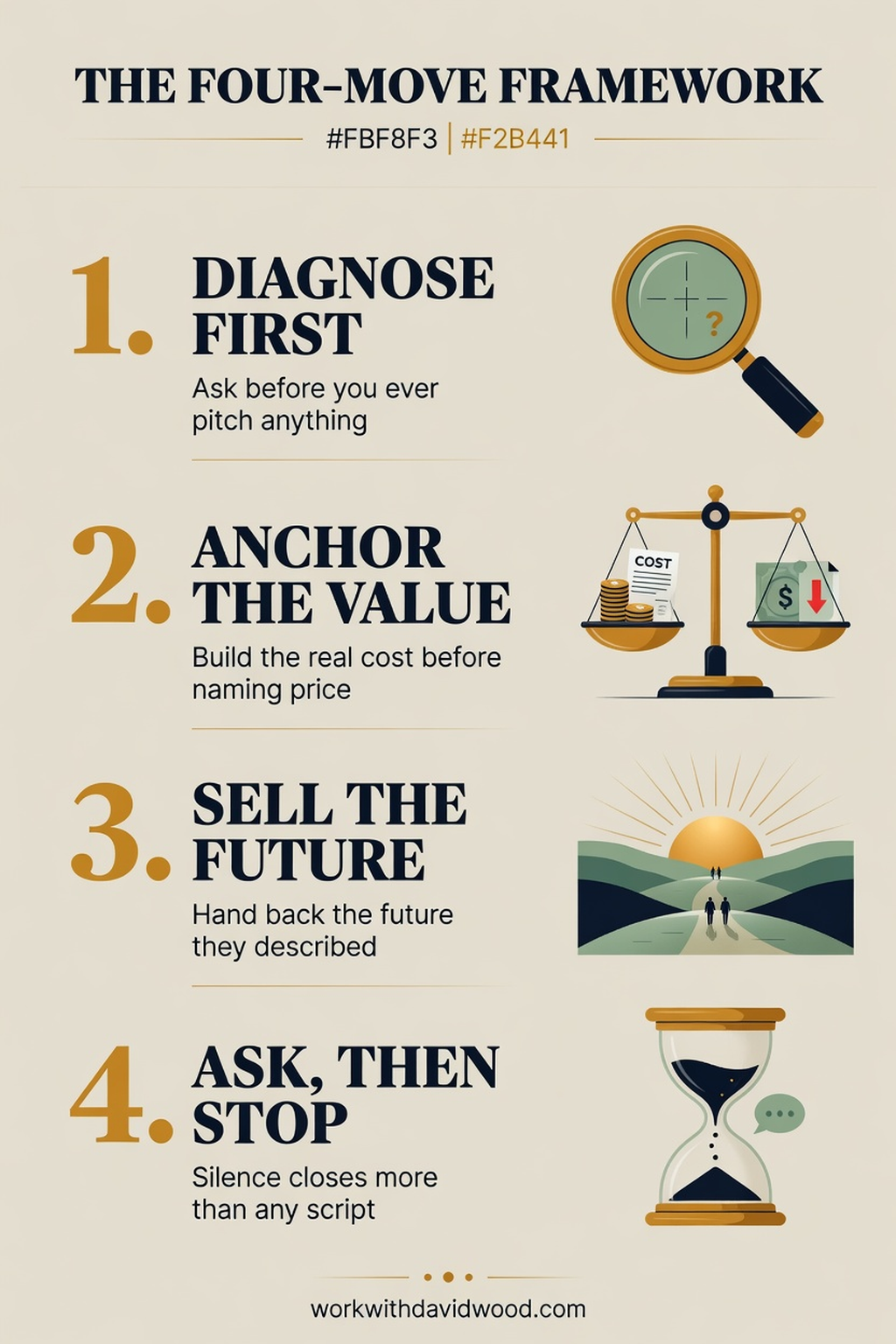
Here’s the actual sequence I use and teach. Four moves, in order. Skip a step and you’ll feel the pressure creep back in, because pressure is what fills the gap where a real framework should be.
Move One: Diagnose Before You Pitch
The first move isn’t a pitch at all. It’s a real conversation where you find out what’s actually broken. Not a script of leading questions designed to walk someone toward a predetermined answer. An honest diagnosis, the way a good doctor won’t write a prescription before an exam.
Ask what they’ve already tried. Ask what happened when they tried it. Ask what it’s costing them, in specific terms, to keep living with the problem unsolved. Most people selling high-ticket skip this because they’re afraid the conversation will reveal the prospect isn’t a fit, and an unfit prospect feels like a wasted hour. Flip that fear around. A prospect who isn’t a fit and who you talk into buying anyway becomes a refund, a bad review, or a client who drains your time for months for an outcome you both knew wasn’t coming. The diagnosis isn’t a delay before the real work. It is the real work.
Move Two: Anchor the Value Before You Anchor the Price
I once watched, and later performed, a demonstration on a hotel conference room stage in Orlando that taught me more about pricing psychology than anything I’d read in a book. Two hundred and fifty people in the room, notebooks out. I walked out barefoot, wearing a single white four-fingered glove, said nothing about it, and told stories for about twenty minutes. Then I handed out a one-page order form headlined “The Secret Of Happiness, Eight Million Dollars.” We built out, together, what a genuine transformation would be worth to a life over eight million dollars, itemized, specific, honest. Only after that number was real in the room did I reveal the actual price. Not eight million. $497, or a lighter option at $47. Seventy-plus people rushed the stage with their cards out. Roughly $33,000 moved in about ninety seconds, with no follow-up sequence at all.
The order form didn’t create the sale. It recorded a yes that the structure of the room had already produced. That’s the move. Before you ever say your price, build the real value of the outcome with the prospect, in their own numbers, their own timeline, their own cost of staying stuck. Your price, whatever it is, will land as reasonable against a number that large, because it’s being compared to the right thing instead of to nothing.
Most people price by guessing what the market will bear. I price by building the real value first, then letting the number make sense on its own. I’ll send you the exact system I use to structure an offer people say yes to without a hard close.
See the framework behind the price →Most participants earn little to nothing. No income is guaranteed. You can verify every payout on the public smart contract.
Move Three: Sell the Future, Not the Object
Years ago someone handed me an ordinary pen on stage and asked me to sell it. I didn’t describe the pen. I told a true story instead, about a friend who went under at a waterfall in Costa Rica and came up a different man, the kind of instant, whole-body decision that reorganizes a life. By the time I picked the pen back up, it wasn’t a pen anymore. It was a stand-in for the decision the room had just watched someone else make. I anchored the room high, took a mercy price down to $1,000 for the first taker, and the room chanted the buyer’s name as he stood up.
Nobody in that room needed a pen. What they were actually buying was permission to make their own decision out loud, in public, the way Justin made his in the water. That’s the whole secret of high-ticket closing, and it applies whether you’re on a stage or on a fifteen-minute call. The object, the course, the coaching package, the nine-rung program, whatever it is, is never really what you’re selling. You’re selling the specific, sensory future your prospect has already told you they want, during the diagnosis in Move One. Your job in the close is to hand it back to them clearly enough that saying yes feels like claiming something that was already theirs.
Move Four: Make the Direct Ask, Then Shut Up
At eighteen, broke, in a tie-dye shirt and holey jeans, I sold Rainbow vacuums door to door out of a newspaper ad promising $815 a week. Eight demonstrations, two weeks, zero sales. My boss finally showed me the actual close, and it wasn’t a script full of tricks. It was standing up after building the real lifetime value of the machine, extending a hand, and saying, “Welcome to Rainbow.” Then not moving. Not blinking. Not filling the silence with one more reason to buy. The first prospect who didn’t kick me out eventually said, “Sign me up already,” annoyed that I’d made them do the work of deciding out loud.
That’s the move most people skip, on both ends of the price spectrum. They build value, they build rapport, and then at the exact moment that calls for a direct, calm ask, they hedge. “So, if you wanted to, we could maybe look at getting started.” That sentence isn’t gentleness. It’s fear wearing a polite outfit, and prospects can feel the difference between confidence and apology instantly. Ask directly. Then stop talking. The silence does work that no amount of extra persuading ever will, because it hands the decision back to the one person who’s actually allowed to make it.
A Worked Example: The Discovery Call, Start to Finish
Theory is easy to nod along with and hard to run on a real call, so here’s what the four moves actually sound like end to end, compressed into roughly fifteen minutes.
Minutes one through six are Move One, and you’re mostly quiet. “Walk me through what you’ve already tried.” “What happened when you tried that.” “If nothing changes in the next twelve months, what does that actually cost you, in dollars or in something else you care about.” You’re not filling a form. You’re building the real picture, and you’re writing down their exact words, because you’ll hand those words back to them later.
Minutes seven through ten are Move Two. You reflect the cost back at real scale. “So doing nothing costs you roughly X a year, and that’s before you count what it’s doing to your Sundays.” Only once that number is sitting in the room, real and specific, do you introduce what solving it actually involves, and what it’s worth relative to the number you just built together.
Minutes eleven and twelve are Move Three. You hand them the specific future they described in Move One, in their own language, not yours. “You told me you want to stop checking your phone at your kid’s game. Here’s what that Tuesday actually looks like six months from now if this works the way it’s designed to.”
Minute thirteen is Move Four, and it’s short by design. “Based on everything you’ve told me, I think this is a fit. Here’s the investment. Do you want to move forward?” Then you stop. You do not add a sentence. You do not soften it. You let the next four seconds belong entirely to them, even when four seconds of silence feels like forty. That silence is not a gap in your close. It is the close.
What Real Risk Reversal Looks Like
People resist high-ticket offers for a reason that has nothing to do with the price, and everything to do with trust. They’ve been burned before, by a comp plan that quietly changed, a guarantee that turned out to have seventeen conditions attached, a dashboard that showed one number while the bank account showed another. If you want to close without pressure, you have to remove that fear before you ever ask for the sale, not paper over it with more enthusiasm.
Genuine risk reversal isn’t a marketing tactic. It’s structural honesty. Tell a prospect exactly what happens if it doesn’t work, in plain language, before they hand over a card. Better still, build a business where they don’t have to take your word for any of it. I route people toward a system built on that exact principle: every commission paid on a public smart contract, settled in the same block as the sale, roughly twelve seconds, readable by anyone on a block explorer. Nobody has to trust my dashboard. They can read the contract themselves. That’s not a sales technique bolted onto the offer. It’s the offer refusing to ask for faith it hasn’t earned.
The Cost of Pressure You Don’t See on the Spreadsheet
Here’s what a pressured close actually costs, and it rarely shows up where you’re looking. It shows up three weeks later as a refund request. It shows up as a one-star review from someone who bought in a moment of manufactured urgency and woke up regretting it. It shows up as a client who resents you quietly for the entire length of the program because some part of them knows they were talked into it rather than led there. None of that appears on the invoice you wrote the day of the close. All of it appears eventually, and it compounds against you the same way good word of mouth compounds for you.
I’ve watched this play out at scale, not just in individual sales. A friend of mine built an organization of 5,000 active people inside one of the largest companies in his industry, and was still only clearing $4,000 a month from that entire team. Five thousand people. Four thousand dollars. That’s not a story about a bad product. It’s a story about a structure built on volume and pressure instead of real fit and real value, and it should terrify anyone who’s been told the answer to a plateau is simply “recruit more, sell harder.” The same effort, aimed at the right price point with the right framework, produces a different world entirely.
Why You’re the One Holding the Price Down
If you’ve read this far, you already know the theory. What’s actually stopping most capable, high-earning people from selling high ticket isn’t the market. It’s a private belief that they don’t deserve to charge that much, or that a friendlier, cheaper version of themselves is safer. I understand that instinct. I’ve felt the ceiling myself, the sense that results were capped by hours in the day rather than by ability. That ceiling isn’t real. It’s a story, and stories can be replaced with better ones once you’ve actually watched the reversal work in your own numbers instead of someone else’s.
You don’t need a script that manipulates anyone. You need a real diagnosis, a value built honestly before the price is named, a future you can hand back to the person who told you they wanted it, and the nerve to ask directly and let silence do its job. Do those four things in order and the pressure you thought you needed simply becomes unnecessary. The close stops being something you perform on someone and starts being something you simply confirm with them.
Start with one conversation this week where you skip the pitch entirely and just diagnose. Write down, in the prospect’s own words, what the problem is actually costing them. That single page is the beginning of every high-ticket close that doesn’t need pressure to work.
This is the exact structure I use to sell high ticket without a hard close: real diagnosis, honest value, a direct ask, and a comp plan you can verify on a public contract before you ever trust a word I say. Enter your name and I’ll send you the walkthrough.
Show me the framework, not the script →Most participants earn little to nothing. No income is guaranteed. You can verify every payout on the public smart contract.
See also: the tools and systems I actually recommend, and start here if you’re new.
Three posts a day. One email a day.
Everything I publish, in one short daily email. Real numbers, no hype, unsubscribe in one click.
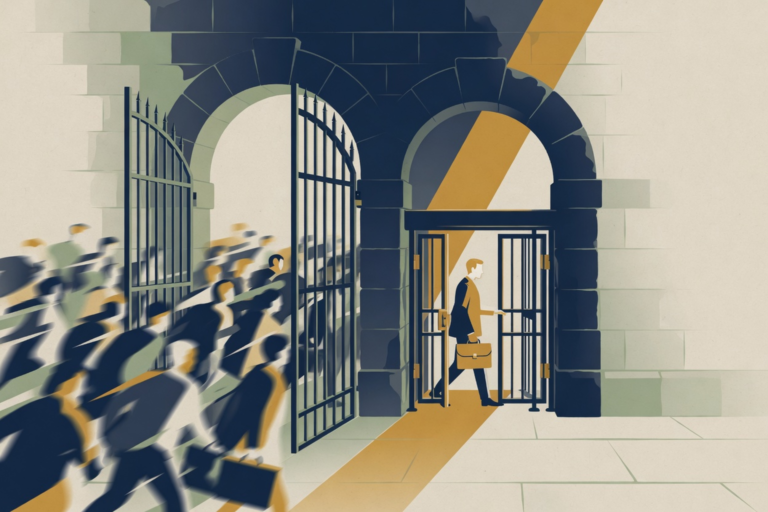
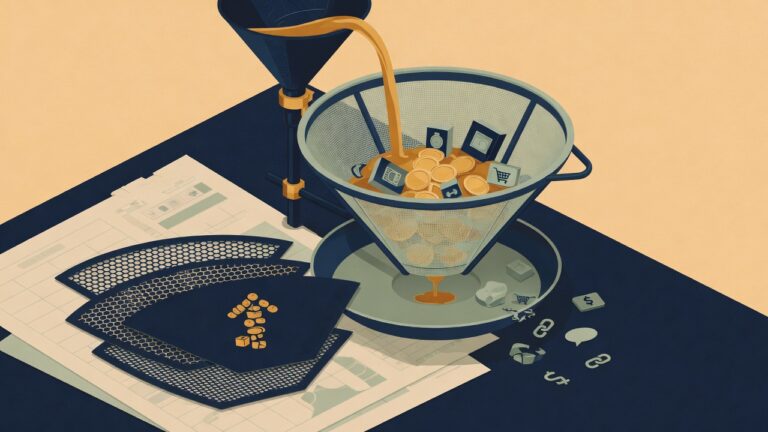


The best case against this framework, and I am not adopting it as my own view, is that diagnosis-plus-silence only works when the prospect already believes the problem is expensive. For someone still shopping category rather than provider, Move One can feel like a long interview with no offer, and Move Four’s silence can read as abandonment rather than confidence. The turquoise and pen stories show price-as-position, but they do not prove that removing urgency works when the buyer has not yet decided the category is worth solving. The math of 257 closes versus 13 is persuasive on volume; it does not by itself dissolve the need for some structured urgency when the offer is unfamiliar.
Minute fourteen, they say they need to think. One clarifying question, or true silence?
Walt, strip the debate language and the post is saying something my mother would get: find out what’s broken before you pitch, make the cost of staying stuck real in their numbers, describe the Tuesday they said they wanted, then ask straight and stop talking. The bit about not filling the silence is the whole close. Pressure is what you reach for when you skipped those steps.
Walt, the way you put the counter-case without burying the post is useful. You named the real risk — unfamiliar offer, buyer not yet sold on the category — instead of just cheering the four moves.