
Part of the guide: Affiliate Marketing
At a certain income level, the problem changes.
When you’re new, the question is “what should I promote?” and almost any answer moves you forward, because the bottleneck is activity, not selection. When you’re already producing six figures, the question inverts. You have traffic. You have a list. You have an audience that will actually click when you send them somewhere. The bottleneck is no longer whether you can sell — it’s what you spend that finite attention on.
I’ve been in this industry part-time since 2002. Over twenty years, the most expensive mistakes I’ve watched producers make weren’t lazy ones. They were enthusiastic ones. Somebody with real distribution pointed it at an offer that had commission but no demand, and burned six months of audience trust learning the difference.
Here’s the filter I use.
In this guide
Demand is not interest, and interest is not a market
The seductive thing about a bad offer is that people like it. They reply to your email. They comment. They tell you it sounds amazing. Then almost nobody buys, and the few who do don’t stay.
That gap has a mechanism behind it. Interest is what someone expresses when the cost is zero. Demand is what someone expresses when the cost is real — money, time, or the risk of looking foolish to their spouse. An offer with real demand has people already paying to solve the problem, right now, with or without you.
So the first question isn’t “is this a good product?” It’s “who is already spending money on this problem, and what are they spending it on today?”
If you can’t name the thing they’re currently buying — the competitor, the workaround, the duct-taped spreadsheet, the agency retainer — you probably don’t have demand. You have interest.
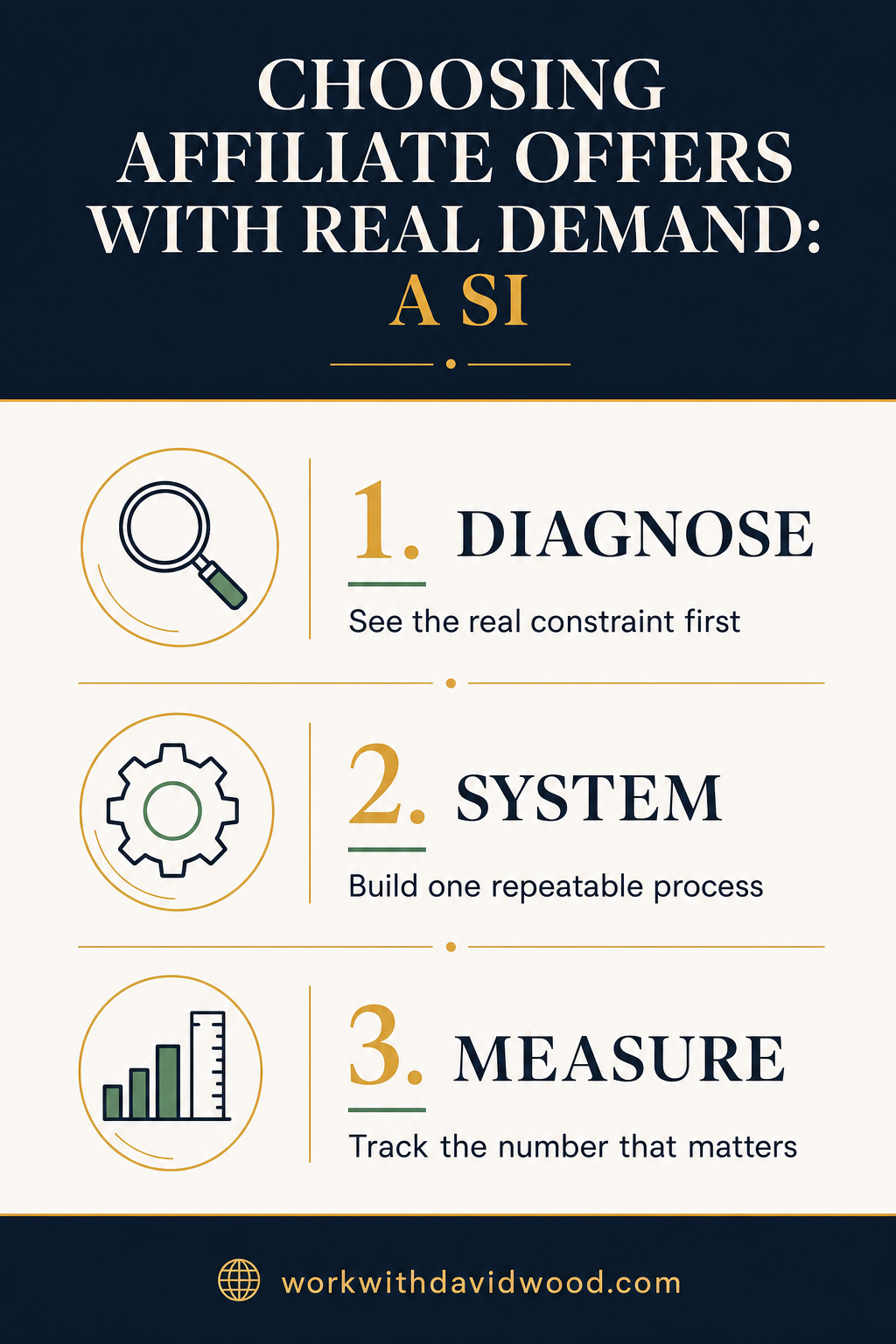
The four tests
1. Does the buyer exist without the compensation plan?
This is the cleanest test I know, and it’s the one that separates a real affiliate offer from a recruiting scheme wearing a product costume.
Ask: if this company deleted its affiliate program tomorrow, would anyone still buy the product?
For a good CRM, the answer is obviously yes. For an email platform, a course from a genuine practitioner, a piece of software that saves someone four hours a week — yes. For a lot of what circulates in this industry, the honest answer is no. The only reason anyone bought was the opportunity attached, which means you’re not selling a product, you’re selling a business model to people who will resell it to people who will resell it.
The FTC has been explicit about this for decades. Its Business Guidance Concerning Multi-Level Marketing and its guidance for MLM participants both turn on whether revenue comes from genuine sales to people who want the product, or from participants buying in. That’s not just a legal line. It’s a demand line. Regulators are asking the exact question a smart affiliate should ask: is there a customer at the end of this chain?
I wrote more about the pattern in MLM red flags, and about how the same structure keeps re-skinning itself in the MLM playbook didn’t die, it bought crypto. The costume changes. The test doesn’t.
2. Is the pain recurring, or did you just catch someone on a good day?
One-time pains produce one-time revenue. That’s fine if the commission is large enough to justify the acquisition cost, but at six figures you’re usually building an asset, not a transaction.
Recurring demand looks like: the problem returns every month, the tool is embedded in a workflow, switching costs are real, and the buyer’s business gets worse if they cancel. That’s what produces retention, and retention is what turns a decent offer into a compounding one.
Watch out for the inverse — offers where the affiliate’s pain is recurring but the customer’s isn’t. If you have to keep feeding new bodies in the top to maintain flat income, you don’t own an asset. You own a job with worse hours.
3. Can you sell it to someone who has never heard of you?
This is the test most six-figure earners skip, because they can sell anything to their own audience. Your existing list will buy from you out of accumulated trust. That trust is real and it’s valuable, and it’s also a terrible measurement instrument, because it masks whether the offer stands on its own.
The question that matters: if a stranger landed on a page about this offer, with no relationship to you, would the offer itself close them?
You have been paid late before
You have watched the number on the dashboard not match the number in your account. What is different now is simple: it settles on a public contract you can check yourself, not a dashboard I control.
Read the contract →Most participants earn little to nothing. No income is guaranteed. You can verify every payout on the public smart contract.
If yes, you have something that scales past your personal reach. If no, every sale costs you a withdrawal from a trust account you spent years filling. That’s how producers with great audiences end up with mediocre audiences.
I go deeper on the anatomy of this in how to build an irresistible offer — the short version is that a strong offer does most of the selling before you open your mouth.
4. Would you recommend it if the commission were zero?
Not a moral question. A commercial one.
The compensation on an affiliate offer is a lagging indicator of how badly the company needs distribution. Enormous payouts often mean the product can’t sell itself and the company is renting your credibility to compensate. Modest payouts on a product people search for by name usually mean the opposite.
I’m not saying take the low commission every time. I’m saying that when the payout is the most attractive feature of the offer, that’s information, and it’s rarely good information.
What I actually check before saying yes
Beyond the four tests, here’s the practical work:
Search behavior. Are people looking for this by category or by brand name? Branded search means an existing market with a known solution. Category search without any dominant brand means demand exists and nobody’s owned it yet — that’s the best possible position for an affiliate.
Refund and churn policy transparency. A company confident in its product will tell you its refund rate if you ask as a serious partner. Evasion is an answer.
Support quality. You are lending your name. Every support failure lands on you, not the vendor. Buy the thing yourself, open a ticket, see what happens.
Attribution terms. Cookie window, last-click vs. first-click, whether coupon sites can override you, whether the vendor runs its own retargeting that strips your attribution. This is where good offers quietly turn bad.
Compliance posture. Does the company give affiliates income claims to repeat? Run. The FTC’s Endorsements and Testimonials guidance makes clear that you, the endorser, carry liability for claims you make — not just the brand. A vendor handing you unsubstantiated numbers is handing you exposure.
The trap of promoting what’s complicated
Complexity kills conversion, and at your income level it also kills your time. An offer that requires forty minutes of explanation before anyone understands what it does is an offer you will promote once, get a mediocre result from, and quietly abandon.
The offers that work over years are the ones where the customer understands the value in a sentence. I’ve written about this failure mode at length in the complexity trap and the real customer, and it’s the same reason I’ve been more selective about the whole category since 2017 — here’s that reasoning.
Simple offers with real demand beat clever offers with theoretical demand. Every time.
One more thing about your audience
The people who follow you at this stage are not the people who followed you at the start. Many of them are building something themselves. They’re evaluating you as a source of judgment, not just enthusiasm.
Which means every offer you promote is a public statement about your standards. Promote three things that don’t deliver and the fourth one — the genuinely great one — lands on deaf ears. Your recommendation is a depreciating asset if you spend it carelessly and an appreciating one if you don’t.
The producers I respect most say no far more than they say yes. Not out of caution. Out of arithmetic.
If you’re rebuilding your offer stack and want to see what’s survived my own filter, the recommended products page is where I keep the current list.
Three posts a day. One email a day.
Everything I publish, in one short daily email. Real numbers, no hype, unsubscribe in one click.
Get paid 100%, on-chain, the second the sale clears
Most affiliates earn little, and that is disclosed up front. The difference here is not a promise about what you will make. It is that you can verify every payout yourself, on a public contract, in about twelve seconds.
See how the payout works →Most participants earn little to nothing. No income is guaranteed. You can verify every payout on the public smart contract.