
Part of the guide: Network Marketing Lead Generation
Every productivity guru has a morning routine to sell you: cold plunge, twelve supplements before sunrise, a gratitude journal, a green juice, forty minutes of yoga before you’ve said a word to another human. I tried versions of this for years. None of it produced deep work on a reliable Tuesday. What actually changed my mornings was throwing out the theater and keeping only the three things with real research behind them: light, timing, and sequence.
Let me show you where I actually learned the sequence part, because it wasn’t from a podcast.
In this guide
What a Mormon mission taught me about the first three hours
At nineteen I was on a mission in England. The schedule wasn’t negotiable and nobody asked my opinion of it. Wake at 6:30. Study for three straight hours, alone, before a single conversation with another human. Then twelve hours on the street, 9:30am to 9:30pm, talking to strangers, getting rejected, occasionally getting into a real debate with a Jehovah’s Witness who knew his own material cold. That routine wasn’t designed for productivity. It was designed by a church for a spiritual purpose. But structurally, it did something I didn’t understand until decades later, running my own businesses. It protected the first block of the day, before contact with anyone else’s agenda, for the one thing that required my whole brain.
I’ve kept some version of that shape ever since. Not the theology, the structure. Wake early, hold a block before the inbox exists for me, work the hard thing first. I’ve written before about starting near 6am and holding a real block of reading or writing before I let the day get its hands on me. That habit is older than any morning-routine listicle I’ve ever read, and it turns out the boring version has more science behind it than the elaborate one.
The part that’s actually sourced, not vibes
Here’s what’s real, and I’ll tell you plainly where it stops being certain.
Your cortisol is already spiking on its own, right when you wake up. This is called the cortisol awakening response, and it’s one of the most replicated findings in the hormone literature. Free cortisol rises somewhere between 38 and 75 percent in the first 30 to 45 minutes after you open your eyes, averaging around a 50 percent jump, and it’s still elevated by roughly a third an hour later. Your body is doing this without your permission. The question isn’t whether you’re activated in the first hour. You are. The question is whether you spend that activation on your hardest problem or on your inbox.
Outdoor light in that same window sets the clock that runs your whole day. Even on an overcast morning, daylight outside runs into the thousands of lux. A well-lit indoor office sits closer to a few hundred. That gap matters because your circadian system uses morning light as its main timing signal, the thing that tells your brain when “day” started, which then determines when melatonin rises tonight and how sharp tomorrow’s cortisol spike actually is. Skip it, and you’re not just a little tired. You’re running the whole system on a signal that never got sent.
Your alertness runs in roughly 90-minute waves whether you plan around it or not. The sleep researcher Nathaniel Kleitman, the same man who co-discovered REM sleep, found in 1963 that the 90-minute cycle governing your sleep stages doesn’t stop when you wake up. It keeps running as a rhythm of rising and falling alertness he called the Basic Rest-Activity Cycle. Later researchers confirmed it in EEG recordings, hormone samples, and straight performance data. Cal Newport, the Georgetown computer scientist who wrote the book that put a name on this whole conversation, defines deep work as professional activity done in distraction-free concentration that pushes your cognitive capacity to its limit, and he’s been honest that even highly trained people top out around three to four hours of it a day. Not eight. Three or four, in clean blocks, matched to a rhythm your brain is already running whether you cooperate with it or not.
Read that last part again. You don’t get to choose whether you have a 90-minute wave. You only get to choose whether your hardest work happens on the peak of it or gets buried under email while the wave passes you by unused.
The morning routine that produces deep work, in the order I actually run it
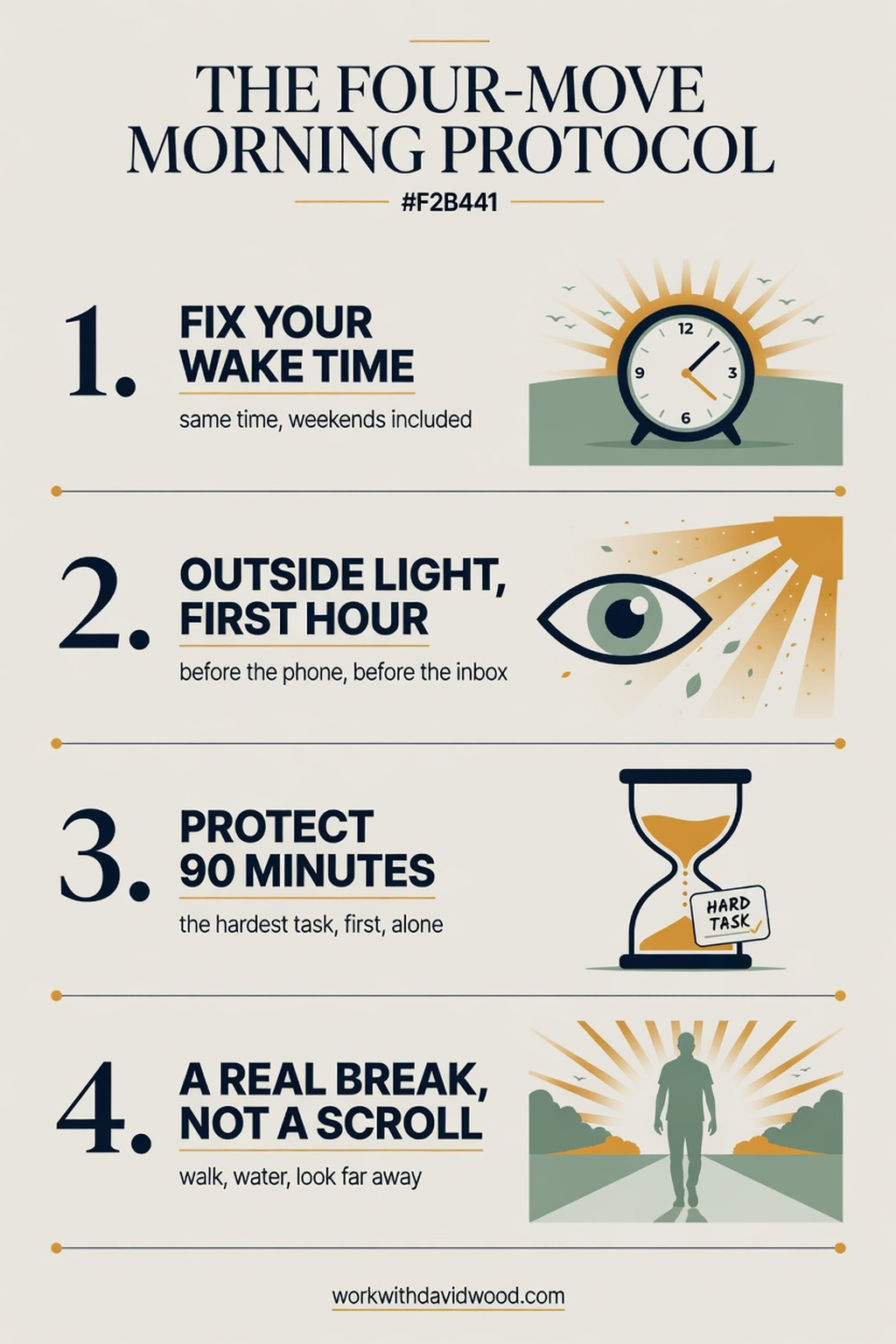
Four moves. None of them require a supplement budget.
1. Fix your wake time and hold it, weekends included. Your circadian system reads consistency, not heroism. A 5am wake three days a week and a 9am recovery on Saturday isn’t a routine, it’s mild jet lag you’re inflicting on yourself every Monday.
2. Get outside light in the first hour, before the phone. You don’t need direct sun and you don’t need ten minutes of squinting at it. You need your eyes outdoors, unshielded by sunglasses, for a few minutes while that lux gap does its work on your clock.
3. Protect one 90-minute block for the single hardest thing, before your inbox exists for you. Phone in another room, one task, nothing else open. This is the block your cortisol spike already paid for. Spend it on the thing that actually requires your whole brain, not on triaging other people’s requests.
4. When the 90 minutes ends, take a real break, not a scroll. Walk, stretch, get water, look at something far away. You’re not fighting the dip in your rhythm with more caffeine. You’re riding it, then loading the next wave with round two if your day has one in it.
Most people design a morning routine off a feeling. I’d rather you see the actual number. CortexSurge opens with a free assessment that gives you a real Brain Profile, built on relational frame training, not a guess about what time of day you’re sharp. Fifteen minutes tells you more than another cold plunge ever will.
See what your own focus curve looks like →Based on published cognitive-science research. Not a medical product or treatment.
What the bro-science version gets wrong
I’m not telling you cold exposure or breathwork or supplements do nothing. Some of it has thin, real research behind it in narrow contexts. What I’m telling you is that none of it is the mechanism that decides whether you produce deep work today. The mechanism is boring. It’s a hormone spike you already have, a light signal your clock is starving for, and a 90-minute wave your brain runs with or without your consent. Every elaborate morning stack I’ve watched people build was an attempt to feel like they were doing something serious about their focus, while skipping the one unglamorous step that actually moves it: closing the laptop’s other tabs and giving the sharpest 90 minutes of your day to the hardest problem you have, before anyone else gets a vote in how you spend it.
That’s the real difference between a person who produces and a person who’s collecting routines. The producer isn’t the one with the most elaborate stack. He’s the one who protected the window his own biology already built for him, and used it on purpose instead of by accident.
If you want the deeper case for why the mind is the one asset in your business you can’t hire around or outsource, that’s the whole argument at The Operator’s Mind. And if this is the first piece of mine you’ve read, start here before you build anything else on top of a foggy morning. The specific tools I use to protect this window, including how I actually train the underlying capacity instead of just scheduling around it, are on the recommended products page.
Set the wake time. Get outside before the phone. Give the hard thing the first 90 minutes. That’s the whole routine, and it’s sourced.
You already know your mornings aren’t producing what they used to. Take the free CortexSurge assessment, get a real Brain Profile in about fifteen minutes, and see exactly where your own focus curve peaks before you build another routine around a guess.
Get my free Brain Profile →Based on published cognitive-science research. Not a medical product or treatment.
See also: the tools and systems I actually recommend, and start here if you’re new.
Three posts a day. One email a day.
Everything I publish, in one short daily email. Real numbers, no hype, unsubscribe in one click.



At sixty-one I no longer pretend I can run someone else’s elaborate stack before sunrise. What still applies is the boring sequence: fix the wake time including weekends, get outdoor light in the first hour before the phone, and protect one ninety-minute block for the hardest work while the cortisol awakening response is already doing its job. I do not need twelve supplements to understand that. The mission story about three protected hours before contact with anyone else’s agenda is the structure I recognise from years of marking papers before the school day began. Age did not cancel the rhythm. It made the theatre version less tempting.
The cortisol awakening response claim is the most falsifiable piece here, and the ranges given (roughly 38 to 75 percent in the first 30 to 45 minutes, still elevated by about a third an hour later) are at least stated as ranges rather than a single tidy number. Kleitman’s Basic Rest-Activity Cycle as a ~90-minute waking alertness wave is more contested in later literature than the sleep staging work; the article treats it as settled. Newport’s three-to-four-hour daily deep-work ceiling is a practical observation, not a lab finding. I would want clearer separation between replicated hormone data and the performance-rhythm claim before calling the whole routine “sourced.”
I ran the four moves for six weeks starting in March. Wake locked at 5:45 including Saturdays. Outside light first, no sunglasses, about four minutes on the back step even when it was grey. Phone stayed in the kitchen. One task only for ninety minutes. Weeks one and two felt clean. Week three was where it fell over: I let email open “just to check one thing” at minute twelve and the whole block turned into triage. Week four I put the laptop in airplane mode and it held. The real break after ninety minutes mattered more than I expected. Scrolling during the dip erased the second wave completely on two Thursdays.