
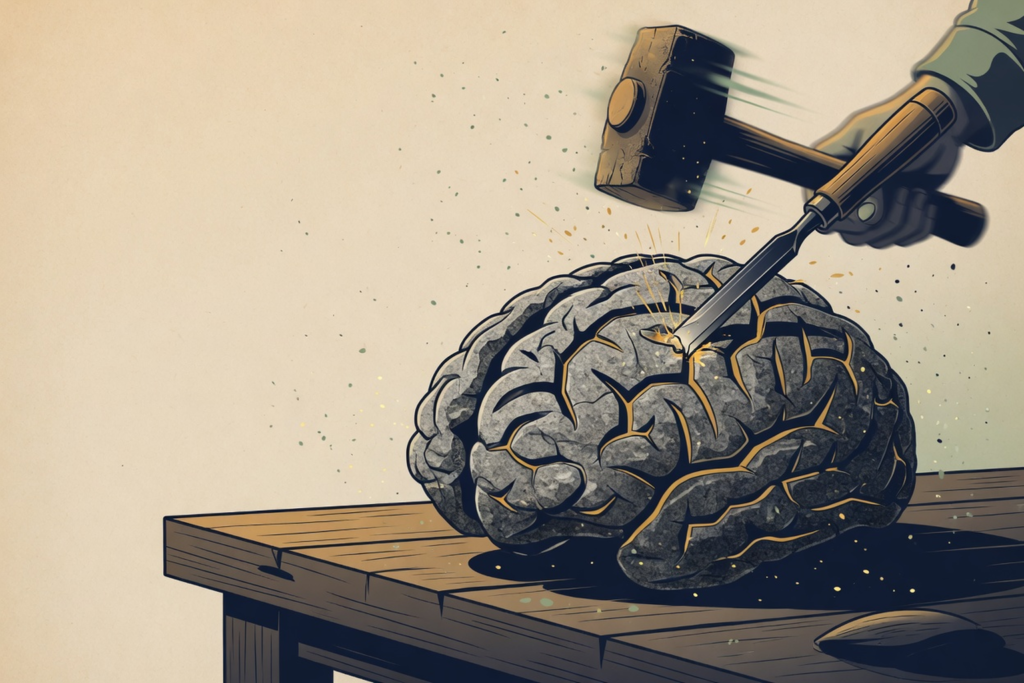
Part of the guide: Network Marketing Lead Generation
Brain training for entrepreneurs sounds like a gimmick until the morning you sit down to write a proposal you’ve written forty times before, and nothing comes. Not writer’s block. Something quieter and worse: the sense that the gears used to catch faster than this. You reread the same paragraph three times. You lose the thread of a call you were leading two minutes earlier. Nobody told you that the thing you built your whole income on, a sharp, fast, pattern-catching mind, needed maintenance like anything else you rely on every day.
I want to open with a confession instead of a hook, because it’s more useful.
For years I believed intelligence was a fixed number stamped on you somewhere around age twenty, the way your height gets fixed. You either had the kind of mind that saw the deal three moves ahead, or you didn’t, and no amount of effort moved that number. I built an entire identity on being one of the ones who had it. Then I hit a stretch, mid-forties, running three businesses at once, where I noticed I was slower to see the connection in a conversation, slower to catch the flaw in a funnel, reaching for a word that used to be right there. I told myself it was just fatigue. It wasn’t only fatigue. It was disuse, and it scared me more than any single business problem I was facing that year, because a business problem has a fix. I didn’t know what fixes a mind.
Here’s the thing worth remembering before we go further: your mind is the one asset in your entire operation you cannot outsource, delegate, franchise, or buy back later at a discount. You can hire a better copywriter. You can’t hire a better version of the judgment that decides which copywriter to hire.
In this guide
- The pain nobody names out loud
- Brain training for entrepreneurs: is intelligence actually fixed?
- What actually transfers, and why most training doesn’t
- Attention: the first discipline, and the one everyone skips
- Working memory: the bottleneck nobody budgets for
- Regulation under stress: the collapse you don’t see coming
- Automaticity: why reflex beats willpower every time
- What it costs you to skip this
- The identity question underneath all of this
- A fifteen-minute way to start today
- What’s ahead in this series
The pain nobody names out loud
Talk to enough ambitious, analytical people and you hear the same confession, usually dropped in low, at the end of a longer conversation about something else. Brain fog. Slower thinking. Missing connections that used to be obvious. Blanking on a problem that isn’t even that novel. Watching someone five years younger get to the insight half a beat before you do, in a room where you used to be the one who got there first.
That’s the pain. It rarely gets said in a business meeting, because admitting your mind feels duller than it used to be feels like admitting you’re losing, in a culture that only rewards looking sharp. So people compensate instead of address it. More coffee. More notifications open at once so nothing slips, which actually makes the fog worse, not better (we’ll get to why later in this cluster). A calendar so full there’s no time left to notice the decline, which is its own kind of denial.
And underneath the pain sits a genuine internal conflict, one I lived inside for longer than I’d like to admit: you’ve believed your whole life that intelligence is fixed, so the idea of training it feels a little naive, like trying to grow taller at forty-five. But you can feel yourself getting duller, and you cannot make yourself accept that as the permanent state of things. Those two beliefs cannot both be true. One of them has to go. I’m going to tell you which one, and I’m going to show you the actual research, not a motivational poster, because you’d smell the difference immediately and so would I.
Brain training for entrepreneurs: is intelligence actually fixed?
Start with the honest baseline, because overclaiming here would cost me your trust for the rest of this piece.
Fluid intelligence, the raw ability to reason through novel problems you haven’t seen before, was long treated as fixed after early adulthood. Then researchers started measuring entire populations over time instead of individuals in a lab, and the picture cracked open. This is the Flynn effect, named for James Flynn, who documented that IQ test scores in industrialized countries rose roughly three points per decade across most of the twentieth century. Whole populations, tested on the same instruments, got measurably sharper generation over generation. Nobody’s genes changed that fast. What changed was the cognitive environment: more schooling, more abstract reasoning in daily life, more practice with the exact kind of pattern-matching an IQ test measures.
That single fact should have ended the “intelligence is fixed” argument decades ago. It didn’t, because a population trend doesn’t tell an individual entrepreneur what to do on a Tuesday morning.
Here’s where it gets more useful, and more contested. In 2016, a peer-reviewed study by Cassidy and colleagues, working from Relational Frame Theory, found that structured training in relational reasoning produced meaningful gains on standard measures of fluid intelligence, not just on the trained task itself. That distinction matters more than almost anything else in this article, so sit with it for a second: most cognitive training only makes you better at the training. This is the one line of research that’s shown gains showing up somewhere else.
Contrast that with the popular brain-training industry, because the contrast is the whole point. Lumosity, the largest consumer brain-training company in the world, was fined two million dollars by the FTC in 2016 for advertising claims it couldn’t back up, specifically the claim that its games would improve real-world performance and stave off cognitive decline. The games got you better at the games. That gain almost never left the app. This is the single most important thing to understand before you spend a dollar or an hour on anything marketed as brain training: ask what, specifically, is claimed to transfer, and ask for the citation.
The challenge you’re right to have
So if you’re sitting there thinking “you can’t really raise IQ, this is just another Lumosity,” you are asking exactly the right question, and I want to answer it directly instead of talking around it. The Lumosity criticism is correct as a criticism of Lumosity, and of most of the category built in its image: colorful mini-games that entertain, generate a feel-good “brain age” score, and don’t reliably move the thing that matters in your actual work. That skepticism is earned. Keep it. Apply it to me too. The difference between a game and a protocol isn’t the marketing copy, it’s whether the training targets the underlying reasoning skill, at a difficulty that adapts to you, with enough repetition to reach fluency rather than novelty.

What actually transfers, and why most training doesn’t
Most cognitive skills are narrow. You get faster at Sudoku. You do not get faster at reading a balance sheet. The skill stays exactly where you built it, in the game, which is why the industry has such a credibility problem.
Relational reasoning is different because of what it actually is. It’s not a fact or a task, it’s the underlying operation your mind uses to relate one thing to another: bigger than, opposite of, part of, the same as, causes, comes before. Every piece of complex judgment you make in business runs on some combination of those relations. When you see that a new competitor’s pricing move is functionally the same threat you faced two years ago in a different market, that’s a relational frame firing. When you catch that a hire’s résumé claims don’t actually cause the outcome they’re implying, that’s a relational frame catching a false connection. Train the relation itself, at high enough volume and difficulty to reach real fluency, and it shows up in every domain that uses that relation, because you’re not practicing a fact, you’re practicing the operation underneath every fact.
That’s the mechanism, and it’s worth being precise about it instead of hand-waving: the training I use runs on nineteen relational frames, the full set researchers have identified, trained to roughly 85% accuracy across more than 3,700 adaptive levels before the difficulty climbs again. It’s built as a detective narrative, not because entertainment is the point, but because a protocol nobody finishes doesn’t train anything. Progress gets tracked on something called a Cortex Index, so you’re not guessing whether Tuesday’s session did anything. You can see the number move.
I’ll say the limitation plainly, because burying it would be exactly the kind of overclaim this whole piece argues against: this is one study, not a mountain of them, and the field of cognitive transfer is still young and contested. What I can defend is this: it’s the one mechanism with a documented, peer-reviewed transfer result, running against a category where the dominant player got fined for claiming transfer it never proved. Between “definitely proven” and “just another brain game,” there’s an honest middle position, and that’s where I actually stand.
The four things an Operator’s Mind actually needs, in order
1. Attention that holds on one problem instead of scattering across fourteen open tabs.
2. Working memory that can hold enough variables at once to reason through something genuinely complex.
3. Regulation under stress, so a hard call doesn’t collapse your reasoning down to fight-or-flight.
4. Automaticity, so the skills you’ve trained fire without you having to think about them under pressure.
Attention: the first discipline, and the one everyone skips
You cannot train what you cannot hold still long enough to look at. Attention is the floor everything else sits on, and it’s also the one most entrepreneurs have quietly let erode without noticing, because notifications feel like productivity and are actually its opposite. Every time your attention snaps to a Slack ping mid-thought, you pay a real cost to reload the problem you were holding, not just the seconds the interruption took. We’ll go deep on the actual research behind that cost, and a specific protocol to rebuild sustained attention, in a dedicated piece in this series. For now, the operating principle is simple: guard the first ninety minutes of your day like it’s the only capital you have, because on the days that matter most, it is.
Working memory: the bottleneck nobody budgets for
Working memory is how many things you can hold and manipulate in your mind at once, and it is the single tightest bottleneck in complex decision-making. Negotiate a deal with four moving variables, price, terms, timeline, and a personnel condition, and you’re asking your working memory to hold all four while you reason about their interactions. Most people’s honest capacity for that kind of active manipulation is smaller than they’d like to admit, somewhere in the range of three to five items at once, not the mythical “magic number seven” most people half-remember from a psychology class. Push past your working memory capacity and you don’t get a graceful slowdown. You get dropped variables and a worse decision that feels, in the moment, like a confident one. I’ll walk through the exact math and a practical audit for this in its own piece down the line, because it deserves more room than a section here can give it.
Regulation under stress: the collapse you don’t see coming
Here’s a fact worth sitting with: under real stress, cortisol and adrenaline don’t just make you feel worse, they measurably shift activity away from the prefrontal cortex, the part of your brain running deliberate reasoning, and toward faster, older circuitry built for physical threat, not for reading a term sheet. That’s a useful system if a car is about to hit you. It’s a terrible system for the exact moment you most need clear judgment: the funding call that’s going sideways, the partner who just texted “we need to talk,” the launch that’s forty-eight hours out and broken. The entrepreneurs who stay sharp under pressure aren’t the ones who feel less stress. They’re the ones who’ve trained a faster path back to deliberate reasoning once the stress hits. That’s trainable, and it’s specific enough to deserve its own full treatment, which is coming later in this series.
Automaticity: why reflex beats willpower every time
The last discipline is the one that makes the other three sustainable instead of exhausting. Anything you still have to consciously decide to do, under pressure, on a bad day, is a skill you’ll eventually skip on the day you need it most. The goal of training isn’t to build willpower, it’s to build reflex, the same way a pilot doesn’t decide, mid-emergency, which gauge to check first. Skills cross a threshold somewhere in the tens of hours of deliberate repetition, past effortful and into automatic, and the entrepreneurs who compound fastest are the ones who’ve pushed the widest set of judgment skills across that line. I’ll map that threshold precisely, with the actual research behind how long it takes, in a companion piece.
Before you decide whether any of this applies to you, get a real baseline. The free Brain Profile assessment measures where your reasoning actually stands right now, not a “brain age” gimmick, a structured read on your relational reasoning, in about the time it takes to drink your coffee. Then you’ll know exactly which of the four disciplines above is your actual bottleneck.
Take the free Brain Profile assessment →Based on published cognitive-science research. Not a medical product or treatment.
What it costs you to skip this
I want to be honest about the price, because a teacher who only shows the upside isn’t teaching, he’s selling. Training your mind costs you something real: fifteen to twenty-five minutes a day you could spend answering one more email, and the discomfort of doing something hard and unglamorous instead of something that feels urgent. Most gains, based on consistent use at four to five sessions a week, show up over two to three months, not overnight, and the honest data suggests something clicks, a genuine shift you notice in daily reasoning, somewhere around fifteen to twenty-five hours of cumulative training. That’s not a weekend. That’s a season.
Here’s the trade you’re actually making, stated plainly. The days you spend training feel unproductive, because nothing shipped, no invoice went out, no call got closed. But the alternative, the fog you started this article reading about, doesn’t stay flat while you wait. It compounds the other direction. Every year you run your business on a mind you never maintain is a year the fog gets a little more familiar, until “a little slower than I used to be” quietly becomes “how I am now.” The cost of training is small and visible. The cost of not training is large and invisible, until it isn’t.
The identity question underneath all of this
Your income is downstream of your identity, and nowhere is that more literal than here. If you believe, quietly, that your reasoning is fixed and slowly declining, you will make decisions from that belief whether you say it out loud or not. You’ll take fewer risks that require sharp, fast judgment. You’ll defer to people you used to out-think. You’ll tell yourself you’re “delegating more,” when some of what’s actually happening is you no longer trust the instrument you used to run on.
Flip that identity and the decisions flip with it. An operator who has decided his mind is a trained asset, not a fixed inheritance, walks into the hard negotiation differently. Not because he’s arrogant. Because he’s got a baseline, a Cortex Index that’s been climbing for three months, actual evidence instead of a hopeful feeling, that the instrument under the decision is getting sharper, not duller. That calm is not a personality trait. It’s downstream of a practice, the same way a calm negotiator on a comp plan is downstream of a contract he can actually verify instead of a promise he has to trust.
A fifteen-minute way to start today
Pause here and actually do this, not just read it.
Open a blank note on your phone right now. Write down the single moment this week your thinking felt slowest, the exact meeting or decision, and what you missed or caught late. That’s your real baseline, more honest than any quiz. Then block fifteen minutes tomorrow morning, before your inbox, before the first call, and give that block to one deliberate reasoning task, whether that’s a structured training session or working through a genuinely hard problem without a phone in reach. Do that five days this week. Not perfectly. Just five days. At the end of the week, reread the note you wrote today and ask yourself honestly whether this week’s version of that same moment would have gone differently.
That’s the whole first step. No app required to start it, though a structured protocol will get you there faster and with a number you can actually track, which is the entire reason the free assessment exists.
What’s ahead in this series
This piece is the doctrine. The rest of what I’ve referenced along the way, attention training for a notification-soaked life, the real math of the working memory bottleneck, stress and cortisol and clear thinking under real pressure, the automaticity threshold where a practiced skill becomes a reflex, why consistency beats intensity in the compounding math of daily reps, what actually transfers from brain training and what doesn’t, will each get its own full treatment here under The Operator’s Mind. Come back to this page. It’s the map for all of it.
But don’t wait for the rest of the series to start. The mind you’re running your entire operation on right now is either compounding or eroding, quietly, every single day, whether you’re paying attention to it or not. Pick the fifteen minutes. Start tomorrow.
You already trust the instruments in your business enough to check them daily: revenue, conversion, cash. Start checking the one instrument everything else runs through. Get your free Brain Profile and see exactly where your reasoning stands today.
Get my free Brain Profile →Based on published cognitive-science research. Not a medical product or treatment.
See also: the tools and systems I actually recommend, and start here if you’re new.
Three posts a day. One email a day.
Everything I publish, in one short daily email. Real numbers, no hype, unsubscribe in one click.


I tried the fifteen-minute morning block for six weeks last fall. Weeks one and two felt pointless — just a hard problem with the phone in another room. Week three I skipped four mornings because school runs ate the window. Week four I restarted at 5:40 instead of after drop-off and held five sessions. What actually showed up was not a dramatic ‘smarter’ feeling. It was one client call where I held four variables (timeline, scope, two constraints) without dropping one mid-sentence, which I had been doing all summer. The fog piece about rereading the same paragraph is exactly what started the experiment. Transfer is still the open question for me; better on that call is not proof it generalizes.
Kelsey, five-forty before drop-off is not available in my house. I get forty-five minutes between bedtime and collapse, not a clean morning block. Did the phone-in-another-room rule still work when the ‘session’ was 10pm and half a problem, or does this only land if you protect first light?
Cassidy is one paper. If hard problems daily already exist, what signal shows the relational-frame protocol adds transfer the problems alone do not?
Ivy’s question about transfer is the right one, and I would add a temperament angle the post barely touches. Everything here assumes you will sit with adaptive difficulty and a scoreboard. Some of us build judgment almost entirely through writing and revision, never through game-like levels. If the mechanism is relational frames, does slow, deliberate written analysis of a messy brief count as training the same operation, or is the claim tied to that specific protocol format?
Ivy, I am sixty-one and started again after a stretch when words I had used for decades took a beat longer to arrive in conversation. The Flynn-effect section and the honest limit — one study, field still contested — mattered more to me than any promise of a quick lift. Fifteen to twenty-five cumulative hours before something clicks is a season, not a weekend, which is the only timeline I would trust at my age. I have begun the blank-note baseline: the slowest moment this week was a decision about a small contract where I lost the thread twice. Tomorrow’s fifteen minutes will be that same problem with nothing else open. Whether fluid reasoning truly moves is for the research to settle; whether I stop compensating with more coffee is something I can test myself.
Arthur, writing down the exact moment you lost the thread — that is the useful move. Specific, not vague. That note will tell you more than another article.