

Part of the guide: Personal Brand
Somewhere in the last two years, a chat window became the first place a lot of capable people go when something hard happens. Not a spouse. Not a mentor. A text box. That’s the quiet shape of ai dependence, and it doesn’t look like addiction from the outside. It looks like productivity. You type faster, you decide faster, and you never notice the muscle you stopped using until someone asks your opinion and you realize you’d rather check first.
I use ChatGPT most days. I’m not writing this from the outside looking in at people who use AI, wagging a finger. I’m writing it from inside the habit, because I caught myself doing the thing I’m about to warn you about, and it took a specific moment to notice it.
In this guide
The moment I noticed my own AI dependence
I was drafting a reply to someone on my team who’d made a call I disagreed with. Instead of sitting with what I actually thought, I opened a chat window and typed the situation out, asking what I should say. The draft that came back was fine. Polished, even. Reasonable. And I almost sent it word for word.
Here’s the thing that stopped me. It wasn’t wrong. It was just not mine. The tone was smoothed flat, the judgment call underneath it wasn’t a judgment at all, it was a statistical average of how a reasonable person might respond to that kind of prompt. I’d handed over the one part of the exchange that was actually my job: deciding what I believed and standing behind it.
That’s the trap. Not the tool. The trap is quietly letting the tool make the call while you keep the byline.
What the chat window actually is, mechanically
It helps to be precise about what’s happening on the other side of the screen, because the marketing around AI encourages you to think of it as something closer to a person. It isn’t. A large language model predicts the next likely word given everything you’ve typed and everything it was trained on. There’s no memory of you between sessions unless you build one in. There’s no stake in the outcome. There’s no version of it that lies awake at 2am worried about whether your business survives the quarter, the way a real partner or a real friend does.
That distinction matters more than it sounds like it should, because the fluency is what fools you. Something that writes in complete, warm, confident sentences feels like it understands you. It doesn’t. It’s completing a pattern. Confusing the two is exactly where the internal conflict starts: you know, intellectually, that it’s a tool, and yet at 11pm, tired, alone with a decision, it’s genuinely easier to keep typing to the box than to call the one person who’d actually push back on you.
The research is starting to catch up with what this actually costs
You don’t have to take my word for the cost. In 2025, researchers at MIT’s Media Lab ran a study that’s since become the reference point for this conversation, informally called “Your Brain on ChatGPT.” They had one group write essays unaided, another use a search engine, and a third lean fully on ChatGPT. The AI-assisted group showed measurably weaker brain connectivity during the writing task, and afterward, a striking number of them couldn’t accurately quote a single sentence from the essay they’d supposedly just written. The tool had done the synthesis. Their brains never fully engaged with the material, so there was nothing to remember.
OpenAI ran its own research with MIT Media Lab the same year looking at emotional reliance among heavy daily users, and found a real, if small, slice of the most frequent users showing patterns that looked less like tool use and more like attachment. Neither study says AI is dangerous. Both say the same thing plainly: the less you engage your own judgment, the less of it you have left when you need it. That’s the pain underneath the convenience. It doesn’t show up as a crisis. It shows up as a slow fog, a harder time finishing your own sentence in a meeting, a longer pause before you trust your own read on a room.
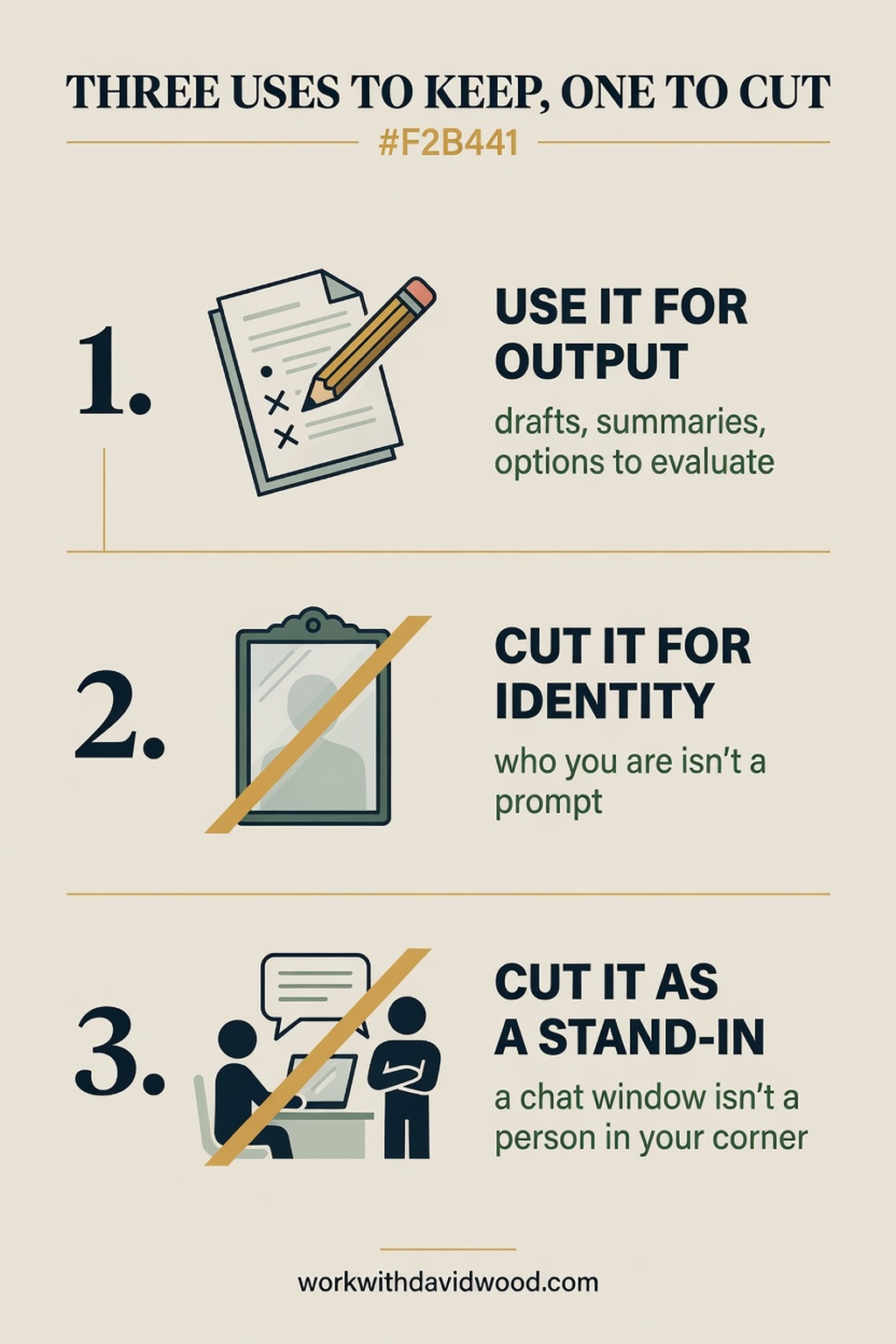
Three uses I’d defend, three I’d cut on sight
This isn’t an argument to quit using it. That would be its own kind of dishonest, since I won’t be quitting either. It’s an argument for a line, and the line is simpler than it sounds.
Use it for output. Drafting an email, summarizing a document, generating options you’ll still evaluate yourself, cleaning up a paragraph you already wrote the substance of. That’s a tool doing tool work. Fast, useful, no different in kind from a calculator doing arithmetic you could technically do by hand.
Cut it for input to your identity. Don’t ask it who you are, what you should feel about a loss, whether you’re doing enough, or what your values should be when they conflict. Those aren’t information problems a pattern-matcher can solve for you. They’re judgment problems, and judgment is the exact muscle that atrophies the moment you stop using it. The same goes for major decisions with real consequences: who to hire, who to trust, when to walk away from a deal. Get the tool’s input if you want it. Never let it hold the pen on the actual call.
And cut it, specifically, as a stand-in for a person who should be in your corner. This is the one that sneaks up on capable, busy people the hardest, because a chat window is always available and never tired of you. A friend who challenges you, a mentor who’s seen the mistake you’re about to make, a room of people already living the version of your life you’re trying to build, none of that is replaceable by something that agrees with your framing by design. It’s built to be helpful, which in practice means it rarely tells you the hard true thing a person who actually knows you would say.
I use AI for drafts. I don’t use it for the decisions that actually shape my life, and I don’t let it replace the people who do. I AM Transformation is a free community, daily conversations, real accountability, people in 150+ countries who’ll tell you the true thing a chatbot won’t. No card, about sixty seconds to join.
Put real people in the loop →The honest objection, and why it’s still not enough
Here’s the pushback I hear most, and it deserves a real answer instead of a dismissal. “A chatbot is available at midnight when nobody else is. It doesn’t judge me. It never gets tired of my problem. Isn’t something imperfect but constant better than nothing?”
Sometimes, briefly, yes. If you’re spiraling at midnight and the alternative is spiraling alone with no outlet at all, typing it out can genuinely help you calm down enough to sleep. I’m not going to pretend otherwise. But notice what that argument is actually conceding: it’s better than isolation, not better than connection. The fix for loneliness was never supposed to be a tool that’s good at sounding like company. It was supposed to be actual company. Reaching for the available thing at midnight is understandable. Building your whole support system out of the available thing, because reaching a real person takes more effort and more vulnerability, is how you end up technically never alone and functionally isolated at the same time.
What actually rebuilds the muscle
The fix isn’t complicated, it’s just less convenient than typing into a box. Before you ask the chat window a question that touches who you are or what you should decide, ask a person first. A specific person, not a hypothetical one. Say the real situation out loud to someone who knows you, and notice how different their answer feels from a fluent paragraph generated in four seconds. It’ll be messier. It’ll take longer. It will also actually be about you, shaped by someone who has something real at stake in whether you get it right.
That’s the whole case for building your identity in a room full of people instead of a conversation with software, and it’s the same case behind The Transformation, the deeper piece this one sits under. Real change doesn’t come from a better prompt. It comes from people who reflect a truer version of you back at you than you can generate alone, whether that’s a mentor, a community, or a friend who’ll actually disagree with you. If you’re building anything worth building, start here for the fuller framework, and see what I actually recommend if you want the specific tools I use, chat window included, in their proper place.
The tool is fine for drafts. It’s a poor substitute for the people who actually reflect you back to yourself. I AM Transformation is free, forever, no card required. Create your account and put real humans back in the loop.
Grow with people, not a chatbot →Use the tool. Just notice, this week, every time you reach for it to answer a question that was never really about information. That’s the moment to close the window and call a person instead. Do that consistently and the muscle comes back. Skip it long enough and you’ll wake up one day outsourcing the parts of your mind that were never supposed to be for rent.
See also: the tools and systems I actually recommend, and start here if you’re new.
Three posts a day. One email a day.
Everything I publish, in one short daily email. Real numbers, no hype, unsubscribe in one click.




Bias first: I spent years on the company side watching field leaders outsource judgment to whatever felt authoritative that month — a script binder, an upline, a Facebook group. The chat window is a new surface on an old habit. What I can say from that seat is that tools which always sound helpful train people out of the hard true answer, because the hard true answer is rarely the most fluent paragraph. Use it for drafts and summaries. Do not hand it the hire, the walk-away, or the values conflict. That boundary matches what I saw when soft substitutes for real mentors quietly lowered the quality of decisions long before anyone called it dependence.