

Part of the guide: Personal Brand
Everyone selling you on hype will tell you authentic marketing is a nice-to-have, a values thing you bolt onto the pitch after the real persuasion is done. I built two different businesses on the opposite bet: that plain honesty, told to a reader smart enough to catch you lying, outperforms any launch script I’ve ever written. Here’s what changed the day I stopped performing a personality and started just teaching what I actually do.
Let me take you back to the couch first, because the whole thesis started there, not in a boardroom.
In this guide
- The couch, and two months of nothing
- Why the “hype wagon” almost worked, and why I dropped it anyway
- The honesty rule from the broke era
- Why the anti-guru wins the educated reader specifically
- What authentic marketing actually looks like in practice
- The trap: authenticity as its own performance
- The compounding effect: trust as an asset
The couch, and two months of nothing
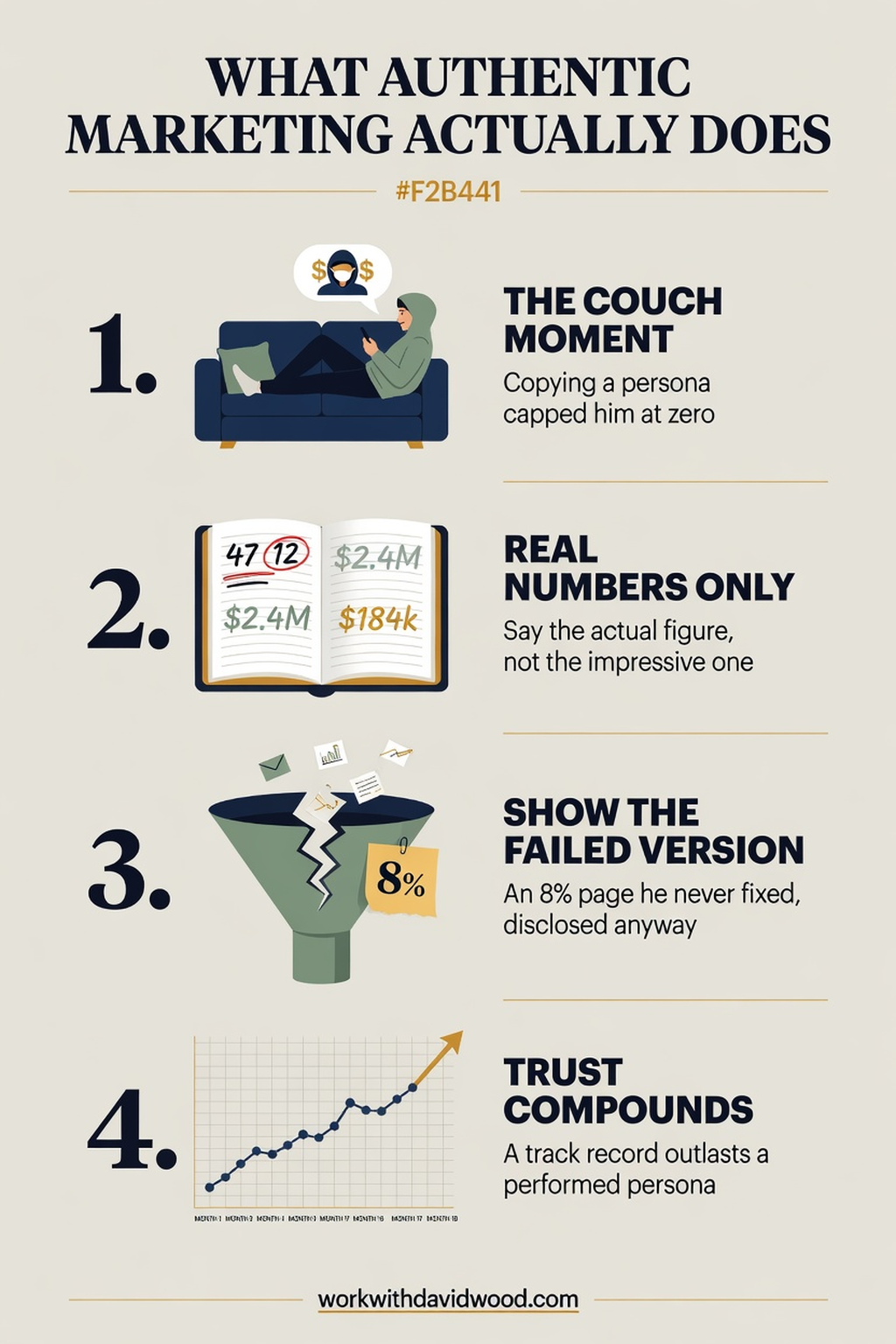
Five years into network marketing I hadn’t sponsored a single person in two months. Not one. I was doing everything the trainings told me to do, dialing my warm market, reciting the scripts my upline handed me, sounding, if I’m honest, like a slightly worse version of whichever leader I’d studied that month. I sat on the couch in my family room one evening and admitted the real problem out loud. I wasn’t failing because I lacked information. I was failing because I was copying someone else’s personality and my prospects could feel the seams.
So I stopped. I quit chasing my warm market, quit trying to sound like the guy on the stage, and started building automated traffic that let prospects meet the actual, unpolished version of me before I ever got them on a call. I went from one recruit a month to ten, then fifty. I was pulling 500 to 1,000 visitors a day, and prospects started asking to join my team instead of me chasing them. Nothing about the product changed. The only variable that moved was how honestly I was showing up.
That’s the pattern I want you to hold onto, because it repeats everywhere I’ve tested it since. The polish wasn’t the problem. The performance was.
Why the “hype wagon” almost worked, and why I dropped it anyway
Here’s an uncomfortable data point, because I want to give you the honest version of this, not the tidy one. My very first YouTube video wasn’t gentle. I filmed it in a stained shirt, ran through nine reasons a competing product “sucked,” and practiced the bit ten times before I hit record. It pulled roughly 4,000 views in a single day and a flood of angry comments. The lesson underneath it was real: nobody engages with “hey, I’ve got this awesome thing.” Conflict gets attention. Agreeableness gets scrolled past.
But I dropped the trashing almost immediately, and here’s why that matters for you. Conflict is a legitimate attention mechanic. Cruelty is not a marketing strategy, it’s a shortcut that burns the trust you’ll need the moment someone actually buys from you. What I kept was the willingness to say a true, unpopular thing plainly. What I cut was the part where I made myself the bully to get the view. You can have the engagement without the residue. Most people who copy the “controversial guru” playbook keep the wrong half.
The honesty rule from the broke era
Back when I genuinely had nothing, I set myself one rule I’ve never broken since. If I was living in my mother’s basement, I wasn’t going to write a book about how I got rich on the internet, because I wasn’t rich on the internet yet. I used to joke about the honest version of that title: “I live in my mom’s basement, and here’s how to make money selling eBooks from your mom’s basement, and eventually move out.” Nobody buys that book. But everybody, eventually, buys from the person who would have written it instead of faking the version with the yacht in the thumbnail.
Sit with that rule for a second, because it’s the whole strategy compressed into one sentence. Authentic marketing isn’t a tone. It’s a constraint you place on yourself before the copy gets written: you only claim what’s true right now, and you let the actual, current version of your results do the selling. It’s slower on day one. It’s the only version that survives contact with a reader who Googles your name.
Why the anti-guru wins the educated reader specifically
Here’s the part most marketing advice skips, and it’s the part that matters most to you. You’re not a beginner. You’ve probably got a degree, a career, a track record of your own, and you can smell an oversold promise from three sentences away. The guru playbook, the yacht thumbnails, the “I found the secret they don’t want you to know,” was built for a reader with no filter for it. You have the filter. Every time a page reaches for hype instead of substance, you can feel the reach, and it costs the writer your trust in real time.
That’s the internal conflict sitting underneath most educated buyers right now. You want a teacher. You’ve read enough books and sat through enough webinars to be genuinely tired of performers pretending to be teachers. The guru sells a persona. The anti-guru shows you the actual mechanism, including the parts that didn’t work, and lets you decide for yourself whether it’s worth your time. One of those earns a sale. The other earns a subscriber who never converts and eventually unsubscribes anyway.
What authentic marketing actually looks like in practice
This isn’t a mood. It’s a short list of specific moves, and you can start using all of them this week.
Say what you actually did, not what worked for someone else. If you sponsored fifty people from a funnel, say fifty, not “hundreds,” and say how long it took. Cite the real number even when the real number is smaller than you’d like.
Show your work, including the failed version. My first capture page converted at roughly eight percent and I never bothered to fix it, because it was still making tens of thousands a month and I was too busy scaling traffic. Knowing better could have doubled or tripled that number. I tell people that on purpose, because a reader who hears about your dumb early mistake trusts your current advice more, not less.
Drop the guaranteed-income language entirely. Most people in most opportunities, including the ones I promote, earn little to nothing. Say that plainly, every time, and then explain what actually separates the people who do well from the people who don’t. That single sentence filters out the wrong reader and earns the right one.
Teach the thinking, not just the script. I trained students on hyper-specific blogging tactics once, and the training broke the moment a large group copied it word for word. The more precisely people followed my exact playbook, the less consistently it worked, because the market adjusts to a script the instant enough people run it. I sent them to a forum full of teenagers instead, because some of those kids had already out-figured me. That’s not false modesty. It’s the accurate account of what happened, and it taught me that principles travel further than recipes.
You don’t build a real audience by performing confidence you don’t feel yet. I AM Transformation is a free community where people show up as themselves, daily, with real accountability instead of a highlight reel. No card, about sixty seconds to join.
Grow this with people, not a persona →The trap: authenticity as its own performance
One honest warning before you run with this, because I’ve watched capable people get it wrong in the opposite direction. The moment “being real” becomes a content strategy, it can curdle into its own act. The manufactured vulnerability post, timed for engagement, confessing a struggle that’s already resolved and safe to share, is just the guru playbook wearing a hoodie instead of a suit. Readers as sharp as you catch that version too, eventually. It just takes one post longer.
The test I use on myself is simple. Would I say this exact thing to one smart friend across a table, with nothing to sell them, on a day nobody’s watching? If the answer is yes, publish it. If the honest answer is that I’m shaping the story to look a certain way, I rewrite it or I cut it. That one filter has saved me from more bad marketing than any framework I’ve ever been taught.
The compounding effect: trust as an asset
Here’s the ultimate benefit, and it’s not abstract. A persona has to be maintained forever, propped up, defended, escalated every time a competitor gets louder. A track record just sits there and keeps paying you. The trust you build by being specifically, provably honest compounds the same way a good investment does, quietly, while the guru accounts around you burn out chasing the next bigger claim to stay relevant.
You already have more real material than you think you do: actual numbers, actual failures, an actual couch-moment of your own if you go looking for it. Read the fuller case for why identity, not persona, is the real leverage point in The Transformation, the pillar this piece sits under. Then go write the true, smaller version of your story before you write the impressive one. The smaller true version is the one that actually gets a reply.
Stop rehearsing a version of yourself you think the market wants. Join a free community built on daily, real accountability instead of a curated feed, and grow the version of you that’s actually true right now.
Show up as yourself, with people who notice →See also: the tools and systems I actually recommend, and start here if you’re new.
Three posts a day. One email a day.
Everything I publish, in one short daily email. Real numbers, no hype, unsubscribe in one click.




The strongest case against this framing is that conflict still outperformed honesty on day one of that first YouTube video. Four thousand views from a stained shirt and nine reasons a competitor “sucked” is not a small data point, and the piece admits attention came from the trashing before the trashing got cut. So the counter-argument writes itself: if conflict is the engagement mechanic, and educated readers still scroll past agreeableness, then pure authenticity may be a filter that only works after you already have attention from messier methods. I’m not saying I buy that counter fully. I’m saying the article hands it to you and then walks away from it a little quickly.
Walt’s counter is useful, but the median case still needs airtime. Most people who copy the controversial-guru playbook keep the cruelty half and never build the trust asset the piece describes. A few get the view spike. Far fewer convert that into readers who stay after Googling the name. Rare is not the same as the typical path. The eight-percent capture page left unfixed is a better median lesson: show the dumb early mistake on purpose so the current advice carries weight.