

Part of the guide: Network Marketing Lead Generation
Somewhere around your four hundredth sales call, something switches off. Not your focus, the opposite of that. The part of you that used to have to figure out what to say now just says it, correctly, before you’ve finished hearing the question. That switch has a name. It’s called skill automaticity, and if nobody ever taught you it’s a specific, triggerable event with an actual threshold, you’ve probably filed it under luck, or talent, or “finally getting comfortable.” It’s none of those. It’s a mechanism. Once you understand what has to happen to trip it, you can trip it on purpose, in a fraction of the time it usually takes by accident.
I remember exactly where I crossed it the first time.
Early in my network marketing career, in a rented office with a phone headset that never quite sat right, I was on a call with a prospect who gave me the objection I’d already heard three hundred times. “I need to think about it.” Old me would have paused, run the mental checklist, picked from the four rebuttals I’d memorized off a script taped to my monitor. That day the pause never came. I heard the words and my response was already out of my mouth before the conscious part of my brain had finished registering what she’d said. I didn’t decide to say it. It arrived pre-decided.
I hung up and sat there a second, a little unsettled by my own voice. That’s the whole gap between competence and mastery, and almost nobody teaches you the mechanism underneath it, because almost nobody who’s good at something can explain what actually happened when they got good at it. They just say “it clicked.”
In this guide
- The three stages of skill automaticity nobody explains to you
- Most people think mastery is more knowledge. It’s a threshold you cross, not a ceiling you inch toward.
- The five conditions that actually move a skill across the line
- Why the threshold matters more once you’re already competent
- The mechanism I built my own training around
- What to do with this today
The three stages of skill automaticity nobody explains to you
Here’s the part that clicked for me years later, reading the actual research instead of just living it. Psychologists Paul Fitts and Michael Posner mapped how any skill gets acquired back in 1967, and the model has held up remarkably well since. Three stages. In the cognitive stage, you’re talking yourself through every step, consciously, slowly, and you make a lot of mistakes because you’re holding the whole procedure in working memory at once. In the associative stage, the errors drop and the steps start to smooth out, but you’re still watching yourself do it. You’re monitoring. In the autonomous stage, the skill runs without conscious supervision. It’s fast, it’s accurate, and critically, it stops competing for the same mental resources everything else needs.
A separate line of research, from Richard Shiffrin and Walter Schneider in the late 1970s, drew the same line from a different angle. They split cognitive processing into two modes: controlled processing, which is slow, serial, effortful, and limited by working memory, and automatic processing, which is fast, runs in parallel, and barely touches working memory at all. The threshold I’m talking about is the exact moment a skill moves from the first bucket to the second. Before that moment, you’re doing the skill. After it, the skill is just how you see the situation.
Most people think mastery is more knowledge. It’s a threshold you cross, not a ceiling you inch toward.
This is where I have to correct something almost every capable, driven person believes about themselves. You’ve told yourself some version of this: “I’ve just always been slow on my feet, some people think fast, I don’t, that’s how I’m wired.” I understand exactly why that feels true, because in the moment, thinking does feel slow. But slow means one specific, fixable thing. It means you’re still running that skill through the controlled, working-memory-dependent circuit. It does not mean you’re incapable of the automatic one. It means you haven’t crossed into it yet, on this particular skill, and you’ve mistaken “not yet” for “never.”
Most professionals plateau in the associative stage for years. They’re good enough. Calls close, deals get done, nobody’s complaining. And that comfort is exactly what stalls them, because doing something well enough while still monitoring it consciously feels like mastery from the inside. It isn’t. It’s a stable, comfortable stop halfway up the mountain, and almost nobody tells you there’s a second half.
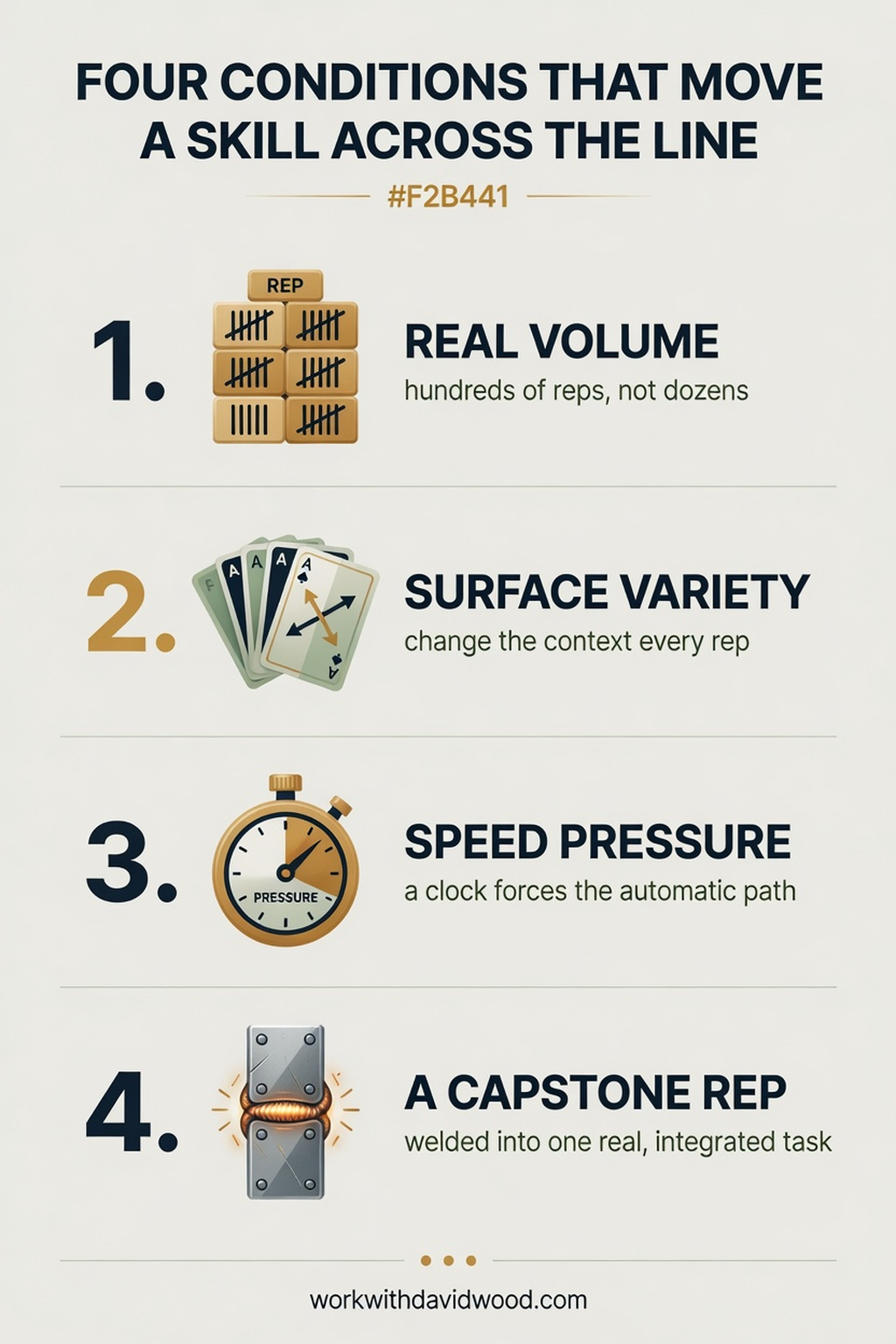
The five conditions that actually move a skill across the line
Volume alone doesn’t do it. I want to be precise here, because this is where most advice quietly lies to you. Reps matter, but the reps have to carry four other conditions with them, or you plateau in the associative stage indefinitely, comfortable and stuck.
1. Real volume. Hundreds of reps, not dozens. There’s no shortcut around the raw number.
2. Surface variety. The same exact scenario, repeated identically, trains a memorized script, not a generalized skill. Change the context, the wording, the order, so your brain has to extract the underlying pattern instead of pattern-matching a specific case it’s seen before.
3. Counterintuitive material. Easy reps that confirm what you already expect don’t force real learning. The reps that build automaticity are the ones that break your naive first guess and make you actually process what’s in front of you.
4. Speed pressure. Untimed practice lets you stay in the slow, controlled circuit forever, because there’s never a cost to thinking it through. A clock forces the automatic pathway to form, because the deliberate one physically can’t keep up.
5. A capstone that binds it. At some point the skill has to get exercised inside a real, integrated task, combined with everything else you know, not drilled in isolation. That’s the rep that actually welds it into how you operate.
Take away any one of those five and you get a plateau that looks like progress and isn’t. Take away variety and you get a memorized script. Take away speed and you get someone who’s accurate but always a half-beat behind the conversation. Take away the counterintuitive cases and you get confident guessing that only works on the easy version of the problem.
The pushback I hear at this point is predictable. “Isn’t this just the ten thousand hours thing? Doesn’t everyone eventually get there with enough reps?” No, and I’ve watched the counterexample up close for two decades. I’ve watched people run the identical script for ten years and still pause before the same three objections, because the reps were real but the variety and the pressure never showed up. Comfortable repetition without those other four conditions trains you to be reliably good at doing something slowly. It does not train the switch.
Most people have never measured which of their skills are still running on the slow circuit. CortexSurge is a science-based cognitive training app built on relational frame theory, and it opens with a free assessment that gives you an actual Brain Profile. Fifteen minutes tells you more than another year of assuming you’re “just naturally slow at that.”
See where your own reasoning actually stands →Based on published cognitive-science research. Not a medical product or treatment.
Why the threshold matters more once you’re already competent
Here’s the part that actually changes your output, not just your comfort. Every ounce of working memory a skill still occupies in the associative stage is capacity you don’t have available for the next-level thinking. The operator who’s still consciously running the objection-handling script has none of their attention left over to notice the prospect just flinched at the price, or that the real hesitation is about the spouse, not the money. The operator whose objection handling runs automatically has that entire layer of attention free, watching the two moves ahead the other person can’t see themselves making yet.
That’s the actual prize. Not speed for its own sake. Capacity. The version of you that doesn’t have to think about the fourth objection anymore has room left over for the thing that separates the people who close from the people who merely respond, which is noticing what’s actually happening in the room while your mouth runs the automatic layer underneath it.
And it compounds, because the identity shift is real too. Once you’ve felt one skill cross the threshold, on purpose, you stop believing the story that you’re just wired slow. You start asking, of every skill you rely on, which stage is this actually in, and what would it take to push it the rest of the way. That question alone, asked honestly and often, is worth more than most of the advice you’ll read this year.
The mechanism I built my own training around
This isn’t only a sales-call question for me. It’s a reasoning question, and it’s the entire design bet behind a cognitive training app I use called CortexSurge, built on relational frame theory. The premise is that reasoning itself crosses the same automaticity threshold a golf swing or an objection response does. Fast, correct pattern recognition under time pressure, without consciously working the logic out first, the same way a chess master sees the right move instead of calculating toward it. It’s scientifically shown to improve reasoning and fluid intelligence, trained level by level, with the same five conditions underneath it: real volume, real variety, cases built to break your naive first guess, a clock, and integrated levels that force everything to work together instead of in isolation.
I won’t oversell it to you, because you’ve earned the right to skepticism by reading this far. Nobody trains their way to a permanently sharper mind in a weekend. What people who actually stay consistent report is that something clicks somewhere in the first fifteen to twenty-five hours, and the gains that are actually felt, not imagined, show up over two to three months at four or five sessions a week. That’s a real timeline. Anyone promising you the shortcut version is selling you the comfortable associative-stage plateau with better marketing.
If you want the fuller argument for why training the mind is the one asset in your business you genuinely can’t outsource or hire around, that’s the whole case I make at The Operator’s Mind. And if this is the first thing of mine you’ve read, start here before you go further, because everything above assumes a skill’s stage is diagnosable and movable, not fixed at birth.
The specific tools I actually use to run these reps, in sales and outside of it, are laid out on the recommended products page, if you want the concrete list instead of the theory.
What to do with this today
Pick one skill you rely on for income that still makes you pause before you respond. Not the ones you’re bad at. The ones you’re already decent at, the ones running in the associative stage, comfortable and stuck. Write down which of the five conditions is missing from how you practice it. Usually it’s variety or speed, because those are the two nobody builds in on purpose. Then go add the missing one this week, on purpose, and watch how much faster the threshold arrives than it did the first three hundred times you did it without knowing what you were waiting for.
You already suspect some of your skills are still running on the slow circuit. Find out which ones, and by how much. Take the free CortexSurge assessment and get a real Brain Profile in about fifteen minutes, then decide if you want to close the gap.
Get my free Brain Profile →Based on published cognitive-science research. Not a medical product or treatment.
See also: the tools and systems I actually recommend, and start here if you’re new.
Three posts a day. One email a day.
Everything I publish, in one short daily email. Real numbers, no hype, unsubscribe in one click.




Look, the Fitts and Posner stages are real enough. Cognitive, associative, autonomous. Fine. What I push back on is the clean switch metaphor. Somewhere around the four hundredth sales call something “switches off” and the rebuttal arrives pre-decided. In field sales I watched people hit thousands of reps and still pause on the same three objections because volume without variety is just a memorized script. The five conditions are the useful part. The threshold-as-event framing still feels too tidy for how messy real skill change actually is.