
Part of the guide: Blog Traffic

This is part two of my top 18 SEO plugins for WordPress list. If you haven’t checked out the first 9 plugins, click here. Otherwise, proceed to read the last 9:
In this guide
- 10. WP Super Cache (works, checked as of 2024)
- 11. LJ Longtail SEO (works, checked as of 2024)
- 12. Pingback Optimizer (works, checked as of 2024)
- 13. SEO Pressor (works, checked as of 2024)
- 14. CommentLuv (works, checked as of 2024)
- 15. SEO SearchTerms Tagging 2 (works, checked as of 2024)
- 16. SEO Rank Reporter (works, checked as of 2024)
- 17. Sharebar (works, checked as of 2024)
- Comments
10. WP Super Cache (works, checked as of 2024)
We all know that your site’s load time has a direct impact on its ranking in search engines. While it’s not a huge factor unless your site takes too long to load, it’s crucial that visitors can access pages quickly. WP Super Cache stores a static version of your site to reduce CPU usage and increase load speed. A must-have plugin if your pages load slowly!
11. LJ Longtail SEO (works, checked as of 2024)
Despite its odd name, this plugin is incredibly useful. LJ Longtail SEO tracks your incoming visitors and the keywords they use to reach your site. It then places those keywords in a widget, linking them to the corresponding pages, enhancing your internal SEO. I use it on all my blogs, and it’s a key element in boosting rankings.
12. Pingback Optimizer (works, checked as of 2024)
This plugin creates RSS feeds from your blog’s pingbacks and submits them to top RSS aggregators, helping to index your backlinks—a crucial step in improving search rankings. It has significantly increased traffic for me.
13. SEO Pressor (works, checked as of 2024)
If you’re new to SEO, this plugin is a great helper. It optimizes your blog posts for the keywords you specify, scoring your pages/posts and suggesting improvements for on-page SEO. It’s a great tool to help you optimize your content effectively.
14. CommentLuv (works, checked as of 2024)
CommentLuv isn’t purely an SEO plugin but focuses on user engagement and comments. However, it offers several SEO benefits as well, making it worth including on this list.
15. SEO SearchTerms Tagging 2 (works, checked as of 2024)
Similar to LJ Longtail SEO, this plugin strengthens your on-page SEO and converts search terms into tags for better indexing. It also tracks popular search terms, helping you focus on the right keywords.
16. SEO Rank Reporter (works, checked as of 2024)
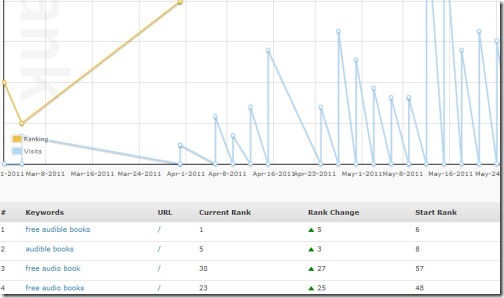
For those who track multiple sites, SEO Rank Reporter helps monitor your keyword rankings over time. It tracks your Google rankings and even sends email notifications when rankings change.
17. Sharebar (works, checked as of 2024)
Although not primarily an SEO plugin, Sharebar adds social sharing buttons for Facebook, Twitter, LinkedIn, and Google+1. It boosts engagement and social activity, ultimately increasing traffic.
That’s the complete list of my top 18 SEO plugins. Install these plugins to improve your on-page SEO and drive more traffic to your site!
In Prosperity,
David Wood
Top 18 SEO Plugins for WordPress – Part Two
Comments
Patrick McConnell
Thanks for the info Dave. I’ve been trying to get a hang of keyword research but I guess I’ve been unwilling to put in ‘hours’ of research to get a good keyword to target. Thanks for the heads up!
Sathish
This article is very useful to everyone, especially newbies. The plugins listed here are mostly used by everyone. Thanks for the awesome article.
Alexis Forrester
You were never meant to do this alone
Reading this changes nothing. Doing it with people who show up changes everything. That is the whole difference between the people who transform and the people who keep starting over.
Start free →This is an amazing post, David! I’ve been using a few of these plugins, but now I can see how crucial the others are for boosting my SEO efforts. Thank you for taking the time to explain the benefits of each one clearly. Definitely adding WP Super Cache to my list!
George Mason
I’m a bit skeptical about some of the results you mentioned, particularly the increase in traffic from Pingback Optimizer. Do you have any data or case studies to support the traffic boost claims? It sounds promising, but I’m curious about the evidence behind these results.
Melina Carter
Rafael Gonzalez
While the post is informative, I feel it could go a bit deeper into explaining how each plugin directly impacts rankings. For example, WP Super Cache speeds up the site, but how much faster does the plugin make the site compared to similar tools? Would love more detailed comparisons!
Ellie Thompson
David! Long time no see! I loved the post, but I had no idea you were diving this deep into SEO. We need to catch up soon, perhaps over coffee? I’ve been experimenting with a few plugins myself and would love to hear more of your insights. Let’s meet up soon!
Mario Reyes
Your post really resonated with me. I’ve been struggling with my site’s slow loading times for months now, and I didn’t know that WP Super Cache could help. I’m installing it right away. It sounds like it might finally solve the issues I’ve been facing. Thanks for the recommendation!
Karen Patel
Have you heard of the SEO plugin “All in One SEO Pack”? It’s quite popular and has features that seem to overlap with some of the tools you mentioned, like SEO Pressor. I’d recommend looking into it, especially for those just starting out. I’ve found it very user-friendly.
John Andrews
This was an eye-opener for me! I wasn’t aware of the importance of pingbacks and how they impact SEO. I especially learned a lot from your section on Pingback Optimizer. I’m excited to implement this new knowledge on my site. Thanks for sharing such valuable information!
Three posts a day. One email a day.
Everything I publish, in one short daily email. Real numbers, no hype, unsubscribe in one click.
Come do the work with people who show up
Not another course you finish alone and forget. A community that is there the next morning, and the one after that. Free, forever. About a minute to join, then come do the first challenge with us.
Join the community, free →



‘It has significantly increased traffic for me’ is doing an enormous amount of unexamined work in the Pingback Optimizer section. Twenty-two years in corporate taught me to be suspicious of exactly that phrase in any internal report — significant compared to what baseline, over what period? We’d have been sent back to redo the whole slide.
Graham’s right, and it’s worse than one unmeasured claim — the whole list has no shared measurement framework at all. Input: install plugin. Output: ‘increased traffic’ or ‘boosted rankings,’ stated identically for eight completely different mechanisms, caching versus pingback indexing versus social sharing. A cache plugin’s effect is measurable in milliseconds. A pingback plugin’s effect on rankings is not measurable in any timeframe this post gives us.
Here’s a small exercise if you’re working through this list: before installing anything else, time your homepage load with a free page-speed tester, install just WP Super Cache, then time it again. That single before-and-after is more useful than anything else in this post, because it’s the one claim here you can actually verify yourself in ten minutes. What did the number look like before you started?
Good exercise, but one measurement isn’t a sample. Run it five times minimum, note the range, not just one number — load time varies 20-30% run to run on shared hosting alone. A single before-and-after pair from this post’s era tells you nothing reliable.
What strikes me reading through all eight of these back to back is that the post uses nearly identical language for plugins doing fundamentally different jobs — ‘a must-have,’ ‘significantly increased traffic,’ ‘a key element in boosting rankings’ — regardless of whether the underlying mechanism is a server-side performance improvement, a backlink indexing shortcut, or a social share button. WP Super Cache’s effect on load time is genuinely measurable and well understood as a ranking factor. Pingback Optimizer’s effect on rankings, by contrast, rests on an assumption about how search engines weight pingback-derived backlinks that was already questionable when this was written and has only gotten weaker since. Treating both claims with the same confident language flattens a distinction that actually matters quite a lot if you’re deciding where to spend your limited setup time.
This might be a silly thing to ask but I installed CommentLuv because it was on this list and I genuinely couldn’t tell after a week whether it did anything for my SEO or if it was more just a nice feature for people leaving comments, and the post itself even says it isn’t purely an SEO plugin, so I’m not sure why it’s numbered alongside the others as if it belongs in the same category.
Bonnie, you’ve actually spotted something real there. CommentLuv’s SEO effect, if any, is indirect at best — more engagement, maybe more comments, which might eventually help rankings. For most sites that effect is going to be small to negligible. Doesn’t mean it’s useless, just means it’s in a different category than something like XML sitemaps, which has a direct mechanical effect.
Eight plugins, one paragraph each, all described as ‘significantly’ helping something. Fine. They can’t all be the most important one.