
Part of the guide: MLM Reviews: The Honest Index
Empower Network is the company I co-founded in 2011, and it’s the one people ask me about first once they find out how long I’ve been in this industry. Not “how do I join.” It doesn’t exist anymore. They want to know what actually happened to the $464,913 checks and the packed stadiums, because the version they half remember online is either a scam story or a hero story, and neither one is true. I was in the room for all of it, the launch, the peak, and the collapse, and you deserve the version that doesn’t flatter me. Here’s the honest autopsy, the real numbers, and the five leverage lessons you can actually use, the ones that were worth what they cost me.
In this guide
- What Empower Network actually was
- The rise, in real numbers
- The compensation plan, explained plainly, and why it broke
- The honest autopsy: what actually killed it
- Who actually won, and who paid for it
- The vetting playbook: how to check any comp plan before it checks you
- The verdict on Empower Network
- The five leverage lessons that survived
What Empower Network actually was
Start with the plain version, because most retellings skip it. Empower Network launched in October 2011, co-founded by me and David Sharpe, built on one idea neither of us had seen done cleanly before: a blogging platform for network marketers, sold at 100% commission on every sale. No company skim. You sold the $25-a-month blog system, you kept the $25. You sold the $100-a-month Inner Circle mindset membership, you kept the $100. That single mechanic, not the products, is what made the phones ring off the hook.
The product stack was never exotic. A blogging platform (later rebuilt and relaunched as Kalatu), the Inner Circle audio training vault, a Costa Rica Mastermind intensive, and a higher-ticket team-building program people just called the 15k Formula. What was new was handing the entire commission straight to the person who made the sale, on a platform built for the exact job of publishing content and getting paid for it. If you’ve spent any time in network marketing, you already know how rare that was, and still is.
The rise, in real numbers
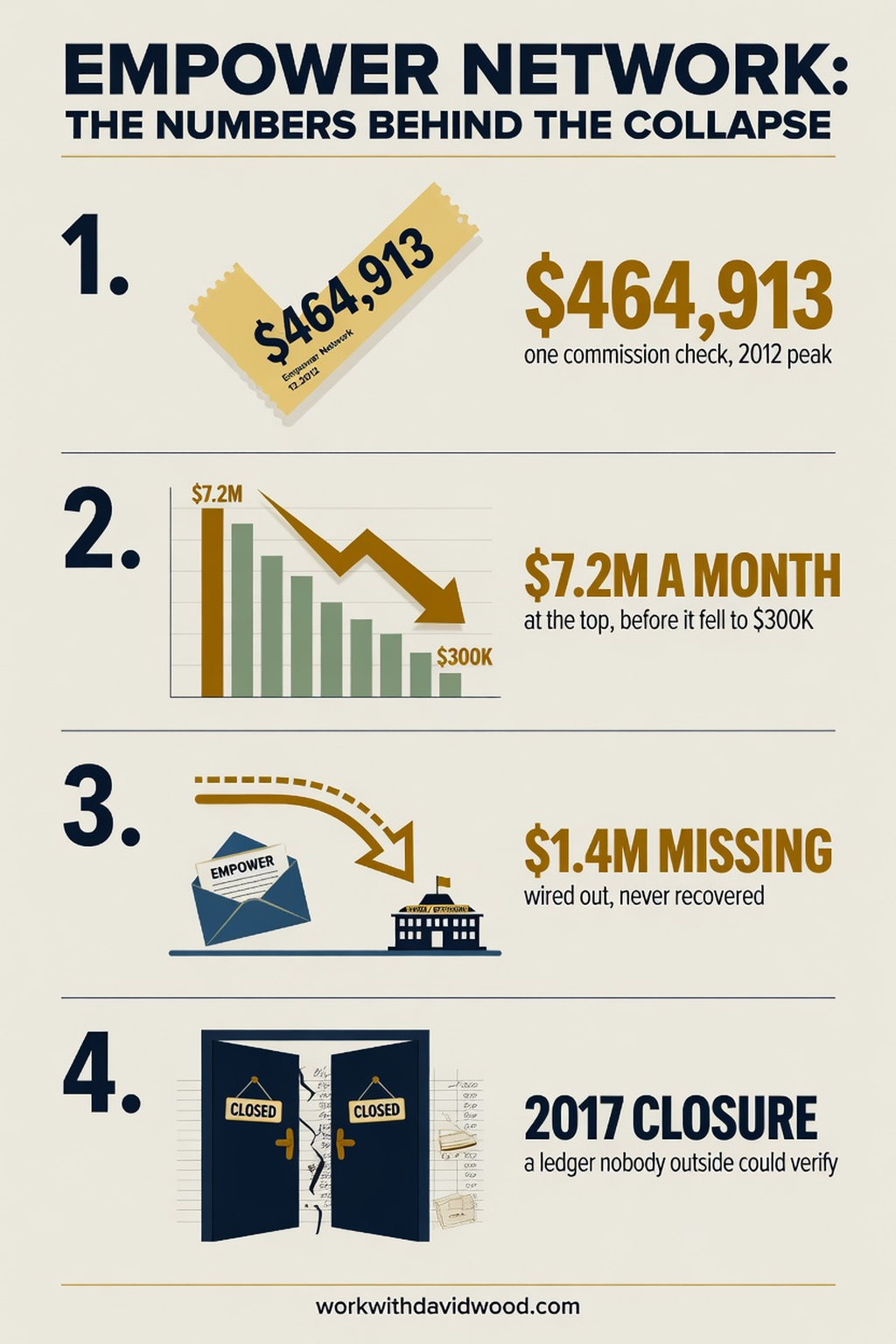
The part that’s easy to romanticize, and I won’t. The first event was 37 people in a rented room. Not 3,700. Thirty seven. Within about two years the company had announced more than $100 million in cumulative revenue, and by September 2013 industry press had it at over $70 million paid out in commissions alone. Audited 2013 revenue came in at $63.3 million for that single year. I still have the screenshot of one commission check, from 2012, for $464,913. One month, one check. If you’ve never watched a room full of strangers see a number like that on a projector screen, it’s hard to describe what it does to the pulse of a crowd. You forget to ask how the money actually moves. That’s the part you should never forget to ask.
The events scaled with the money. That first room of 37 became crowds of 1,100, then 2,400, then 4,500. The biggest one, “Don’t Be A Wussy,” filled an Atlanta ballroom in 2012 with 6,200 people who’d put the flight and the hotel room on a credit card because they believed this was finally the one. At the peak the company was moving something close to $7.2 million a month. Add up the years it actually ran at real volume, from the 2012 ramp through the 2013 to 2014 high-water mark, and the honest lifetime figure for total sales that moved through Empower Network lands north of $200 million. I’m not proud of that number and I’m not ashamed of it. It’s just the number, and it’s what makes the next part worth studying closely.
The compensation plan, explained plainly, and why it broke
Educated readers want the mechanics, not the highlight reel, so here they are. Every product paid 100% commission direct to the affiliate who sold it, no override skimmed off the top for corporate. That was the entire “genius” of the plan. It wasn’t a binary. It wasn’t a twelve-rank unilevel matrix. It was closer to a straight retail commission with a fast, loud community stacked on top of it.
Here’s the thing nobody mentions when they praise “100% commissions” as the innovation, and it’s the thing you should ask about the next time you hear that pitch. Paying out 100% of every sale only works if the company’s own overhead, staff, servers, merchant processing, executive salaries, comes from somewhere else. From 2011 into 2013, that somewhere else turned out to be nowhere. The accounting simply wasn’t tracking whether the company was paying out more than it was taking in. Nobody caught it while it was small. When our CEO at the time, Jonathan Cronstedt, surfaced the real numbers clearly in 2014, the hole was already enormous, and roughly $1.4 million had been wired out of the company to Vietnam and never came back. A business that had been running near $7 million a month fell to about $300,000, while still owing money to its own members.
The honest autopsy: what actually killed it
By August 2017 the company closed its doors for good. I was the one who had to tell tens of thousands of people that the thing they’d believed in, some of them for six years, was over. I won’t dress that up. If you want the version told by people who weren’t in the room, BehindMLM covered the closure in detail at the time, and I’ve linked their reporting below. Here’s mine: we didn’t lose to a competitor, and we didn’t lose because the market moved on. We lost because nobody outside the company, including most people inside it, could verify in real time whether the math actually worked. You trusted a dashboard. The dashboard was wrong, and by the time anyone with the authority to fix it saw the real books, there wasn’t enough left to fix.
David Sharpe stepped back from day-to-day operations around 2014, well before the end. I stayed, tried to save it, and paid for that at a cost that had nothing to do with money. I’ve said this publicly before, so I’ll say it plainly here instead of pretending otherwise: through those last years I was running on alcohol, on Concerta I’d been prescribed for ADD and kept taking for three years past when I should have stopped, and on testosterone. The man on stage telling a room of thousands they could have freedom was privately falling apart. I’m not telling you that for sympathy. I’m telling you because the company’s collapse and my own were the same story told in two different ledgers, and separating them would be a lie by omission.
Who actually won, and who paid for it
Some people made real money in Empower Network. I’ll be as fair about that as I’d insist on being fair to anyone else’s company. The people who won were, almost without exception, the ones in early with an existing audience or team, willing to recruit hard while the momentum was real. A handful crossed seven figures. That’s documented and it’s true.
The person who lost is the one this site is written for. A capable professional, a few thousand dollars a month into a side business, doing the actual work, watching the number on a dashboard climb, and trusting that the number was the truth. If you’ve ever gotten a commission notification that didn’t match what actually landed in your account, or watched a comp plan get quietly rewritten between you and a payout you were counting on, you already know the feeling I’m describing from the inside. It isn’t paranoia. It’s the correct response to handing your income to a system you can’t independently check. That’s the quiet fear underneath every “is this legit” question you’ve typed into a search bar at midnight. You suspect you’re not the problem. You’re right.
I built the company where you had to trust me with the math, and the math broke. What I run now settles 100% of every commission on a public smart contract, in the same block as the sale, about twelve seconds, before you ever have to trust a word I say. Drop your name and I’ll send you the walkthrough.
Show me a comp plan I can verify myself →Most participants earn little to nothing. No income is guaranteed. You can verify every payout on the public smart contract.
The vetting playbook: how to check any comp plan before it checks you
Maybe Empower Network never crosses your path, but something built the same way will. Here’s the actual audit, in order, the one I wish someone had handed me in 2011 instead of a stage and a microphone.
1. Ask who controls the ledger, by name. Not “the company.” A person, a title, an entity you could look up. If nobody can answer that in one sentence, that’s your answer.
2. Request the last two years of financials, not the highlight reel. You are allowed to ask. A serious operation can show you real numbers. A pitch deck is not a balance sheet.
3. Calculate the ratio of customers to affiliates yourself. Find ten people who bought the product with zero interest in the income opportunity. If you can’t find ten, you’re looking at a recruiting engine, not a business, no matter what the brochure calls it.
4. Check whether commissions settle instantly or on a cycle the company controls. Every day between the sale and your money in hand is a day someone else’s accounting problem becomes your problem.
5. Ask what happens to your commission if the company’s cash position changes. Get the answer in writing if you can. If you can’t get an answer at all, you already have one.
6. Look for a public paper trail before you look for a reason to trust your gut. State business registration, any regulatory filings, an income disclosure statement if one exists. Most affiliates in this industry earn little to nothing, and any honest disclosure will tell you that plainly. That’s not a red flag by itself. A refusal to show you one is.
7. Test small before you test big. Put in the minimum, run it for ninety days, and reassess with your own receipts instead of the pitch you heard on day one. The company that’s telling the truth survives that test easily.
The verdict on Empower Network
Empower Network was real. It moved real money, changed real lives for a stretch, and taught tens of thousands of people how to write and publish online, some of whom are still building careers on that skill today. It also collapsed because the people running it, myself included, controlled a ledger nobody outside the company could check, and the math quietly broke before anyone with the power to fix it saw it clearly. That is not a scam story with a villain. It’s a systems story with a design flaw, and I built the flawed system. I’ve had a long time to sit with that sentence, and the sentence you should sit with is simpler: judge the system a company runs on, not the stage it stands on.
The five leverage lessons that survived
1. A commission you can’t verify is a promise, not a payment. We genuinely paid 100%. The percentage was never the problem. The problem was that you had to take our word for the math.
2. The dashboard is not the truth. Our members watched healthy numbers tick up on a screen while the real books were bleeding out underneath it. A screen the company controls is not proof. It’s a promise with a nicer font.
3. Incentives that reward recruiting over real customers always drift. That’s not a moral failure of the people involved. It’s physics. A plan that pays more for signing people up than for selling to someone who just wants the product will tilt that direction every time.
4. Your income cannot outrun your identity. I built a company about freedom while quietly losing my own. The business runs on the person behind it, and if that person is falling apart, the business falls with them on a delay.
5. Whoever controls the ledger controls the outcome. Everything that sank Empower Network traces back to that one fact. Take the company out of the middle of the money, and the specific thing that killed it can’t happen to you the same way again.
Here’s the part that matters more than any one company’s verdict, including mine. Whether you build something that lasts has almost nothing to do with which comp plan you pick and everything to do with whether you can verify the thing you’re trusting with your income. I hear the objection before you type it: isn’t a public smart contract just another crypto gimmick wrapped around the same old pitch? I’d have asked the same thing. The difference is you don’t have to believe me. You pull the contract up on a block explorer yourself, read exactly where every dollar settles, and decide with your own eyes instead of my word. That’s the whole shift, from a promise to a proof, and it’s the entire reason real income leverage starts with who holds the ledger, not how big the stage is.
That’s the thing I actually built after Empower Network closed. Three stages, nine rungs, one public contract on Base that pays 100% of every commission in the same block as the sale, readable by anyone, including you, before you ever hand over a dollar. Not because 100% commissions were the wrong idea. Because a company controlling the ledger was. If you want to see the tools and systems I actually stand behind today, they’re gathered on the recommended products page, and if you’re new to how I think about all of this, start here and I’ll walk you through it from the beginning.
I already built the company where you had to trust me with the money. I’m not doing that to people again. This is the system I run now, every commission settled on a public contract you can verify before you trust a word I say. Enter your name and I’ll send you the walkthrough.
Show me the system I run now →Most participants earn little to nothing. No income is guaranteed. You can verify every payout on the public smart contract.
Founder’s retrospective and analysis, not legal or financial advice. Empower Network ceased operations in 2017. I have no financial relationship to Empower Network today and earn nothing from this review either way; links to Wealth Transformation are my own business and I earn if you join. As with any opportunity, most participants earn little to nothing and no income is guaranteed. Facts are accurate to the best of my recollection and the public record as of August 2026. Sources: BehindMLM’s coverage of the 2017 closure, BusinessForHome on the $100 million revenue milestone, BusinessForHome on the $63.3 million 2013 revenue disclosure, and the FTC’s guidance on multi-level marketing and pyramid schemes.
See also: the tools and systems I actually recommend, and start here if you’re new.
Three posts a day. One email a day.
Everything I publish, in one short daily email. Real numbers, no hype, unsubscribe in one click.