
Part of the guide: Network Marketing Lead Generation
Attention training sounds like something you’d do at a meditation retreat, not something you’d need for a Tuesday. But if you’ve caught yourself reading the same paragraph three times while a notification blinks in the corner of your eye, you already know the truth. Focus isn’t a personality trait you were issued at birth. It’s a skill, and like every skill I’ve ever taught for a living, it gets built in reps, not in good intentions.
I learned that the hard way, and not at a desk.
In this guide
- What my Wing Chun instructor knew about attention
- Most people think focus is a personality trait. It’s a rep count.
- The challenge: “this is just willpower, and I don’t have more of it”
- The protocol: how to actually train it
- Why attention training has to be structured, not just “less phone”
- What actually changes
What my Wing Chun instructor knew about attention
Years ago I trained under a Sifu named Carlos Colorado. Small school, no stretching before class (he ran it as a strict gradual warm-up, no exceptions, and I once watched him charge across the room yelling at my hyper-flexible training partner Will for trying to force a split cold). Wing Chun runs on 108 principles. Only one of them ever left the mat with me.
“Look at nothing. See everything.”
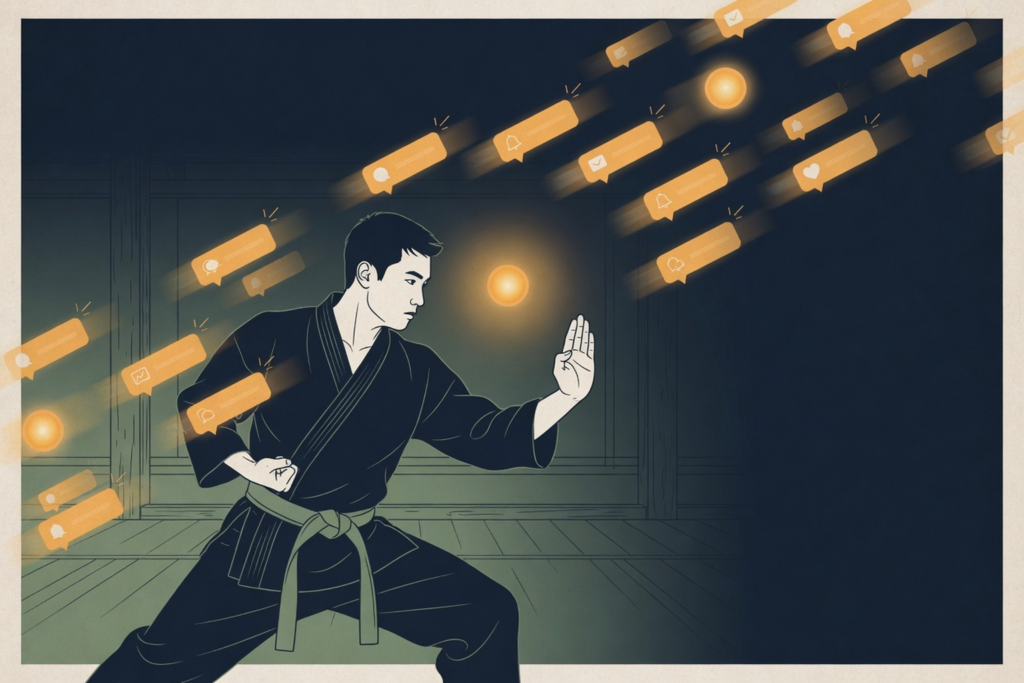
Carlos taught us to pull our eyes off the opponent’s face and fix them roughly six inches in front of his chest, in the empty air. Sounds passive. It isn’t. Fixed, narrow focus on one point (the fist, the eyes, whatever seems threatening) is exactly what gets you hit, because your brain is busy processing one small, loud signal instead of the whole field. Soften the gaze, hold it steady in that neutral spot, and reaction speed jumps two to ten times. You’re not trying harder to pay attention. You’re aiming attention correctly, and the correct aim is trained, not inherited.
That’s the whole argument of this post. Your notifications are the fist coming at your face. You keep flinching at each one individually, spending your entire day reactive, and you call it “being on top of things.” What you actually need is the six-inch spot. One trained place to rest your focus that lets the whole field stay visible without hijacking you.
Most people think focus is a personality trait. It’s a rep count.
Here’s the internal conflict I hear from smart, capable people constantly. “I’ve always just accepted that some people can concentrate and I can’t, that’s how my brain is wired.” I understand the instinct. It feels naive to think you can raise something as fundamental as attention, the same way it feels naive to think you can raise intelligence. But you can feel yourself getting duller. You can feel the sharper people around you pulling ahead while you’re the one who reads an email, forgets what you opened the laptop for, and reopens it four minutes later having accomplished nothing.
That gap between “I probably can’t change this” and “I can feel myself losing ground” is where most operators quietly live. Nobody says it out loud at a mastermind dinner. Everybody feels it at 2pm on a Wednesday.
So let’s deal with the actual mechanism, because the science here is not fuzzy. Researchers at UC Irvine who’ve spent close to two decades tracking how people actually use screens found that the average time someone can hold attention on a single screen before switching away has collapsed, from around two and a half minutes in the mid-2000s to under a minute today. Separate research out of the same lab, going back to Gloria Mark’s original interruption studies, put the average recovery time after a meaningful interruption at over twenty minutes to fully return to the depth of focus you were at before the ping. Read that twice. Twenty minutes. Not to notice the text. To get back to where your brain actually was.
Do the arithmetic on your own day. If you’re checking a phone every few minutes, and each real interruption costs you the better part of twenty minutes of depth, you are never actually arriving anywhere. You’re commuting between shallow thoughts all day and calling it work.
The challenge: “this is just willpower, and I don’t have more of it”
The pushback I get is always some version of “I know all this, I just need more discipline.” Here’s the thing. Willpower is a depleting resource, attention is a trainable capacity, and treating the second problem like the first one is why the New Year’s resolution to “focus more” always dies by February. You don’t beat a bicep into growing through sheer moral resolve. You load it, you rest it, you load it again. Attention responds to the same logic. It needs structured, progressive reps, not a pep talk.
If you’re new to how I think about training the operator’s mind rather than just the operator’s schedule, start here, because everything below assumes attention is trainable, not fixed.
The protocol: how to actually train it
Four moves. I use all four. None of them are exotic.
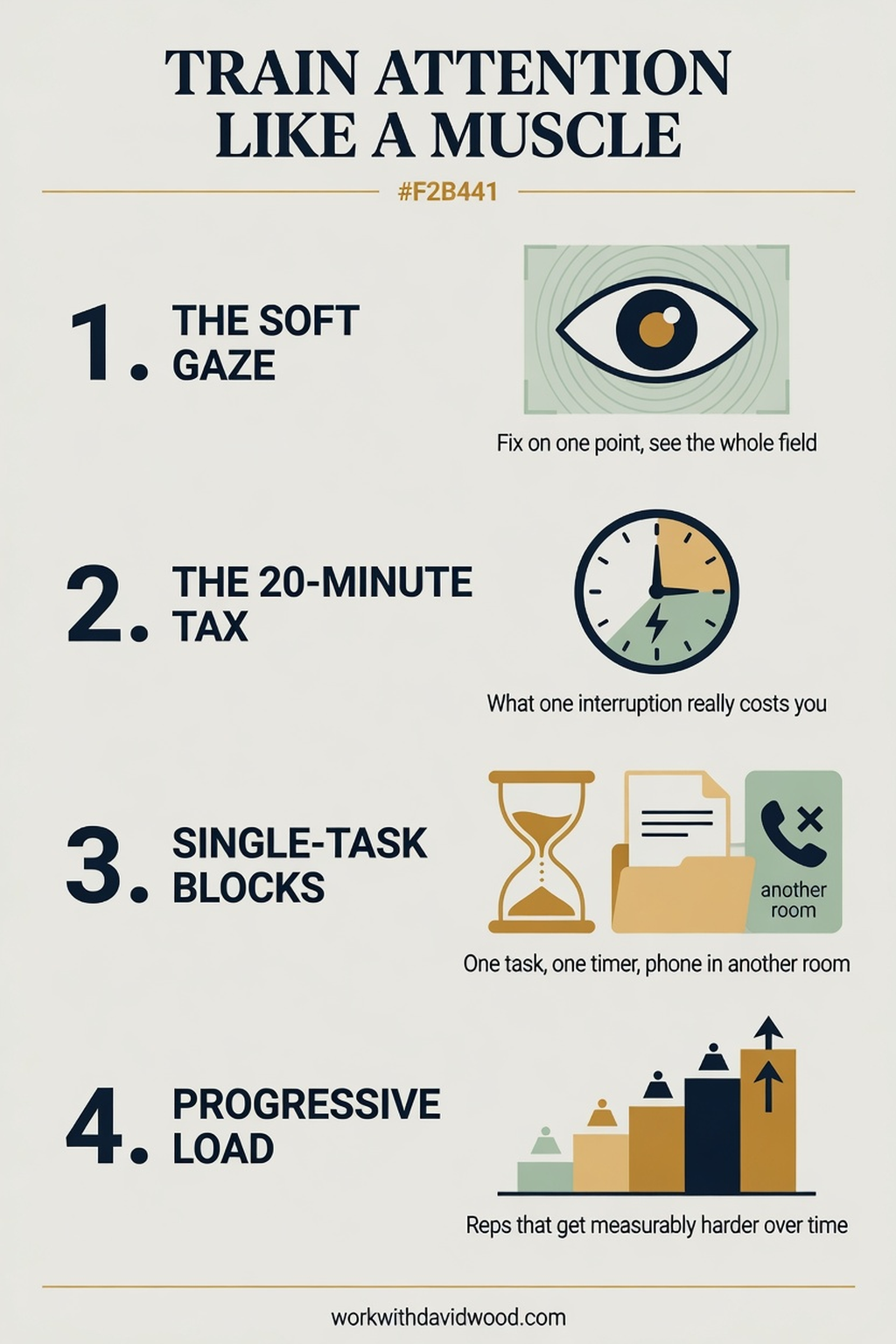
1. Single-task in blocks, on purpose, with a timer. Not “try to focus.” A visible timer, one task, phone in a different room (not face-down on the desk, a different room, the temptation to glance is itself a tax). Start at 25 minutes if you’re out of shape. Build to 90.
2. Train the soft gaze off the desk, not just on it. The Wing Chun principle transfers directly. When you sit down to write, close every tab except the one you’re working in. Your “six inches in front of the chest” is the cursor, not the seventeen browser tabs shouting for a reaction.
3. Notice the twenty-minute tax before you pay it. Before you check the phone “real quick,” ask what it will cost you to come back. Most people never run that math. Once you’ve felt the twenty minutes drain out of a real workday, the phone stops looking free.
4. Load it progressively, like a muscle, with something that actually measures the rep. This is where most people quit early, because willpower-based focus has no scoreboard, so you can’t tell if you’re improving or just white-knuckling through another Tuesday. A structured training protocol solves that by giving you a number that moves.
Most people guess at their own attention span. I’d rather measure it. CortexSurge is a science-based cognitive training app built on relational frame theory, and it opens with a free assessment that gives you an actual Brain Profile, not a vibe. Fifteen minutes tells you more than another year of “I should really focus more.”
See where your focus actually stands →Based on published cognitive-science research. Not a medical product or treatment.
Why attention training has to be structured, not just “less phone”
Digital detox advice treats the phone as the whole problem. It isn’t. The phone is the delivery mechanism. The actual skill you’re missing is the capacity to hold a single relevant thread of thought while your environment offers you a dozen easier ones, and that capacity is trainable the same way strength or reaction time is trainable, through structured, adaptive, progressively harder reps that a to-do list can’t give you.
That’s the honest case for something like CortexSurge instead of just “delete the apps for a week.” It’s built around relational frame training, which is the mechanism behind fluid reasoning and pattern recognition, run across thousands of adaptive levels so the difficulty actually tracks your improvement instead of staying flat. You’re not playing a game that entertains you for twenty minutes and evaporates. You’re loading a specific capacity on a curve, the same way Carlos had us drilling the soft gaze for months before it became automatic under pressure.
I won’t oversell it to you, because the reader who’s earned the right to skepticism here deserves the honest version. Nobody trains their way to a permanently different brain in a weekend. What people who stay consistent report is that something clicks somewhere in the first fifteen to twenty-five hours, and real, felt gains show up over two to three months at four or five sessions a week. That’s a real timeline, not a headline. If you want the shortcut version instead, there isn’t one, and anyone selling you one is selling you the phone-scroll version of self-improvement, which is exactly the problem you’re trying to fix.
What actually changes
Here’s what I’ve watched happen to people who put in the reps, myself included. The twitchy reach for the phone during a hard sentence gets quieter, then mostly goes away. You start finishing the thought before you reach for the escape hatch. Meetings you used to drift through become meetings where you catch the detail nobody else caught, because your attention arrived on time instead of twenty minutes late. And the compounding version of this, the one that actually matters for anyone building something, is that a sharper working attention span is upstream of every other skill you’re trying to build. You can’t close a sale, write a script, or run a team while your mind is checking its phone every ninety seconds. The mind is the tool everything else runs on, and it’s the one asset in your business you can’t outsource or hire around.
The tools I actually use to protect and train that asset are on the recommended products page, and the fuller argument for why the operator’s mind is the whole game, not just a side habit, lives at The Operator’s Mind.
Pull your eyes off the fist. Find your six inches. Start the timer.
You already know your attention is worse than it used to be. Now find out by how much. Take the free CortexSurge assessment and get a real Brain Profile in about fifteen minutes, then decide if you want to train it.
Get my free Brain Profile →Based on published cognitive-science research. Not a medical product or treatment.
See also: the tools and systems I actually recommend, and start here if you’re new.
Three posts a day. One email a day.
Everything I publish, in one short daily email. Real numbers, no hype, unsubscribe in one click.



Look, the UC Irvine numbers are ugly and I believe them. Under a minute on a screen, twenty-plus minutes to get depth back. Fine. The premise still slides from ‘interruption is expensive’ to ‘structured progressive reps fix it’ without proving the second half. Deleting the delivery mechanism is not the whole skill — conceded. Treating focus like a bicep still assumes a life where you can put the phone in another room for ninety minutes. Agency work does not always allow that. Soft gaze on the cursor is a useful image. It is not a full answer to a calendar full of other people’s pings.
Marla, twenty-two years of corporate life gave me the opposite problem of the open-plan myth: endless ‘focus initiatives’ and productivity theatre while Slack stayed on. The post’s arithmetic is the part that survived my cynicism — if each real interruption costs the better part of twenty minutes of depth, you are not working, you are commuting between shallow thoughts. I am eighteen months out of the insurer and still catching myself granting the tax without running the math. Timer, one task, phone in another room is less glamorous than a corporate wellness webinar and more honest. Your point about other people’s pings is fair; the client does not care about your soft gaze. The only lever I have found is protecting the first block before their day reaches me, which is a privilege of leaving the regional role, not a universal fix.
Graham — seventeen tabs, never on camera. Closing everything but the draft is my six-inch spot. The post never required live video.