

Part of the guide: Personal Brand
You know the itch. Block off a weekend, grind for fourteen hours straight, feel like a machine, then vanish for two weeks because your body and your calendar both revolt. That cycle is the opposite of a consistency habit, and it is the reason capable people plateau while less talented ones quietly pull ahead. I want to show you the actual math behind daily reps, the kind you can run on a napkin, because once you see the curve, intensity stops looking like discipline and starts looking like a worse trade.
Let me start with the year I ran an experiment on myself, because the result changed how I train, how I work, and honestly how I think.
In this guide
- The Quarter I Stopped Chasing the Big Push
- The Math Nobody Runs
- Why Intensity Feels Productive, and Usually Isn’t
- The Dip Before the Curve Bends
- Training a Mind the Way You’d Train Anything Else
- The Consistency Habit Protocol, If You Want to Actually Run It
- What Compounds Doesn’t Feel Like Anything, Until It Does
The Quarter I Stopped Chasing the Big Push
For years my default mode was the blitz. Clear the decks, work a project into the ground for three or four days, collapse, repeat in a month when guilt built back up. It felt productive. Sweat, exhaustion, a sore neck from hunching over a laptop until 2am, all the physical evidence of effort. And the results were genuinely fine. Fine is a dangerous word, because fine hides how much better the same hours could have done for you if you’d spent them differently.
So one quarter I ran a different protocol. Twenty minutes a day, every day, on the one skill I most wanted to sharpen, no exceptions for a bad night’s sleep or a bad mood. Twenty minutes is almost insultingly small. It felt like doing nothing, most days. Here’s the thing though. At the end of that quarter I sat down and actually counted the reps against the old blitz method, and the math stopped me cold.
The Math Nobody Runs
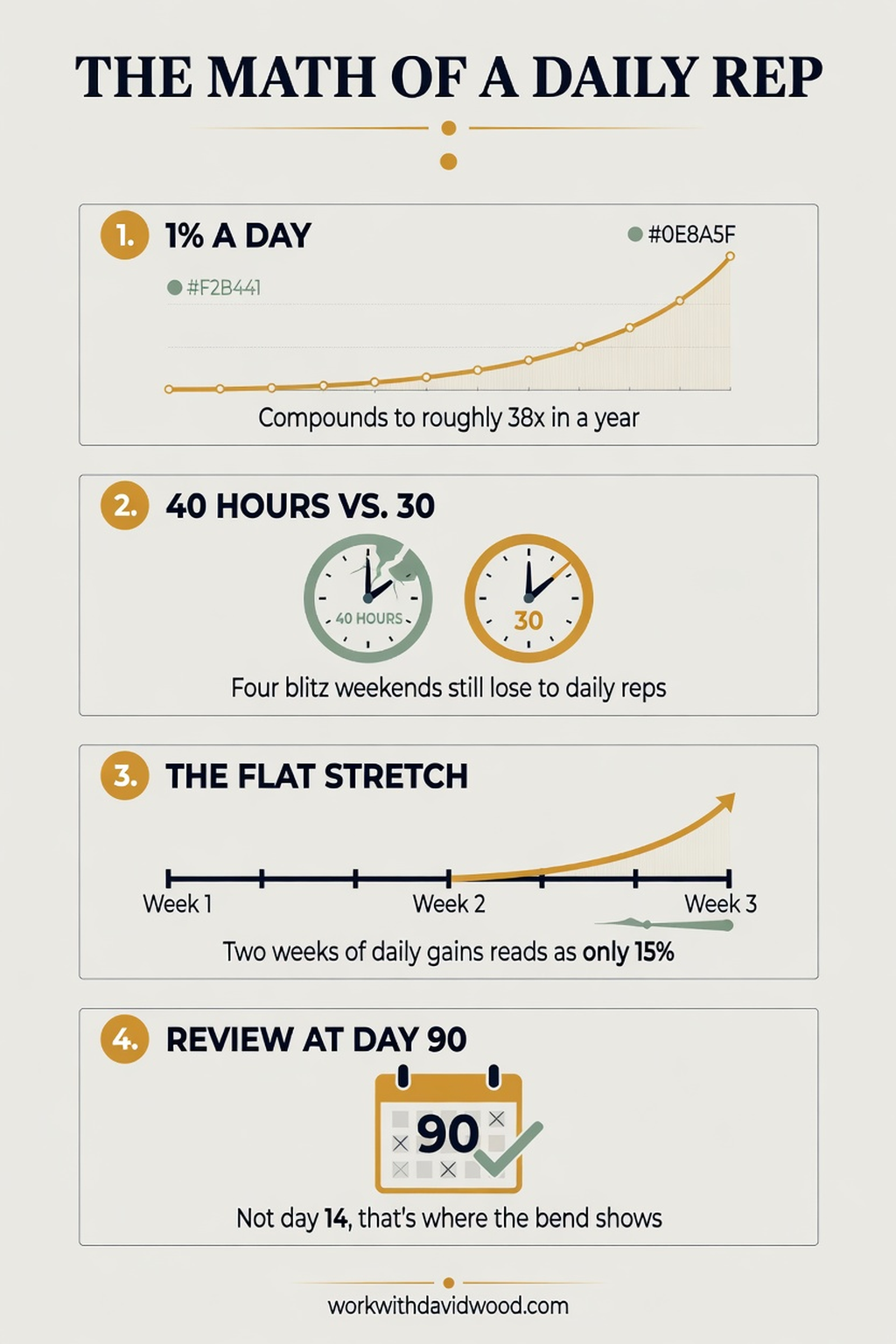
Four blitz weekends a quarter, ten focused hours each, gets you forty hours. Twenty minutes a day for ninety days gets you thirty hours. On raw hours the blitz wins. So why did the daily version outperform it so badly that I never went back?
Because a skill isn’t a bucket you fill. It’s a compounding curve, and compounding punishes gaps. Improve by a fraction of a percent on a task and repeat that improvement daily, and the growth isn’t additive, it’s multiplicative. Run the numbers: get 1% better each day for a year and you don’t end up 365% better, you end up roughly thirty-eight times better, because each day’s gain compounds on top of yesterday’s, not on top of day one. Lose 1% a day instead, the version most blitz-and-crash cycles actually produce once you count the decay between binges, and you don’t end at zero. You end near nothing, about three percent of where you started. That’s not a motivational poster stat. That’s what exponents do to a number smaller than one, repeated over time. The blitz gives you a spike and then, while you recover, a slow bleed back toward baseline. The daily rep never lets the baseline slip, so every session starts from a slightly higher floor than the last.
Read that twice if you need to, because it’s the whole argument, and almost nobody in a hurry lets it land.
Curious what your own curve looks like right now? Take a free cognitive assessment and get a real Brain Profile, so you can measure the compounding instead of guessing at it.
Run your own baseline in 10 minutes →Based on published cognitive-science research. Not a medical product or treatment.
Why Intensity Feels Productive, and Usually Isn’t
I used to believe more effort in a shorter window had to beat less effort spread thin. It’s an intuitive belief. It’s also wrong for anything that depends on your nervous system adapting, and thinking is one of those things. Here’s the internal fight most driven people never resolve. You’ve built your identity on being the person who can outwork anyone in a sprint, and slowing down to twenty minutes a day feels like admitting you’ve gone soft. I felt that exact resistance the first week of my experiment. It’s a strange thing to sit with, wanting to grind harder specifically because the small version is working and doesn’t feel heroic enough to count.
But your brain doesn’t build durable pattern recognition, faster reasoning, or sharper working memory from one exhausting marathon session any more than a muscle builds from one brutal workout followed by three weeks on the couch. Both need frequency more than they need peak load. The research on skill consolidation says the same thing in more careful language: spaced repetition beats massed practice for retention, almost every time it’s been tested, because the gap between sessions is when the actual wiring happens, not just the session itself. You don’t get stronger during the workout. You get stronger during the rest that follows it, provided you show back up before the adaptation fades.
The Dip Before the Curve Bends
Here’s what the compounding chart won’t tell you up front, and what kills most consistency habits before day thirty. The early stretch of a 1.01 curve looks almost flat. Two weeks of daily 1% gains gets you to roughly 1.15, a fifteen percent improvement that’s genuinely hard to feel in daily life. It’s not until you’re deep into the second and third month that the curve visibly bends upward, and by then most people have already quit, decided the small habit “isn’t working,” and gone back to hunting for a bigger, faster push.
That dip is the whole filter. It’s not a flaw in the method, it’s the mechanism doing exactly what compounding does, and it’s the reason the people who stick past week six almost always separate from the people who don’t. If you want the version of yourself who thinks faster under pressure and catches patterns other people miss, that version lives on the far side of a stretch that will feel, for a while, like nothing is happening.
Training a Mind the Way You’d Train Anything Else
This is the part that took me the longest to actually apply to cognitive work specifically, as opposed to sales calls or workouts, because for most of my adult life I assumed intelligence was more or less fixed. You either had a quick mind or you didn’t, and the best you could do was manage around the ceiling. I’ve since had to unlearn that, and the unlearning came from watching daily, structured practice do to reasoning speed what it had already done to every other skill I’d trained this way.
The honest version of the science: this isn’t the claim that a handful of matching games raises your IQ twenty points, and you should be skeptical of anyone who tells you that. What the better research supports is narrower and more useful, that structured, repeated practice on the underlying relational patterns your brain uses to reason, the way it connects “more than,” “opposite of,” “same category as” across new material, genuinely improves fluid reasoning when it’s trained to fluency rather than dabbled with. That’s a very different claim than a brain-game app promising you’ll out-think the room by Friday, and it’s the difference between a protocol and entertainment. If the operator’s mind is the one asset in your business you can’t outsource, and it is, this is the muscle worth the daily twenty minutes.
The Consistency Habit Protocol, If You Want to Actually Run It
Here’s how I’d set it up, stripped down to what matters.
Pick one skill. Not three. One. Trying to compound gains across five habits at once is how people quit all five by week two.
Set a floor, not a ceiling. Twenty minutes, one round, one page, one set. Small enough that skipping it requires an actual excuse, not just a busy day. The floor is what survives your worst week, and your worst week is the one that decides whether the habit lives past month one.
Track the streak, not the outcome, for the first thirty days. You will not feel smarter, faster, or better at your craft in week two. You will only be able to see the number of consecutive days you showed up. Trust that number more than your feelings for the first month, because your feelings are measuring the flat part of the curve.
Review at day ninety, not day fourteen. That’s roughly where the bend becomes visible in most compounding skills, cognitive or otherwise. If you check in every three days looking for proof, you’ll talk yourself out of it before the math has a chance to work.
If you want a structured way to run this specifically for reasoning speed and working memory rather than building your own drills from scratch, that’s what a real daily protocol is for, not a novelty app you open twice and forget. And if you’re building any kind of income on the side that depends on your judgment under pressure, the same principle applies to your business systems, the kind I map out in The Operator’s Mind. Check what’s actually on my recommended tools list before you buy anything marketed as a shortcut. Shortcuts and daily reps are almost always opposites.
What Compounds Doesn’t Feel Like Anything, Until It Does
The strange, almost unfair thing about this whole approach is that it never feels like it’s working while it’s working. There’s no day where you wake up and sense the extra fifteen percent. What you notice instead, months later, is a meeting where you saw the pattern before anyone else spoke, or a decision you made faster and slept fine that night, or a problem that used to take you an hour that now takes twelve minutes, and you can’t point to the exact day it changed because there wasn’t one. That’s what compounding actually feels like from the inside. Not a leap. An accumulation you only notice in the rearview mirror.
If you’re new to any of this, from your income to your thinking, start here and build the floor before you chase the ceiling. And if the one asset you keep meaning to train, the mind that runs every other decision you make, has been sitting on the back burner while you chase bigger swings elsewhere, this is the place to actually start the daily rep instead of postponing it for a better week that never comes.
Twenty minutes a day is the whole ask. Take the free assessment, get your Brain Profile, and let the compounding start doing what your next blitz weekend won’t.
Start your daily rep today →Based on published cognitive-science research. Not a medical product or treatment.
See also: the tools and systems I actually recommend, and start here if you’re new.
Three posts a day. One email a day.
Everything I publish, in one short daily email. Real numbers, no hype, unsubscribe in one click.




Twenty clean minutes a day is a fantasy on nights. The floor idea is right. The blitz weekend was already dead.
Sorry if this is obvious, but when it says get about 1% better each day and end up roughly thirty-eight times better in a year, is that a real measurement people take, or a math illustration? I am six months in and I do not know what I would even measure daily without turning it into another thing I fail at.
Look, the napkin math is tidy. Fine, spaced practice beats massed practice for retention — I will concede the learning-science point. The premise still over-smooths real work. Some skills have deadlines and clients who do not care about your streak. A launch week is massed practice by definition. Treating every blitz as a character flaw ignores the calendar. Consistency wins the long game. Intensity still pays the invoice due Friday.
I ran a version of this last winter on one skill only — outbound message quality, not five habits. Floor was fifteen minutes after school drop-off, timed. Days 1–12 I felt nothing and almost quit. Day 18 I missed two days and the streak broke; restarting was harder than starting. At day ninety I compared: the old blitz Saturdays produced more raw hours in a quarter, but the daily version left me with drafts I could actually send on a Tuesday without a whole weekend to ‘get in the zone.’ Week three was where it nearly fell over, which matches the flat part of the curve in the post. What I cannot claim is a precise percent better. I can claim I stopped vanishing for two weeks after a heroic push.
I think what is being missed here, Marla, is that the post is not banning hard weeks. It is arguing that the default identity of ‘I am the person who outworks everyone in a sprint’ becomes a trap when the skill needs a nervous system that adapts between sessions. The forty hours of blitz versus thirty hours of daily reps is the comparison that stayed with me: raw hours favor the blitz, compounding favors the floor. Nia is also right that twenty minutes is not free if you work nights — then the floor has to be smaller, not abandoned. One skill, a floor that survives the worst week, review at day ninety not day fourteen. That is the claim worth defending, not a fantasy of endless gentle progress with no peaks.
Ade is defending the right core: this is spaced repetition and skill consolidation, not a morality tale about hustle. Ebbinghaus through modern spacing literature is fairly robust for retention; the viral ‘1% better every day → 37×’ framing is popular arithmetic, not a measured cognitive protocol. Where the research is weaker is transferring lab-style daily gains into messy professional judgment under deadline pressure — exactly Marla’s launch-week objection. The post is stronger when it sticks to frequency versus decay between binges, and softer when it implies the exponent maps cleanly onto real work output.