How To Create An Empathy Map To Boost Conversions

If you could take the necessary steps to better connect with your audience; you’d drastically improve conversions. Making sales is all about knowing your audience. Understanding what they’re going through. Their emotions, thoughts, and feelings.
One of the most useful exercises for gaining a better understanding of your audience is creating an empathy map. An empathy map is essentially a map of someone’s point of view. Your ideal buyer’s point of view or your target audience’s point of view.
It’s what your target buyers see, think, feel, and hear. It’s about creating a map and avatar of their perspective allowing you to better understand them. That’s all it is, an exercise to help your understand your audience, their emotions, thoughts, and beliefs.
Ideally you should create an empathy map in a group. You need as many opinions as possible so your empathy maps don’t end up skewed by your own personal beliefs.
Why Create An Empathy Map?
Empathy maps are simply another exercise you can utilize to gain a better understanding of your audience. They allow you to combine all of your observations you’ve made to characterize your ideal buyers. With the end goal of being able to target (in your marketing) the exact people you want as your customers who are most likely to buy.
Creating an empathy map is an exercise much like creating an Avatar, which I wrote about here. Empathy maps allow you to create more accurate avatars. The goal is to gain a deeper understanding of your customers and audience; within a given circumstance.
A circumstance like before making a purchase. During this exercise, you should be able to map out the exact feelings, thoughts, emotions, and actions of your audience. Empathy maps really help you fill in the banks of the knowledge you’re missing about your audience.
You can create your map however you like. Ideally laid out like this:
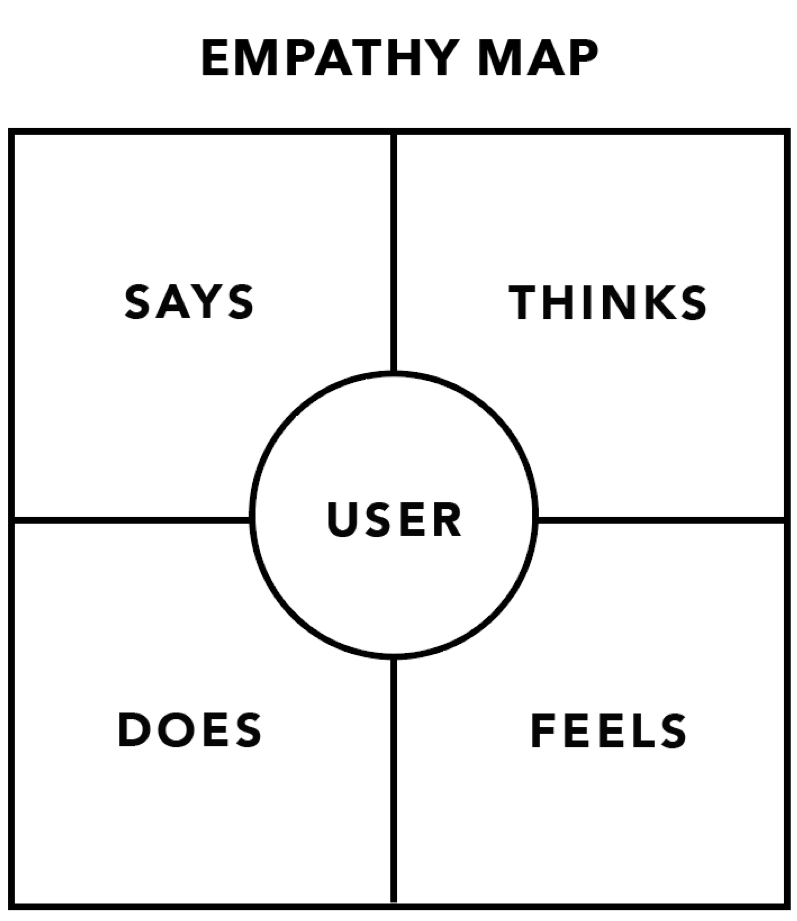
You can stick a picture of your “ideal customer” on a piece of paper and start filling out the following criteria:
- Gains
- Pains
- Say And Do
- See
- Hear
- Think And Feel
Write the 5 things above on your “Empathy Map” and start filling it out. The idea is to write down what your “ideal customer or audience” has to gain, what they are saying and doing, seeing, hearing, thinking & feeling.
Now ask yourself the following questions:
- What do your audience have to gain? (by purchasing your product/service)
- What are their pains? What do they have to lose?
- What are your audience saying and doing?
- What are they seeing?
- What are they hearing?
- What are they thinking and feeling?
All of these questions you need to answer to the best of your abilities i.e. from your own point of view. Next start doing some research. You need to learn about your audience in order to answer these questions properly. You can’t make assumptions or the exercise becomes somewhat useless.
To dig deep and learn about your audience use the following tools:
- Forums – http://www.forumssearch.com/
- Blogs
- Quantcast.com (Analyze the sites you know where your audience hang out)
The best way to convert visitors into customers is to speak directly to the hardwiring of their body i.e. their emotions.
To take it a step further you can speak to their physical senses. Their sight, hearing, bodies, mind and even taste. To sky-rocket conversions, speak to all the senses in your ad copy. But before you can do that; you must gain a deeper understanding of your audience by creating avatars and empathy maps.
Your marketing and ad copy should speak directly to the pain and pleasure of your audience’s physical and emotional hard wiring. Marketing that speaks directly to their physical and natural feelings will allow them to move the fastest i.e. buy quickly.
Now answer those questions on your empathy map in their respective columns. To take it a step further, you can repeat the process asking the same questions AFTER they’ve purchased your product/service.
What will your customers see once they buy your product? (Immediate fat loss/Money In their bank accounts/A better self)
What will your customers hear once they buy your product? (The happy sound of their spouse’s voice when they tell them they’ve made that money/Their friends saying how great they look now they’ve lost that weight/etc)
What will your customers taste? (This one isn’t the easiest to use, but an example: the amazing taste of lobster now that they can afford to eat at their favorite sea food restaurant/the taste of salty air after arriving at their dream vacation destination)
What will your customers physically feel and do? (Feel vibrant, healthy and attractive now that they’ve lost weight/Feel the confidence to go anywhere/Feel financially independent/Feel love)
What will your customers smell? (Again this one isn’t easy to use, but it’s powerful nonetheless, for example: the gorgeous smell of the ocean air as they walk across the beach of the holiday resort they can now afford)
What will your customers emotionally feel? (This one is huge and doesn’t need any examples)
By answering all of the above questions after careful research, you will gain an incredible insight into the lives, feelings, thoughts and minds of your target audience as well as your customers. Once you have that info, you can work it into your ad copy and boost conversions astronomically.
In Prosperity,
David Wood
P.S. Leave me your thoughts, comments and questions below.
Comments
Sarah Thompson, July 30 2024, 21:20
Thank you for sharing this comprehensive guide, David. The strategies are practical and easy to follow. I’ve been struggling to create effective empathy maps, and your detailed breakdown provides a clear roadmap. I especially appreciate the sections on understanding the audience’s emotions and thoughts. Keep up the great work!
Michael Lee, July 30 2024, 21:25
Great tips, David! I appreciate the detailed breakdown of each strategy. It’s refreshing to see actionable steps that can be implemented immediately. The part about mapping out the audience’s perspective is particularly interesting; I hadn’t considered that method before. I’m looking forward to trying these strategies out and seeing how they impact my marketing efforts. Thanks for the valuable insights!
Emily Richards, July 30 2024, 21:30
Could you provide more examples of successful empathy maps you’ve created? Your insights are always so practical, and seeing specific examples would be incredibly helpful. I’ve tried a few of these strategies before with mixed results, so I’m curious about what has worked best for you. Thanks for another great post!
John Peterson, July 30 2024, 21:35
This post is very informative, David. However, I’d like to hear more about the potential challenges and how to overcome them. For example, what are some common pitfalls with creating empathy maps, and how can they be avoided? Also, how do you ensure the accuracy of the maps you create? Your advice would be greatly appreciated.
Daniel Kim, July 30 2024, 21:40
Hey David, great insights as always. Let’s catch up soon and discuss these strategies over coffee. I find the idea of creating empathy maps particularly intriguing. It seems like a smart way to better understand the audience and boost conversions. Looking forward to hearing more about your experiences with this approach. Cheers!
Laura Martinez, July 30 2024, 21:45
I’ve had success with some of these strategies in the past, especially using empathy maps to guide my marketing campaigns. Your tips are spot on and very helpful. One thing I’ve found effective is focusing on the audience’s emotional triggers. Thanks for sharing these insights; I’m excited to implement more of them!
Mark Johnson, July 30 2024, 21:50
I recently started implementing some of these strategies, and I’ve already seen positive results. The method of creating detailed empathy maps has been particularly effective for me, helping to refine my marketing messages and attract the right audience. Your advice on understanding the audience’s perspective was very helpful. Thank you for the valuable insights, David!
Rebecca Lee, July 30 2024, 21:55
I’m still skeptical about the effectiveness of some of these strategies, especially the use of empathy maps. Do you have any case studies or concrete evidence to back up these claims? It would be helpful to see some real-world examples of these methods in action. Your posts are always thought-provoking, and I appreciate the effort you put into them.