How To Break Free From The Chains Of False Beliefs & Transform Your Identity
Every time. Every time I come across someone who’s been struggling for years, it’s the same thing. It’s not their Facebook strategy, it’s not their link building. The reality is these reasons are rarely the issue with people who struggle for a long time. The real reason has NOTHING to do with traffic generation or any marketing strategy, their problem is that their beliefs are all messed up.
Now as you pay close attention to this post and easily read every word from top to bottom; you may realize something interesting about yourself. You may experience an internal shift – that ultimately leads you to make a new decision.
People struggle because of the ‘hidden force’ behind their daily actions. The hidden force that rules your mind, that dictates your behaviour and tells you what and how to think.
This ‘hidden force’ comes down to a single word; beliefs. How many people do you know that work extremely hard, they create ‘vision boards’, they set goals, and yet they still struggle. Almost all of the time, it’s because of FALSE BELIEFS.
Mental blockages. The thing about limiting beliefs is that you can rarely see them. Beliefs are like operating systems. They control what you can and can’t do; regardless or whether or not you can physically “do” them.
If someone is told they’re stupid their whole life, it becomes a part of their self-image and belief system. The person with that belief will hold it with them their entire life, and subconsciously move away from anything that requires what they perceive as too much intelligence.
Now the interesting thing about beliefs is that they can be changed. Through daily conscious effort, you can alter your deep-rooted subconscious beliefs. The kind of beliefs that are screwing with your life, preventing you from living your dreams.
I’m not going to break down exactly how these beliefs effect your daily actions (roughly 80%), that’s what I did with this post.
The problem with false beliefs is we usually create them as children, and we start ‘operating’ on them throughout our life re-inforcing them again and again – until eventually they become a part of us – and we unconsciously operate as if they’re real limitations or boundaries.
If you believe you’re limited to a particular way of living, then you are. Ask any elephant. Elephants have been known to die in fires because they think they’re trapped by the 2 inch band of steel loosely wrapped around their leg. The 2 inch band of steel is attached to a chain that’s maybe 6 feet long.
Now the chain is attached to a stake that’s been driven into the ground. It’s clear that any grown elephant could quickly and easily pull out the stake and escape; but they don’t. The elephant was first chained to the stake when it was a baby and wasn’t strong enough to move it. It tried again and again to yank the stake free; but soon accepted it as a life-long limitation.
By the time the elephant is strong enough to free himself, he’s stopped trying and is now confined to live a life within a 6-foot radius.
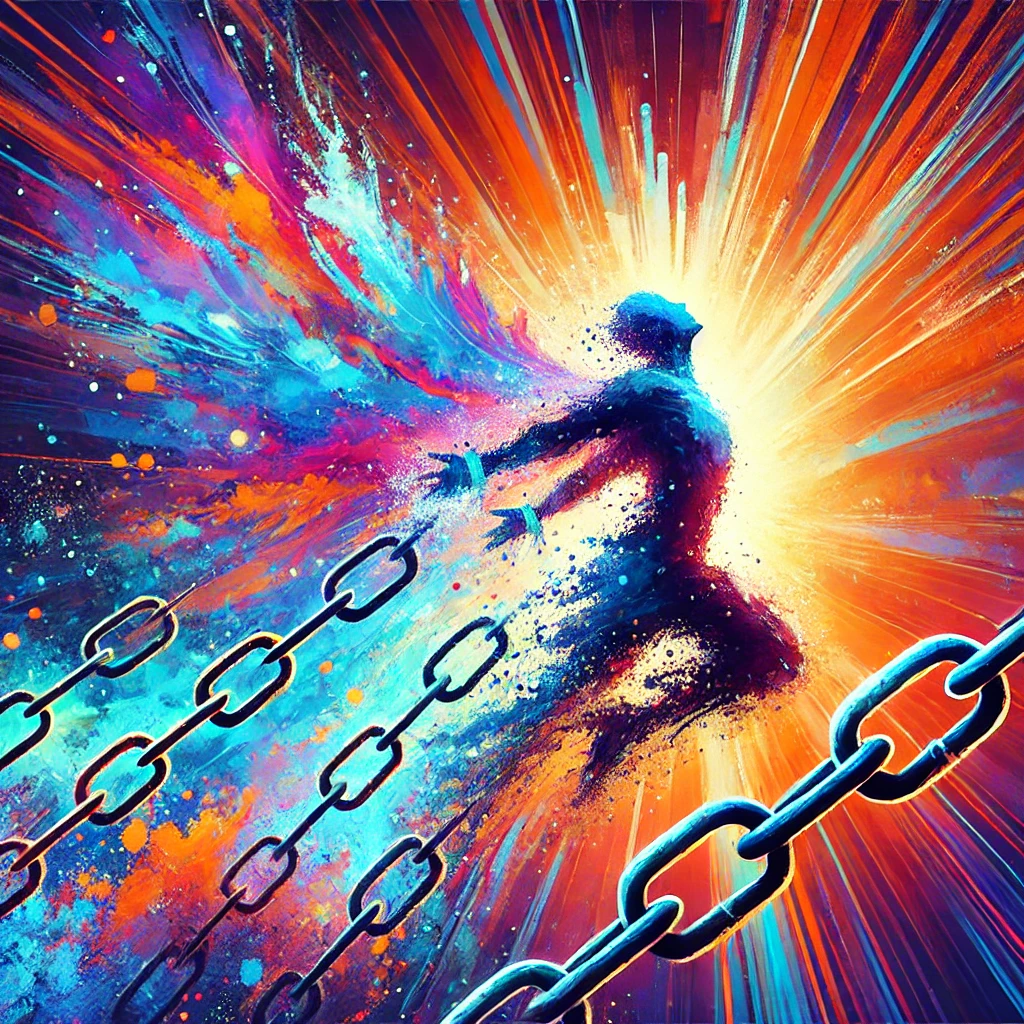
Human beings aren’t so different. Many of us live our entire lives within these ‘false chains’, even though they’re completely non-existent or we could break out of them in an instant.
Unlike elephants, however; we have a more rational mind. Beliefs are often the false chains in our lives. Now every one of us has ideas about ourselves that we believe are true. Whether they are or not it doesn’t matter; because the subconscious mind agrees with everything the conscious tells it.
After hearing a message so many times and agreeing with it, the subconscious operates on the basis that the message is absolutely true. Based on the fact that most of our daily actions are unconscious, if we have ‘bugs’ in our mind like false beliefs; you can see how it can really screw with our success.
When I talk to people who clearly have belief and identity issues, they generally don’t realize it. They think they’re stupid or can’t make money or whatever the false belief is, without realizing it. Simply because after hearing something for so long, you stop recognizing it, you stop being aware of the false information.
So we’re completely unaware of the false chain, and all we’re seeing is the negative result. Scratching our heads wondering where we went wrong.
A boy is called ‘selfish’ as a child whenever he’s asked for something. His mom says ‘who do you think you are, we’re not made of money’. As a result, in his adult life he settles for a marginal, limited life; subconsciously believing he doesn’t deserve wealth or abundance.
A young girl grows up in a family of 3 older brothers. Her parents are constantly admiring the brothers, telling them how clever they are. She never receives the admiration or attention she wants and starts to believe she’s stupid. Maybe her parents tell her ‘she’s not the brightest tool in the box’ or ‘we don’t need another intelligent person in the family, you’ve got the looks’. She grows up subconsciously moving away from anything mentally challenging, resulting in a mediocre life & career.
These false chains are everywhere, almost everyone has them. Now if you’re going to make stuff up, you may as well make stuff up that’s useful. It doesn’t really matter what you subconsciously believe to be true, as long as its helpful for creating the kind of life you want.
Most of our beliefs originate from childhood when we’re incapable of seeing any grey areas or rationally thinking; much like the elephant. The problem is we don’t realize the beliefs are created and we fail to challenge them.
Most of the time people have identity issues, false beliefs about themselves. You can have identity issues or false beliefs about external things like money or relationships. Your own personal beliefs start being formed by the reflections you receive from your parents. These reflections form the basis of your own self-worth and image. Later more reflections are held up from friends and teachers, co-workers and spouses.
The false beliefs we have about external things form from things we hear. Things we read, watch and hear from the people we associate with. They’re formed over time from the input we receive through the 5 senses. Now these beliefs… We accept and operate on them, they create our internal software – the operating system. People who aren’t getting the results they want generally have bugs in their software. Now the reality is, when we actually challenge these false beliefs, they never really ‘hold up’ or make any sense at all.
Getting rid of them is a process of de-hypnotizing yourself. I’ve broken it down into a 3-step process:
- Identify The Root Of The Belief
- Challenge It
- Replace It With New, Positive Data
Constantly challenging and replacing the data. Identifying beliefs can be difficult, which is why most clients who end up in therapy have no idea what’s causing their problem. Whether its problems in their relationships, certain actions they execute or physical issues like panic attacks.
1. To identify false chains, ask yourself these questions:
- Do you ever feel anxious or fearful in situations that pose no real physical threat?
- When pursuing a goal, do you have thoughts like ‘I can’t do this’ or ‘I don’t deserve this’ come up?
- Do you ever have feelings of hopelessness or procrastination when moving towards a goal?
Ask those questions, and think about them very closely. You’ll come up with several answers. Figure out why you have these feelings and thoughts. Think about the earliest events and memories that could have caused the beliefs that lead to these results to be formed. Now identify the exact belief that’s causing the issue.
2. Challenge the belief.
Ask yourself if there’s any rational reason for believing such a thing? Is it possible that the belief isn’t 100% correct? Why should you continue to act in accordance with that belief?
3. Replace it.
Replacing the beliefs is simple, but not easy. Just because it takes consistent effort for several weeks or longer. You need to cancel and replace the negative thoughts caused by the belief. Consider these things:
- What negative thoughts will you cancel?
- What will you replace these thoughts with?
The biggest obstacle is always self-doubt. If you hear yourself thinking or saying things like ‘this is never going to work’ – visualize the ‘horse and rider’ analogy I talked about in this post. Your logical left brain operating on the old belief system is going to tell you things like ‘it’s not going to work’, but this is just the subconscious mind at work – operating on the old system. Attempting to ride you down the old path. Use your conscious mind as the ‘rider’ to tug on reigns of your horse, steering it into the new, more empowering direction. It’s not easy, but it’s definitely simple.
Love ya,
David Wood
P.S. Leave me your thoughts and comments below.
Comments
Alice Turner, July 21 2024, 10:15
This article is amazing! It really helped me understand how my beliefs are holding me back. Thank you for sharing this valuable information. I have been struggling with self-doubt for years, and your insights have given me a new perspective. I feel more empowered now to tackle my limiting beliefs and transform my identity. Your writing style is engaging and easy to follow, which made it a pleasure to read. Please continue sharing such helpful content. It’s making a big difference in people’s lives.
Robert Hayes, July 21 2024, 11:45
I learned a lot from this post. The idea of changing beliefs to change identity is powerful and something I had never considered before. The way you explained the process was clear and concise, making it easy to understand. I especially appreciated the practical tips you provided on how to start identifying and altering limiting beliefs. This has given me a roadmap to follow in my own journey of personal development. Thank you for sharing your knowledge and experience. I look forward to applying these principles in my life.
Emily Nguyen, July 21 2024, 13:00
Could you explain more about the methods you used to change your beliefs? I’m particularly interested in understanding the specific techniques that helped you the most. For example, how did you identify which beliefs were holding you back? Did you use any specific tools or exercises to facilitate this process? Additionally, I’m curious about how long it took for you to start noticing significant changes in your identity and behavior. Any further details or examples you could provide would be incredibly helpful for those of us who are new to this concept and looking to implement these changes in our own lives.
Emily Nguyen, July 21 2024, 13:00
Could you explain more about the methods you used to change your beliefs? I’m particularly interested in understanding the specific techniques that helped you the most. For example, how did you identify which beliefs were holding you back? Did you use any specific tools or exercises to facilitate this process? Additionally, I’m curious about how long it took for you to start noticing significant changes in your identity and behavior. Any further details or examples you could provide would be incredibly helpful for those of us who are new to this concept and looking to implement these changes in our own lives.
Michael Brown, July 21 2024, 15:20
While I found some points helpful, I think the post could have included more practical examples. The concepts you discussed are important, but real-life scenarios would have made them easier to relate to and apply. For instance, sharing a personal story or a case study could illustrate how changing one’s beliefs can lead to a transformation in identity. Also, some sections felt a bit repetitive. Streamlining the content could enhance the reading experience. Overall, it’s a good post with valuable insights, but there’s room for improvement in making it more practical and concise.
Linda White, July 21 2024, 16:35
Hi, it’s been a while! I just read your latest post and it was fantastic. I hope you’ve been doing well. Your insights on breaking free from false beliefs really resonated with me. I’ve been working on some similar issues myself and found your advice very helpful. Let’s catch up soon. How about a coffee next week? It would be great to see you and discuss these ideas in person. Looking forward to hearing from you. Keep up the great work with your blog – it’s truly inspiring!
Chris Green, July 21 2024, 17:50
This reminds me of a time when I had to overcome similar beliefs. It wasn’t easy, but it was worth it. A few years ago, I realized that my fear of failure was holding me back in my career. I decided to confront this belief head-on by setting small, achievable goals and gradually pushing my limits. Over time, I noticed a significant change in my confidence and willingness to take risks. Your post brought back those memories and reinforced the importance of continuously challenging our beliefs. Thank you for sharing your experiences and inspiring others to do the same.
Sarah Blue, July 21 2024, 19:05
Have you tried using [Tool Name]? It offers great resources for belief transformation. I’ve been using it for a few months now and have found it incredibly helpful. The guided exercises and daily prompts are designed to help you identify and change limiting beliefs. It’s been a game-changer for me in terms of personal development. I highly recommend it to anyone looking to make a significant change in their mindset. Your post aligns perfectly with the principles they teach, and I think you and your readers would find it valuable. Check it out at [Tool Website].
David Red, July 21 2024, 20:30
I find it hard to believe these results are typical. Do you have any evidence to support this? While I appreciate the insights shared in the post, I am skeptical about the extent of the transformation you described. It would be helpful to see some data or case studies that back up these claims. Have you conducted any research or gathered testimonials from others who have successfully implemented these strategies? Providing concrete examples or evidence would strengthen the credibility of your post and help convince readers of the effectiveness of these methods.