

Part of the guide: Network Marketing Lead Generation
Robert Allen built one real stream of income before he ever wrote a word about multiple streams of income. Say that phrase to someone who hasn’t earned a full living from any single source, and watch what happens next. They open four things in the same month, give each one twenty minutes a day, and nine months later they have four trickles instead of one river. Multiple streams of income is real advice for a real stage of building. It is close to the worst advice you can hand someone who hasn’t reached that stage yet, and almost nobody tells them the difference before they’ve burned a year finding out the hard way.
I’ve watched this pattern up close for over twenty years, on both sides. I’ve been the guy chasing three things badly. I’ve also watched exactly what happens when one company you built your entire income around makes a decision in a boardroom you never sit in, and your “one stream” disappears in an afternoon. Both mistakes are real. Most of the advice online only warns you about one of them.
In this guide
- Multiple Streams of Income: The Advice Nobody Finishes Reading
- What Stream-Hopping Actually Costs You
- The Threshold: When a Stream Is Actually Earned
- Why You Still Need a Second One, Eventually
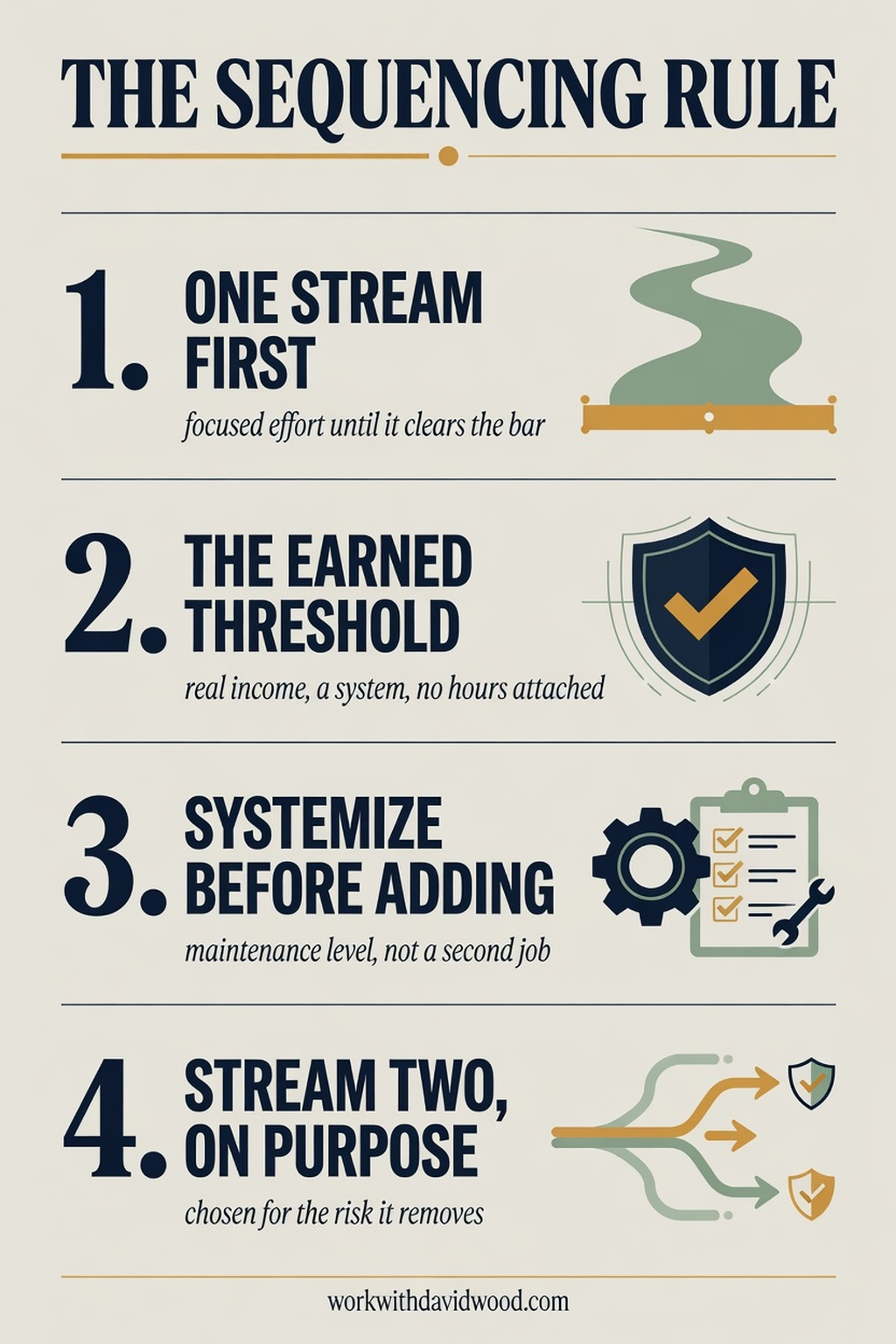
- The Sequencing Rule
- Choosing Stream Two Without Repeating the Mistake
- One Stream, Earned, Beats Four That Never Cross the Line
Multiple Streams of Income: The Advice Nobody Finishes Reading
Allen’s original thesis, back in the 1990s, was never “start five things at once.” It was that wealthy people typically have several income sources, so build toward that instead of depending on one paycheck forever. Fair point. The problem is what happens when that idea reaches someone with zero working streams and a credit card. They hear “multiple streams” and skip the part where every stream in Allen’s own case studies started as one thing, built with focused effort, until it produced real, repeatable income before a second stream got any attention at all.
Strip the nuance out of that idea and hand it to a beginner, and you get a person running a dropship store, an affiliate blog, a network marketing team, and a crypto trading bot, each one getting whatever’s left of their evenings after the day job. None of them reach the volume where compounding starts. None of them get systemized. All four stay stuck at the exact same stage a year later, because a stream needs a threshold of focused hours to cross before it produces anything close to leverage, and splitting your attention four ways means none of them ever cross it.
What Stream-Hopping Actually Costs You
A friend of mine, I’ll call her the way I did back then, “Mrs. New Deal,” called me at 5am once with news of a fresh opportunity. We’d spent close to two years building together, recruited nearly a thousand people between us in one company. She wanted me in on the next thing. I said no, and I’ve said no to versions of that call more times than I can count since. It isn’t loyalty for its own sake. It’s math.
Mark Yarnell, who wrote the book most serious people in this industry still cite, found that over 95 percent of distributors who stay with one company for ten years or more reach six figures. Not because the tenth company is worse than the first. Because the compounding that actually pays doesn’t start at month three, or even month eighteen. It starts once your name, your content, and your systems have had years to accumulate in one place instead of resetting to zero every time something shinier shows up. Every company hop, every “next best thing,” sets that clock back to the beginning. Do it four times and you’ve spent a decade with the compounding of six months.
That’s the part the “diversify now” crowd conveniently skips. Diversification isn’t free. It costs you the compounding you’d have gotten from staying put, and you only want to pay that cost once you’ve actually collected the first payoff.
The Threshold: When a Stream Is Actually Earned
So what counts as earning a stream, if it isn’t just “I made some money from it once”? Here’s the bar I use, and it has three parts.
First, it has produced real income for a stretch long enough to rule out luck, meaning a good quarter, not a good week. Second, some real piece of it runs without your hours directly attached, a system, a piece of content still working, a team member closing without you, a contract paying out without a phone call. Third, you could describe exactly why it works to a stranger in under two minutes, which means you understand the mechanism instead of just riding a result you can’t repeat.
Size alone doesn’t clear that bar, and I’ve seen this proven the hard way by people I respect. A friend named Aaron Rashkin, who later became a million-dollar earner at Empower Network, once had 5,000 active people on his team in one of the largest juice companies in the world. Five thousand active people. He was making $4,000 a month from all of it. The team was massive. The stream wasn’t earned, because the model underneath it paid almost nothing for the volume it required. Big is not the same as earned. A stream earns its name when it pays you disproportionately to your remaining hours in it, not when the org chart looks impressive.
This is the same idea I lay out at length in The Leverage Doctrine: the income that survives you stepping back was never built on hours in the first place. Until a stream clears that bar, it isn’t a second stream candidate. It’s still stream one, unfinished.
Why You Still Need a Second One, Eventually
Now the other side of it, because staying loyal to one thing forever carries its own risk, and I learned this one the expensive way.
I built an entire online business around a single company called iLearningGlobal. Traffic, content, an email list, all of it pointed at one MLM wing of one company. Then corporate made a decision in a room I wasn’t in, shut that wing down, and the business built around it was gone in an afternoon. Not because I did anything wrong. Because I never had a second stream to absorb the hit, and a decision I had zero control over erased years of work overnight.
That’s the real argument for eventually diversifying, and it has nothing to do with impatience. It’s about platform risk. Any income that depends entirely on one company’s continued goodwill, one platform’s algorithm, one comp plan staying the way it was when you signed up, carries a single point of failure. The mistake isn’t wanting a second stream. The mistake is building it before the first one is real, which spreads you thin at exactly the stage when focus is the only thing that works, and then never building it at all, which leaves you one boardroom decision away from starting over.
The resolution isn’t “pick one.” It’s sequencing. Build one stream to earned status first. Then add a second, funded by the first one’s freed capacity instead of squeezed out of your sleep.
Once your first stream is real, the second one should cost you less, not more. The system I run pays 100% of every commission on a public smart contract, settled the same block as the sale, about twelve seconds, with nothing that requires my hours once it’s built. Drop your name and I’ll show you exactly how it’s structured.
Show me a stream built to run without me →Most participants earn little to nothing. No income is guaranteed. You can verify every payout on the public smart contract.
The Sequencing Rule
Here’s the version of this I actually use, and it’s three steps, in order, no skipping ahead.
Step one: pick one stream and give it everything until it clears the earned threshold. Not “everything” forever, everything until it produces real income for a full quarter and some piece of it runs without your direct hours. For most people that’s twelve to twenty-four months of real focus, not a weekend.
Step two: systemize it down to a maintenance level before you touch anything else. Document the process. Hand off or automate the pieces that were only ever busywork. If stream one still needs forty hours a week to survive, you don’t have a system, you have a job with better branding, and adding a second job on top of it is how the four-trickles problem starts.
Step three: choose stream two on purpose, for a different risk profile than stream one, not just because it’s available. If your first stream depends on one company’s internal decisions the way mine did with iLearningGlobal, the second stream should not carry the same exposure. That’s the actual point of diversifying, reducing the specific risk that already burned you, not just adding noise to your calendar.
Choosing Stream Two Without Repeating the Mistake
The instinct once you’ve earned one real stream is to reach for whatever’s trending. Resist that. The question worth asking isn’t “what’s making money right now.” It’s “what structurally can’t be taken from me the way the last thing was.”
That’s why I pay attention to how a system actually settles money, not just what it promises to pay. A comp plan you have to trust on faith carries the exact same fragility as the corporate decision that ended my iLearningGlobal income, someone else controls the rules, and they can change without asking you. A payout you can verify yourself, on a public ledger, before you commit a single hour, removes that specific risk instead of just relocating it to a new company with a newer logo.
Before you add anything, get honest about which stage you’re actually in. If you don’t yet have one stream clearing real, repeatable income, stop reading second-stream advice and go finish the first one. If you’ve already cleared that bar and you’re weighing what to add, the tools and systems worth putting behind a second stream matter more than the excitement of a new opportunity. And if none of this framework has landed yet because you’re earlier in the process than either stage, start here first. The sequencing only makes sense once you’ve seen the whole map.
One Stream, Earned, Beats Four That Never Cross the Line
Multiple streams of income is correct advice for someone who already has one stream doing real, repeatable work without consuming every hour they’ve got. It is a trap for someone who doesn’t, because it gives permission to avoid the hard, boring, unglamorous work of finishing one thing by calling the avoidance “diversification.” Four unfinished streams aren’t safer than one earned stream. They’re just four ways of staying busy while nothing compounds.
Pick the one thing you’ll actually finish. Build it until it clears the bar, real income for a real stretch, some piece of it running without you, a mechanism you could explain to a stranger in two minutes. Then, and only then, go find the second one, and pick it for the risk it removes instead of the excitement it promises.
When you’re ready for a second stream, build it on something you don’t have to take on faith. I’ll show you the exact on-chain system I use, where every commission is public and verifiable before you ever trust me with your time. Enter your name and I’ll send you the walkthrough.
Show me the system built for stream two →Most participants earn little to nothing. No income is guaranteed. You can verify every payout on the public smart contract.
See also: the tools and systems I actually recommend, and start here if you’re new.
Three posts a day. One email a day.
Everything I publish, in one short daily email. Real numbers, no hype, unsubscribe in one click.




The three-part earned threshold is what I will keep. Real stretch of results, some piece that runs without your direct hours, and a mechanism you can explain to a stranger in two minutes. In Turkey I have watched friends open a dropship store, an affiliate blog and a side distribution line in the same month, each getting the leftovers of the evening. A year later none of them had crossed the line where leverage starts. What I still wonder is whether twelve to twenty-four months of focus is realistic when the day job already takes most of the week, or whether the calendar has to look different outside the US market.