
Part of the guide: Network Marketing Lead Generation
Pull up your calendar from last week and look at it without flinching. Every call, every inbox sprint, every hour you burned at 9pm answering messages you could have ignored until Monday. That’s the raw material for a time leverage audit, and the first honest one usually delivers the same gut-punch: half the week paid you nothing you can point to, and you can’t say which half until you score it. Here’s the one-page version I use, built for someone who’s good at the work and done pretending “busy” is the same thing as “paid.”
I first felt the gap between busy and paid at four in the morning, half-delirious, talking to a friend named David Schwind. We were both still working. He looked at me and said something I’ve repeated in my head for years: “We’re kind of a contradiction. We work fifteen hours a day, scheming of evil ways to make money without working.” That week I’d averaged seven thousand dollars a day. The hours weren’t the variable. What the hours were connected to was the variable.
That’s the whole idea behind a leverage score, stated plainly. It takes roughly the same energy to earn five dollars an hour as it does to earn five thousand dollars a day. Effort isn’t the scarce resource. What the effort is attached to is the scarce resource. An hour spent on a thing that pays once, for you, alone, is worth less than an hour spent building a thing that pays again without you in the room. Most professionals never separate the two, because both hours feel identical from inside a Tuesday.
In this guide
Why “Busy” Lies to You
You’ve done well. You’re clearing six figures, maybe well past it, and you got there the way capable people always do: by outworking the problem. That’s exactly the habit that now caps you. Your income can’t outgrow your calendar, because you never built a version of your effort that survives without your hours attached to it. The fear underneath this, if you’re honest, isn’t laziness. It’s the opposite. You suspect that if you slowed down, the whole thing would stop, and that suspicion keeps you doing more of the activity that got you here instead of a different kind of activity that could get you somewhere else.
I learned this the ugly way in 2007. I’d built my first real team the old-fashioned way, home parties and three-way calls, and someone sold me on a “duplication secret” that turned my phone into a leash. I went from a normal week to roughly 150 calls a day, 8:30am to 11:30pm, chasing five thousand dollars a month. A friend named Tom, who was living out of a refrigerator box in the back of a store at the time, quit mid-sentence on a three-way call about his “Aunt Mary” and told me, “No amount of money is worth what you just did. I’d rather work at Safeway.” I haven’t carried a cell phone the same way since. The best four-week stretch I’ve ever had, by contrast, brought in $257,000 with zero calls and zero meetings, because by then the hours were attached to a system instead of to me.
The One-Page Time Leverage Audit
Here’s the audit itself. It takes about twenty minutes, and all you need is last week’s calendar and a scrap of paper.
Step one: log every hour
List every working hour from the last seven days in one column. Don’t estimate. Pull the actual calendar, the actual call log, the actual browser history if you have to. Round to the half hour. If you truly can’t reconstruct last week, track this week in real time instead. Either way, write down all of it, including the hour you’d rather not admit to.
Step two: sort each hour into a level
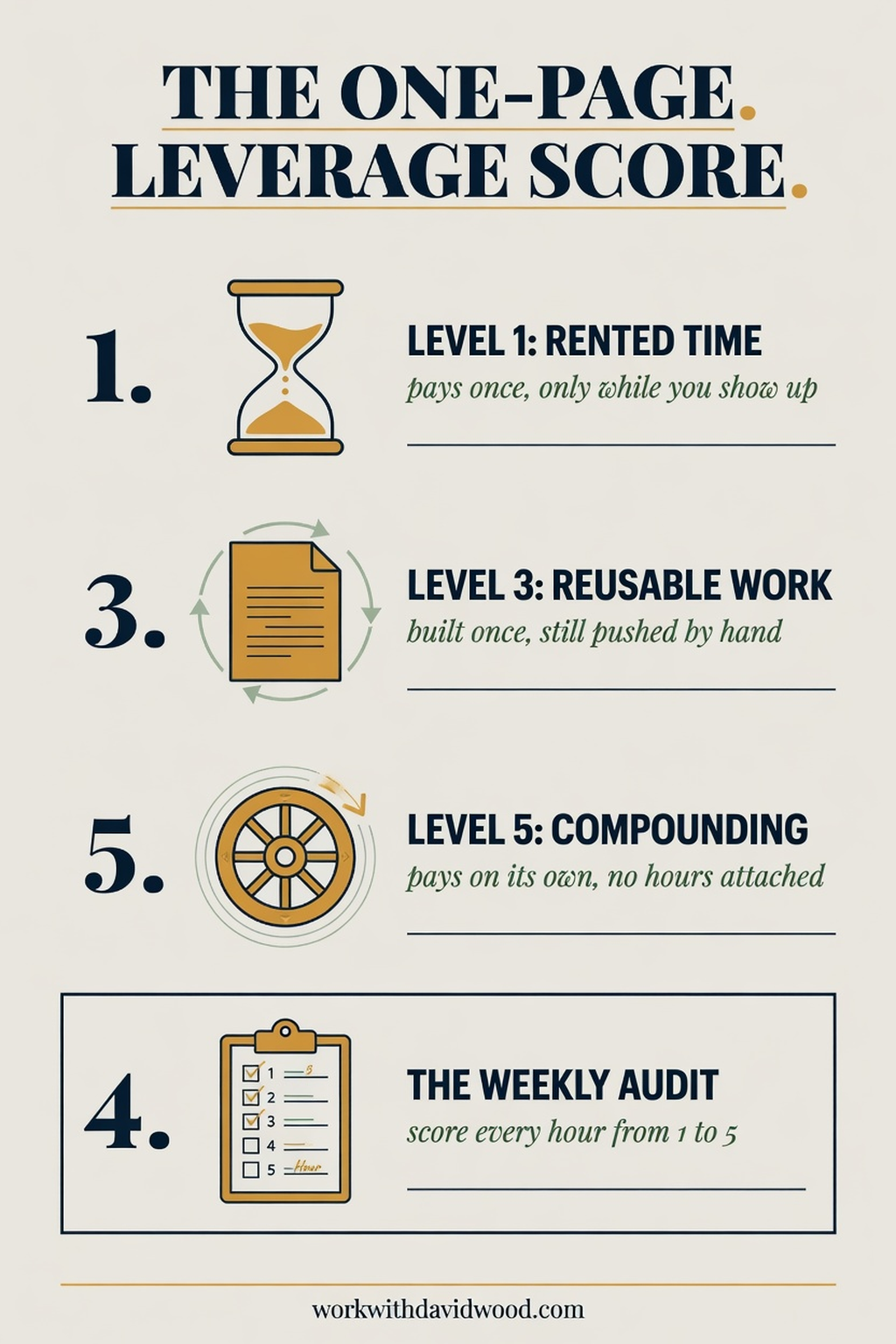
- Level 1, Rented Time. The outcome exists only because you personally did the thing, once. A sales call, a one-off proposal, an hour of manual data entry. Stop showing up and the income for that hour stops with you.
- Level 2, Maintenance. Inbox, scheduling, invoicing, the admin that keeps the machine from breaking down. Necessary, but it produces nothing new on its own.
- Level 3, Reusable Work. You built something once, an article, a script, a recorded training, that can be used again. It still needs you to push it out the door every time, so the leverage is real but thin.
- Level 4, Delegated or Systemized. Someone else, or something else, now runs a piece of work you used to do by hand. You trained it once; it fires without you.
- Level 5, Compounding. The hour built or fed an asset that pays independent of your continued presence. A piece of content still ranking, a team member closing deals you never touch, a system that settles income on its own.
Step three: do the math
Multiply the hours in each bucket by its level, add the five totals, and divide by your total hours worked. That’s your Leverage Score, somewhere between 1.0 and 5.0.
Run it on a real week so you can see how it lands. Say you logged 45 hours. Twenty went to Level 1 (calls, one-off outreach), fifteen to Level 2 (inbox and admin), eight to Level 3 (a training you recorded), two to Level 4 (fixing a process a contractor now runs). Zero touched Level 5. The math: (20×1) + (15×2) + (8×3) + (2×4) = 20 + 30 + 24 + 8 = 82. Divide by 45 and the score is 1.8. That’s a full-time, well-paid professional whose week, on paper, barely clears “rented.”
Reading Your Number
Under 2.0, you are the business. Every dollar has your fingerprints on it, which means every dollar has a ceiling shaped exactly like your calendar. Between 2.0 and 3.0, you’re building real assets but you’re still the one pushing them out the door, so growth tracks your energy, not your systems. Above 3.0, income starts to detach from your hours, which is the entire definition of leverage, and there’s a specific kind of calm that shows up once you can watch a number move on a Tuesday you didn’t work. Almost nobody I’ve walked through this lands above 3.0 on the first pass. That’s not a character flaw. It’s what happens when you spent your whole career being trained to get paid for presence, not for what you built while you weren’t looking.
Moving the Score Without Adding Hours
You don’t fix a 1.8 by working more. You fix it by moving hours up the ladder, on purpose, one category at a time. Batch every Level 1 activity into the fewest blocks you can manage. Push every piece of Level 2 onto a tool or a person this week, not “eventually.” Take the best thing you built at Level 3 and stop reselling it by hand. Point it at something that distributes and collects for you automatically instead.
That last move is the one most people skip, because it means trusting a system you didn’t build with your own two hands, and that discomfort is exactly what keeps capable professionals parked at Level 2 for a decade. This is the same principle behind the four vehicles I lay out in The Leverage Doctrine: the income that survives you stepping away was never built on your hours to begin with. It was built on something that keeps running, a contract, a team, a piece of content, a royalty, while you’re asleep or on a plane or just doing something else with your Tuesday.
If none of this framework has landed yet because you’re earlier in the process, start here first. This audit will make a lot more sense once you’ve seen the whole map instead of one page of it.
The single highest-leverage hour on my calendar this month was spent looking at a public smart contract, not making a call. Every commission in the system I run settles 100% in the same block as the sale, about twelve seconds, no invoicing, no chasing, nothing that needs my hours attached to it once it’s built. Drop your name and I’ll walk you through how it’s structured.
Show me a Level 5 mechanism →Most participants earn little to nothing. No income is guaranteed. You can verify every payout on the public smart contract.
The Audit Only Works If You Run It Again
One score is a snapshot. The number that actually changes your income is the trend, run weekly for a quarter. Some weeks it’ll drop, because a launch or a crisis dragged you back into Level 1, and that’s fine. What you’re watching for is the average climbing over 90 days, not perfection in any single week.
Here’s the part most people quietly skip. If you build a Level 5 asset and then spend your newly freed hours filling the calendar right back up with Level 1 work, you haven’t gained leverage. You’ve just changed what you’re busy doing. The tools and systems worth putting behind a Level 4 or 5 hour matter, but the habit of running the audit matters more, because the habit is what catches you drifting back into rented time before a whole quarter disappears into it.
Pull the calendar. Do the math today, on paper, in the next twenty minutes. Then do it again next Sunday. That’s the whole system, and it costs you nothing but the honesty to write down where the hours actually went.
If your Leverage Score keeps landing under 2.0 no matter how hard you work, the problem was never your effort. It’s what your hours are attached to. I’ll show you the exact on-chain system I use, where the payout is public and the leverage isn’t borrowed from your calendar. Enter your name and I’ll send you the walkthrough.
Show me how the 100% on-chain payout works →Most participants earn little to nothing. No income is guaranteed. You can verify every payout on the public smart contract.
See also: the tools and systems I actually recommend, and start here if you’re new.
Three posts a day. One email a day.
Everything I publish, in one short daily email. Real numbers, no hype, unsubscribe in one click.