
Part of the guide: Personal Brand
Starting over after failure is not a metaphor when it actually happens to you. It’s a specific Tuesday when the business partner who runs the money stops answering, and by Friday the company that was doing eight figures a year is a legal mess and a phone that won’t stop ringing with the wrong kind of calls. You want to know if the comeback is real or just a story people tell themselves. I built a company to $7.2 million a month once and watched it collapse almost as fast as it rose. Here’s what actually rebuilt me, and it wasn’t the thing you’d guess.
Let me give you the whole shape of it first, because the collapse only makes sense next to the climb, and you need both halves to use any of this.
In this guide
The climb, then the floor gives out
In 2011 I launched a company with a business partner out of a room of 37 people. That’s the entire first event: thirty-seven folding chairs, half of them borrowed. Eighteen months later we were doing roughly $64 million a year in company sales, north of $90 million once you count what moved through affiliates’ own merchant accounts. I stood in front of 4,500 people at one event, framed a check for $464,913, and hung it on the wall because the number was genuinely hard to believe.
Then my partner walked. Not slowly. He was gone, and what we’d built together didn’t survive the exit. I lost the company, the partnership, the marriage, and for a while, real time with my own son, all inside the same stretch. This piece is worthless if I sand it down, so here’s the rest of it straight: I lost my mind for a bit too. An ex-contractor I’d trusted drugged me with an overdose-level dose of meth I never agreed to take, and I ended up posting a video of myself with a bloody face, rubbing a lime on my own skin, half convinced it would help. People who’d followed my career for years watched that video and quietly assumed I was done.
Here’s the thing nobody warns you about a collapse that size. It’s never one loss. It’s five or six landing in the same season, and your nervous system doesn’t get to process them one at a time the way a workbook suggests. They arrive together. You just have to be standing when they hit, whether you feel ready or not.
Starting over after failure: what I actually did with the wreckage
I didn’t have a system waiting for this, and that’s worth admitting since you’re about to get one from me in a minute. No pretending one was ready the day it was needed most.
What I had was books. Roughly 250 of them in eighteen months, waking at 6am and reading until noon most days, because nothing could get built yet and my brain needed to be occupied with something other than the wreckage. The domain to the old business was gone for years. A staff member eventually rebuilt the archived posts from the Wayback Machine, one cached page at a time, because there was no clean backup left, just fragments of a company that used to move sixty-four million dollars a year.
Slowly, book by book, walk by walk, I rebuilt the only asset that survives a collapse that size. Not the company. Not the bank account. The part of a person that can look at a blank page and start again anyway.
I rebuilt the second time with people around me from month one, not after there was money to share again. I AM Transformation is a free community, daily conversations, real accountability, people in 150+ countries who actually show up. No card, about sixty seconds to join. Go put yourself in a room that expects the comeback before you’ve proven it.
Don't rebuild this alone →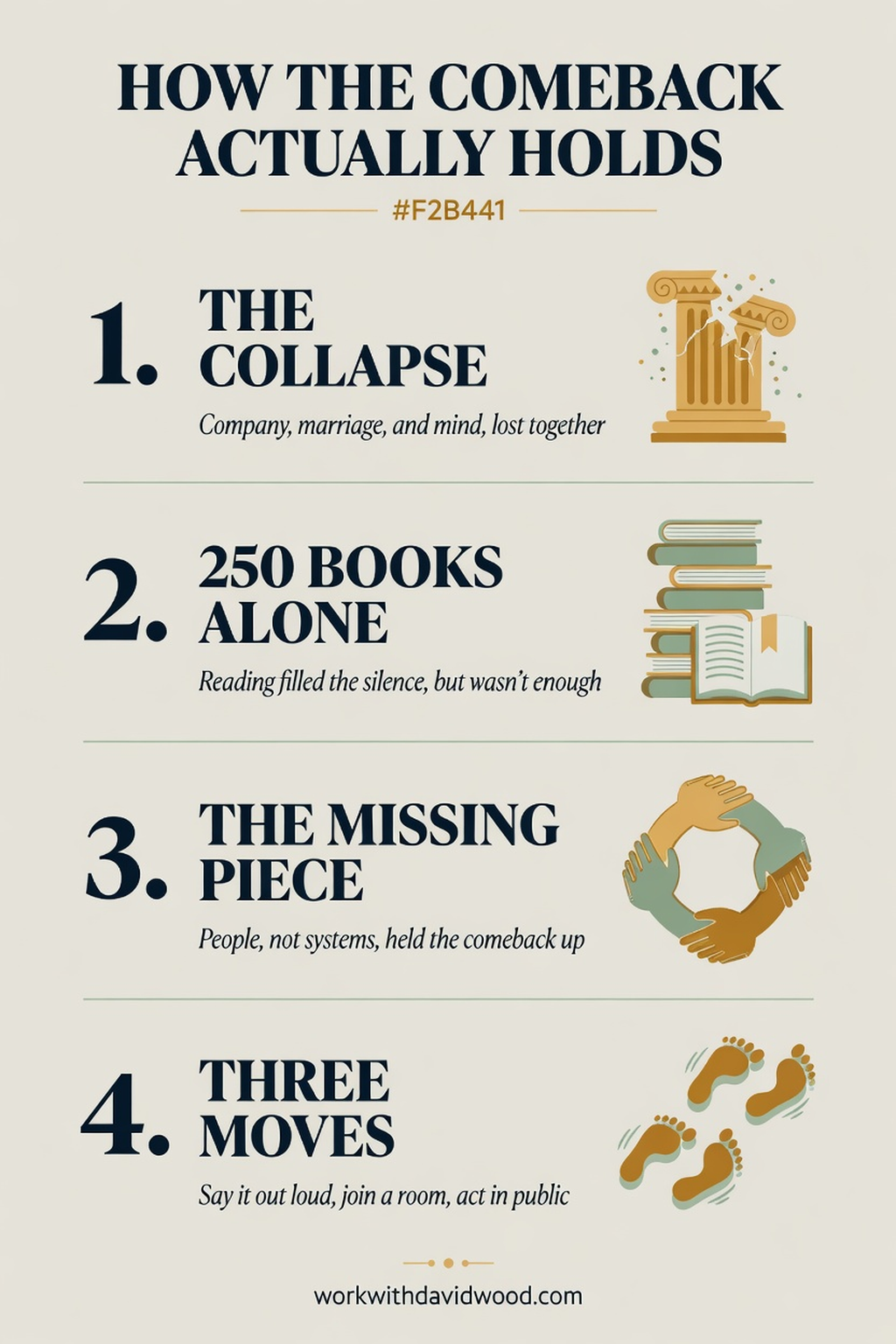
The trap that almost got me twice
Here’s what matters to take from this, because the story isn’t really the point. The mechanism underneath it is what you’re here for.
You already know a quieter version of the same thing. Maybe you finished a course last year, felt the charge for three weeks, and slid back into the old patterns by month two. Maybe you’ve read some of the same books I read, taken the notes, made the Sunday-night promise to yourself, and watched it evaporate by Wednesday. Underneath that, if you’re honest, sits a quieter fear: that maybe you’re not actually built for the comeback, that the old version of you is the real one and this new version is temporary. That’s not a discipline problem. Get precise about it with yourself: it’s a loneliness problem wearing a discipline costume.
Here’s what rebuilding alone in a rented room with a stack of library books taught me, and it’s the one thing I’d hand my earlier self if I could reach him: you cannot hold a new identity through willpower alone, no matter how many books you’ve read or how much money you made before the collapse. The old identity has momentum. Grief has momentum. Momentum only breaks against something with equal or greater force pushing the other way, and for me that force eventually became other people, not more books.
The ninety days nobody saw
There’s a stretch in there, close to three months, where I genuinely wasn’t sure I’d build anything again. I wasn’t broke in the literal sense, not the sleeping-in-a-van kind of broke I’d been at the very start of my career. I was broke somewhere quieter. I’d stand in front of a blank screen most mornings and feel nothing pulling me toward it. The fire that had taken a room of 37 people to 4,500 had gone dark.
What brought it back wasn’t a strategy session or a new funnel. It was a handful of people who refused to let me disappear. Who checked in without being asked. Who reflected a version of me back to me that still believed the comeback was coming, on the days I genuinely didn’t believe it myself. That’s the internal benefit nobody sells you directly: you stop having to hold the whole thing up on your own strength, on the days your own strength is exactly the thing that’s missing.
Notice what that actually requires of you, because it isn’t what the personal-development shelf usually tells you. You don’t need more discipline. You don’t need a better morning routine, though those help at the margins. You need people close enough to notice when your fire goes dark, and stubborn enough to sit with you until it isn’t. If you’re trying to run that whole job alone, in your own head, at your own kitchen table, you’re fighting the hardest part of any comeback with the weakest tool anyone’s ever handed you for it.
Three moves, if you’re in the middle of it right now
You don’t need the full theory to start. You need three concrete moves, the kind you can make today whether or not you feel ready yet.
First, say the loss out loud to one other person before the week ends. Not in your head. Not in a private note nobody else reads. The real number, the real relationship, the real thing that ended. Silence lets a collapse calcify into a verdict about who you are. A witness keeps it a fact instead.
Second, put yourself in a room, in person or online, full of people who have already survived their own version of this. You will not talk yourself back into believing a comeback is possible from inside your own head. You need proof walking around in front of you, on video calls, in comment threads, wherever it shows up.
Third, pick one visible action this week that only the rebuilding version of you would take, and take it somewhere someone else can see you do it. Not the whole plan. One action, in public, today.
What collapse actually taught me about leverage
Everybody in this world talks about leverage like it’s a spreadsheet term. Systems, funnels, income that compounds while you sleep. I built plenty of that, and I still believe in it. The collapse taught me something the spreadsheet can’t show you, though. The highest-leverage asset you will ever own isn’t a funnel. It’s the people who show up when the funnel breaks.
Think about it plainly. A system with nobody standing behind it does nothing. My company had genuinely good systems. Every one of them stopped mattering the day the person running the business, me, didn’t have the internal architecture left to keep standing. You can automate a sales sequence. You cannot automate the will to start over. That has to be rebuilt by hand, and it gets rebuilt fastest in the company of people who’ve already done it, or are doing it right now beside you.
That’s the piece I didn’t have in the years right after, and it’s usually the piece you’re missing too, whether you’ve ever run an eight-figure company or not. You’re almost certainly a capable person who has built real things and can build more. And you’re probably also, right now, trying to hold a comeback, a habit change, or a leap into something new almost entirely by yourself, the exact way I tried for a stretch. It’s slower that way. Sometimes it doesn’t work at all, no matter how good the plan on paper is.
You don’t need to lose eight figures a year to learn this lesson early. You need people who reflect the comeback back to you on the days you can’t see it yourself. I AM Transformation is free, forever, and takes about sixty seconds to join. Create your account and stop climbing back alone.
Build the second climb differently →Building back, the second time, on purpose
By the time the next company got built, the process itself was different. Not just smarter tactically, though it was that too, but structurally different, with people around from month one instead of people found only once there was money worth sharing. That single change is most of the reason the second climb held when the first one didn’t. You can make that same change on day one, without needing a collapse to teach it to you first.
If you’re in your own version of the wreckage right now, whatever shape it takes for you, here’s the direct move. Stop trying to write your way out of it alone at 6am with a stack of books nobody else knows you’re reading. Books helped me, and I had 250 of them. They still weren’t enough on their own. Find the room where people are already doing the rebuilding you’re trying to do, and let them watch you do it too, in public, before you’ve fully proven it works. You’ll notice the difference inside of a week.
Here’s the objection you might already be forming: “I’ve tried a group like that before. It didn’t stick.” Fair. Most groups aren’t built for this. A page that goes quiet the week after you join isn’t accountability, it’s a mailing list wearing a community’s clothes. What actually holds you together is daily contact with people who have real skin in your comeback, the way the handful of people who found me had skin in mine, not a one-time cheer squad that forgets your name by spring. That’s the difference worth testing for yourself before you decide community doesn’t work.
Read the deeper case for why leverage without people around you eventually breaks in The Transformation, the pillar behind this piece. And if you want the shortlist of what actually helped me rebuild, from the books to the community itself, here’s what I recommend. If none of this is familiar yet and you’re earlier in your own story, start here before you go any further.
The collapse will happen to you, or it already has. That part isn’t optional for anyone who builds something real. What’s optional is whether you rebuild it in a room by yourself, or in a room full of people who already know exactly what the climb back looks like. Pick the second room. Today, not after you’ve got it figured out on your own.
See also: the tools and systems I actually recommend, and start here if you’re new.
Three posts a day. One email a day.
Everything I publish, in one short daily email. Real numbers, no hype, unsubscribe in one click.



I left the field side of this industry after six years all-in, and I am not here to romanticize collapse. What I will concede is the mechanism the post lands on: the stretch where books and 6am reading occupy the wreckage but cannot supply the force that breaks old identity and grief. I tried the solo version — stacks of notes, private promises — and it held until it did not. The claim that loneliness wears a discipline costume is the line I would have resisted in 2019 and cannot dismiss now. Highest-leverage asset when the systems stop is the people who refuse to let you disappear. That is not a slogan I would have trusted from a stage; it matches what actually separated a quiet exit from a rebuild for people I watched up close.