

Part of the guide: Network Marketing Lead Generation
You make more money than almost everyone you grew up with, and you still feel the ceiling. That’s not a contradiction, it’s income leverage, or the total lack of it, doing exactly what it always does to smart, hard-working people who were never taught the difference between a job that pays well and a system that pays without them. I’ve built both kinds. I’ve made five figures a month doing everything myself, and I’ve made more than that from teams and systems I never touched on a given day. This is the doctrine that explains the gap, and the four vehicles that actually close it.
In this guide
- The ceiling you can’t see from inside a good year
- The centerline principle
- Wages versus profits, in one honest paragraph
- The leverage doctrine, stated plainly
- The four vehicles
- Why most people never leave vehicle one or two
- The diagnostic: which vehicle are you actually in?
- Building vehicle three and four without torching vehicle one
- What income leverage actually buys back
The ceiling you can’t see from inside a good year
Here’s the pattern I’ve watched for over twenty years, in myself and in a few thousand people I’ve coached, trained, or sponsored. Income goes up. Hours don’t go down. A raise arrives, a promotion lands, a book of clients grows, and the person earning it quietly notices they’re working the same brutal calendar they worked three years and forty thousand dollars ago. Nothing about the arithmetic changed. They just got better at the thing that was always going to cap them.
You know this feeling if you’re reading this. You didn’t get here by accident. You’re disciplined, you’re competent, you probably outwork most of the room, and you can feel, somewhere under the good numbers, that the next dollar is going to cost you the same hour the last one did. That’s not a mood. That’s a structural fact about the vehicle you’re in, and no amount of hustle changes a structural fact. You can only change the structure.
I want to be precise about the internal conflict this creates, because it’s rarely spoken out loud. Part of you suspects you’re doing something wrong, that a person this capable should have already solved this. Another part of you is skeptical of every “financial freedom” pitch that’s ever landed in your inbox, because you’ve watched people you respect get burned chasing exactly that promise. Both instincts are correct. You haven’t done anything wrong, and you’re right to be skeptical. The problem was never your effort. It was that nobody ever showed you the actual menu of vehicles, only the one you happened to inherit.
The centerline principle
I trained Wing Chun for years under a Sifu named Carlos Colorado, a serious teacher who ran a serious school. No stretching before class, gradual warm-up only, and once he sprinted across the room yelling at my brother Will for trying to force a full split before his body was ready. One of the 108 principles Carlos drilled into us was this: look at nothing, see everything. Pull your focus about six inches off your opponent’s chest instead of tracking their hands, and your reaction speed multiplies, sometimes by ten times, because you stop chasing the fake and start reading the whole body at once.
There’s a business version of that principle, and it’s the one that actually matters here. Most income-producing activity in a day is fake movement. It looks like work, it fills the hours, and none of it moves the centerline. In the systems I’ve built, only four activities ever actually produced income: build a list of real contacts, reach out to new people daily, get people in front of a real presentation, and follow up in a way that doesn’t depend on your memory. Everything else, the redesigning, the reorganizing, the “getting ready to get ready,” is motion without leverage. The first shift toward income leverage isn’t a new opportunity. It’s noticing which four things on your calendar are the centerline, and which fifty are the fake.
Wages versus profits, in one honest paragraph
Jim Rohn used to draw a hard line between wages and profits, and it’s worth stating plainly before we go further. A wage is what someone pays you for your hours. A profit is what a system pays you because you built or own something that produces value whether or not you personally show up today. Almost everyone reading this is earning excellent wages. Very few are earning real profits yet. That single distinction, more than any tactic in this post, is the one that determines whether your income compounds or resets every Monday morning.
The leverage doctrine, stated plainly
A friend of mine, David Schwind, once said something to me at four in the morning while we were both still awake scheming: “We’re kind of a contradiction. We work fifteen hours a day, scheming of evil ways to make money without working.” I’ve never forgotten it, because it names the exact tension a lot of high earners live inside. Here’s the doctrine underneath the joke, and it’s the whole thesis of this post.
It takes the same energy to earn five dollars an hour as it does to earn five thousand dollars a day. I mean that almost literally. The physical and mental effort of showing up, focusing, and executing well doesn’t scale ten thousand percent between those two outcomes. What scales is the vehicle carrying that effort. One person’s energy is captured by an hourly wage with a hard ceiling. Another person’s identical energy is captured by a system, a team, or an owned asset that multiplies what a single hour of focused work is worth. Same person, same discipline, radically different output, because the vehicle is different.
That’s the entire doctrine in one sentence: your income is a function of your vehicle, not your effort. Work ethic decides whether you succeed inside a vehicle. It never decides which vehicle you’re in. Only a decision does that.
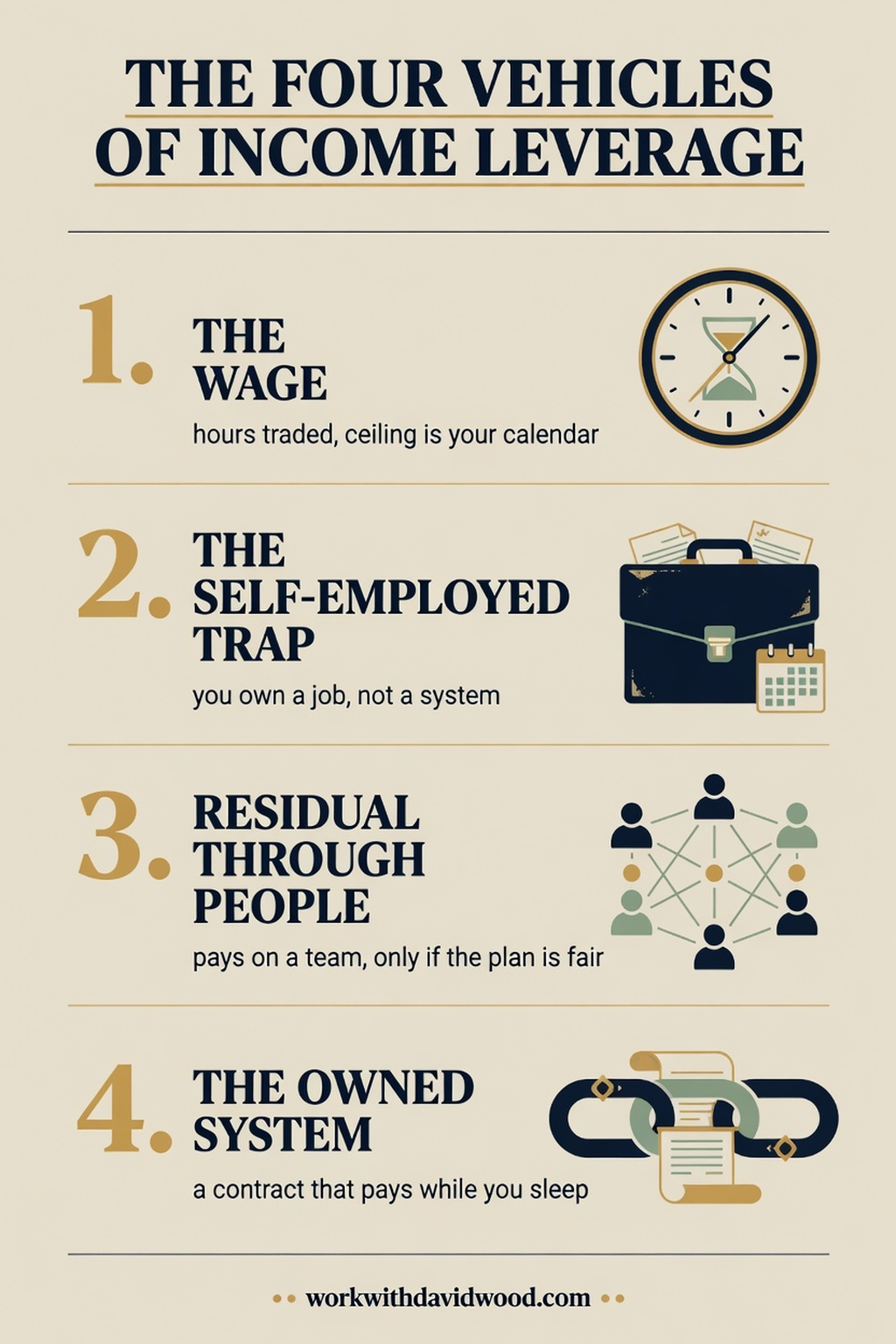
The four vehicles
I’ve watched capable people occupy each of these four, sometimes more than one at a time, and I’ve built real income inside three of them myself. None of the four is morally superior to another. But they are not equal, and pretending they are is exactly why so many careful, intelligent people stay stuck under an income ceiling they could clear in a year if someone handed them this map honestly.
Vehicle one: the wage
You trade a fixed unit of time for a fixed unit of money. A salary, an hourly rate, a billable hour. This is the vehicle almost every reader of this post started in, and most still have a foot in it. Its ceiling is your calendar. There are only so many hours you can sell, and the buyer sets the price. Stop showing up and the income stops the same day. It’s the most stable vehicle in the short term and the most capped vehicle over a decade. Nothing wrong with using it. Everything wrong with staying in it exclusively once you can see past it.
Vehicle two: the self-employed trap
This is the one that fools smart people the longest, because it feels like freedom. You’re the consultant, the agency owner, the practitioner with your name on the door. You set your own hours, you keep more of what you make, and it genuinely beats vehicle one. But look closely and you’ll usually find you didn’t leave the wage model, you just became your own employer inside it. The business still can’t produce income without you personally in the room, on the call, or at the keyboard. I’ve talked to consultants clearing three hundred thousand dollars a year who are more trapped by their calendar than a salaried employee, because there’s no HR department telling them to take a vacation. You own a job. It’s a very nice job. It is still a job.
Vehicle three: residual income through people
This is the vehicle where you build or join a system that pays you on the ongoing efforts of a team, not just your own hours. Direct sales, affiliate structures, network marketing at its honest best. Done right, it’s the first vehicle on this list that can genuinely pay you while you sleep. Done wrong, and this is the part almost nobody tells you, it can look exactly like vehicle one wearing a costume.
In 2007 I built my first real team the old-fashioned way and got sold on a “duplication secret” that turned me into a telemarketer working eight-thirty in the morning until eleven-thirty at night, roughly a hundred and fifty calls a day for about five thousand dollars a month. My friend Tom, who was living in the back of a store at the time, quit mid-call one night after I dragged him into a three-way pitch about his “Aunt Mary.” He said, “No amount of money is worth what you just did to me. I’d rather work at Safeway.” I haven’t carried a cell phone the same way since. My whole team burned out within ninety days, because the vehicle I’d built them was still vehicle one, just with a bigger downline attached to it.
The version that actually works looks nothing like that. My best four-week stretch off a downline I’d built through systems, not phone calls, brought in two hundred and fifty-seven thousand dollars with zero calls and zero meetings from me personally. A friend of mine, Dave Lovette, spent close to a decade in Amway earning around eight hundred thousand dollars a year while taking four or five calls a month. Same industry, same vehicle, opposite result, because one version runs on the founder’s manual effort and the other runs on a system that keeps producing once the founder steps back.
Here’s the piece that separates a real vehicle three from a fake one, and it has nothing to do with hustle. It’s the design of the compensation plan itself. I built a real distributorship in a company called Agel back in 2006, good products, real momentum, and I noticed something in my own numbers that bothered me. For every actual customer buying the product because they wanted it, I had roughly five distributors who’d signed up mainly for the income opportunity. I flagged it to corporate. They were decent about it, nothing changed, because field leadership liked the math the way it was. A five-to-one ratio like that isn’t a moral failure of the distributors. It’s physics. A plan that pays more for recruiting than for retail sales will drift toward recruiting every time, no matter how sincere the people running it are.
I know the objection sitting in the back of your mind right now, because I’d have the same one: isn’t this just another MLM built to enrich the people at the top? It’s a fair question, and the honest answer is that it depends entirely on whether you can verify the plan yourself instead of taking someone’s word for it. A compensation structure you can’t audit is a compensation structure that can be quietly changed on you. That’s the exact gap the fourth vehicle exists to close.
Vehicle four: the owned system
This is the newest vehicle, and it’s the one most high earners haven’t been offered yet because it didn’t fully exist a decade ago. It’s an owned asset, code, a contract, a platform, that pays out according to fixed, checkable rules instead of a person’s discretion. The commission isn’t decided by a comp-plan committee that can change the rules next quarter. It’s written into the mechanism itself.
The system I use is built exactly this way. Every commission settles on a public smart contract, on-chain, in the same block as the sale, about twelve seconds. You don’t take my word for what I’m earning. Anyone can pull the contract up on a block explorer and read it, before they’ve decided to trust a single thing I’ve told them. There’s no dashboard someone can edit behind the scenes, no “the plan changed” email six months in. The contract is the truth, and that single fact turns a vehicle-three structure, people, a team, a comp plan, into something with the auditability of vehicle four underneath it. It’s built on a “three stages, nine rungs, one contract” model, with a trademarked 1/3 Walk-Up Method that routes every third sale up to the person who sponsored it, so growth compounds through the whole line instead of pooling only at the top. Entry starts around three dollars and thirty cents for the first rung, and the commission on that sale, and every one after it, is paid in full, on-chain, before you’ve had time to refresh the page.
I’m not telling you this to sell you on one company. I’m telling you because it’s the cleanest current example of what vehicle four actually looks like in practice, and once you’ve seen a compensation structure you can personally verify, the ones you can’t feel very different.
Most of the tools and platforms I’ve actually used across all four vehicles, the ones that held up and the ones that didn’t, are listed plainly at the products I recommend. I’d rather point you at what worked than make you guess.
You don’t have to take my word for any of this. I’ll send you the walkthrough of the exact on-chain system I use, the one where every commission settles on a public contract in about twelve seconds, so you can read it yourself before you trust a word I say.
Show me a comp plan I can verify myself →Most participants earn little to nothing. No income is guaranteed. You can verify every payout on the public smart contract.
Why most people never leave vehicle one or two
It isn’t laziness. I want to be direct about that, because the industry I’ve worked in for two decades has a bad habit of implying that anyone who hasn’t broken out just didn’t want it badly enough. That’s condescending and it’s usually false. Most capable people stay in vehicle one or two for three real reasons.
First, nobody ever laid out the four vehicles as a decision, so it never felt like a decision. It felt like a career, which is a different thing, something that happens to you rather than something you choose. Second, vehicle three has a genuinely bad reputation, earned honestly by decades of five-to-one comp plans and phone-based burnout stories exactly like mine with Tom. Distrust of “the opportunity” is a rational response to real history, not a character flaw. Third, moving into vehicle three or four requires a season of doing two jobs at once, your current one and the new vehicle, before the new one can carry any weight. That’s a real cost. Anyone who tells you it isn’t is selling you something. The honest version is that it costs you some of the evenings and weekends you’d otherwise spend feeling productive in the old vehicle, for a period with no guaranteed length, in exchange for a payoff that only shows up later. That trade is worth making. It is not free.
The diagnostic: which vehicle are you actually in?
Run this on yourself honestly, because the answer is usually less comfortable than the job title suggests.
Ask yourself what happens to your income if you stop showing up for thirty days. If it drops to zero inside a week, you’re in vehicle one, no matter what your business card says. Ask whether your income depends on a person, a client roster, or a program whose rules you don’t personally control and can’t independently verify. If yes, you’re exposed to vehicle-three risk even if you think you’ve built vehicle four. Ask what percentage of last month’s income arrived because of something you did that same week versus something you built months or years ago. The higher that second number, the closer you are to real leverage.
If you’re brand new to all of this and none of the four vehicles currently describe you, start here before you pick one. Vehicle three and four both reward people who’ve already proven they can commit to something for more than a month, and that proof has to come from somewhere.
Building vehicle three and four without torching vehicle one
You do not need to quit your job to start this, and I’d tell you not to even if you wanted to. The sequencing that actually works looks like this. Keep vehicle one or two funding your life exactly as it does now. Choose one vehicle-three or vehicle-four structure, ideally one with a verifiable mechanism instead of a promise, and give it a fixed, honest slice of your week, five to seven hours, protected the same way you’d protect a client meeting. Track only the centerline activities from earlier in this piece, contacts, outreach, presentations, follow-up, and ignore everything else that feels like progress but isn’t. Give it a real season, ninety days at minimum, before you judge it. Most people quit in week three, right before the compounding starts to show, because nothing compounds visibly in week three. It compounds invisibly in week three and visibly around month four or five.
What income leverage actually buys back
Here’s the part I want you to sit with, because it’s the reason any of this matters beyond a bigger number in a banking app. Income leverage isn’t really about money. It’s about which hours of your one life belong to you. I’ve made a couple hundred million dollars in sales across my career, built a company to over seven million dollars a month, watched it collapse, and rebuilt from close to nothing more than once. What I actually notice on the good days now isn’t the revenue. It’s that I can walk in the mountains at ten in the morning on a Tuesday, and nothing breaks.
That’s what vehicle three and four are actually for. Not a bigger house. The ability to be present for the people in your life without your income punishing you for it. If building any of this ever costs you your marriage, your health, or your kids, the income has already lost, no matter what the dashboard says, and I’d rather you hear that from me now than learn it the hard way later. The whole point of leverage is that it should give you more of your life back, not less. If a system is asking for more of you than it’s giving back in freedom, it’s not vehicle four. It’s vehicle one with better marketing.
You didn’t get this far by accident, and the ceiling you’re feeling right now isn’t a sign you’ve done something wrong. It’s a sign you’re finally close enough to see it. The next move isn’t more effort inside the same vehicle. It’s a decision about which vehicle you’re actually going to build.
Pick the vehicle. Then verify it before you trust it. I’ll send you the exact walkthrough of the on-chain system I use, where every commission is public, checkable, and settled in the same block as the sale. Enter your name and I’ll send it over.
Send me the walkthrough →Most participants earn little to nothing. No income is guaranteed. You can verify every payout on the public smart contract.
See also: the tools and systems I actually recommend, and start here if you’re new to any of this.
Three posts a day. One email a day.
Everything I publish, in one short daily email. Real numbers, no hype, unsubscribe in one click.



The four-vehicle map is clean on paper, but the median path through vehicle three is still the 2007 burnout pattern described here: the plan drifts toward recruiting because the plan pays that way, and most people never audit that before they burn ninety days. Separating the rare systems version from the phone-grind costume matters more than listing the vehicles. Most careful people stay in one or two for the three reasons named at the end, not because they lack ambition.
Look, Hector. Fine on the median case. The bigger problem is the frame itself. Calling self-employment a ‘trap’ flattens every consultant who deliberately chose calendar control over scale. Some of us left network marketing because vehicle three kept dressing up as vehicle one. The diagnostic about thirty days off is useful. The moral ranking of the four vehicles is not.
The strongest case against the whole doctrine, if I am not stating my own view, is this: calling the vehicle the only variable treats effort and market access as interchangeable, and they are not. Someone in vehicle one with a scarce skill still compounds career options that a poorly designed vehicle-three structure will never match. The centerline activities still require a market that answers the phone. Vehicle design multiplies execution; it does not invent demand where none exists.
Walt — over what sample does vehicle design outweigh skill scarcity? n, time frame, and failure rate for people who switched vehicles mid-career would help. Without ranges this stays assertion.
Yuki, that request for ranges is exactly what I wished for when I first tried to apply these ideas outside the US market. In Turkey vehicle three often means family networks and local reputation, not cold outreach lists, so the same centerline activities look different on the calendar. A range that includes non-English markets would tell me whether the doctrine travels or only fits one kind of list-building culture.
When the compensation plan itself cannot be audited by the participant, what concrete checks should someone run in week one before giving it that five-to-seven-hour slice?
Process map as I read it:
Inputs → protected 5–7 hrs/week + current vehicle funding life
Centerline only → contacts, outreach, presentations, follow-up (everything else = fake motion)
Vehicle choice → 3 or 4, prefer verifiable mechanism
Season → ≥90 days before judgment (quit-at-week-3 is the common failure mode)
Diagnostic failure points: if nothing continues when you step away for 30 days → still vehicle 1; rules you cannot verify → vehicle-3 risk wearing vehicle-4 clothes; % of last month from work done that same week vs assets built earlier → real leverage.
If you cannot draw the centerline on a weekly calendar, you are still optimizing fake motion.
Tomas, the diagram is clear, but ‘verifiable mechanism’ needs an operational definition before it is useful as a gate. What counts as verification for someone who is not technical — a public ledger entry they can pull up themselves, a written plan that cannot change mid-quarter, something else? Without that, people will treat any polished dashboard as vehicle four. Also, the 90-day floor assumes the signal appears around month four or five; I would want to know what leading indicators in weeks 4–8 separate real centerline work from busywork that only looks like the four activities.
Sorry if this is obvious, but when it says keep vehicle one funding your life and only give the new structure five to seven hours, how do you know which of those hours are actually the four centerline things and which are just ‘getting ready to get ready’? I keep filling evenings with setup and then feel productive without ever doing the outreach part.