The Billion Dollar Bullseye and The Seven Rings Of Power [Jcron Book Review]
This book review is a special pleasure of mine to write, as I am personal friends with Jonathan Cronstedt [Jcron] who just published a bestselling book called “The Billion Dollar Bullseye“ which you can now buy on Amazon.
Jonathan first told me about his upcoming book in early September, about 2 weeks before it was published. Of course, knowing Jcron for all of these years and seeing the kind of business leader that he is in person and the results he can get, I was eager to get my hands on a copy of the book. I’m in Costa Rica, which makes shipping a bit difficult, so he sent me a PDF copy on the promise that I wouldn’t distribute it.
I devoured the book from September 4th to September 6th, underlining something on almost every page. A little bit of background on my relationship with Jonathan Cronstedt is that I met him originally around June of 2013 at an event in Denver, Colorado with about 6,200 people for a company that I used to run.
I don’t know where I would put this book exactly on my list, but this is in my top 5 favorite business books that I’ve ever read, right up there with “Resolved, 13 Resolutions for Life” by Orrin Woodward, who is also a friend of mine. I haven’t made a review of that book yet, but will at some point.
So What Is “The Billion Dollar Bullseye” All About And Why Should You Read The Book?
As a little bit of background, Jonathan worked with me from 2013-2015 during a very difficult transition period in my company and I will say that he was the most productive, honest employee that I ever had work for me. After working with me for a couple of years and building a close friendship, he moved on to his next project on positive terms and became the President of Kajabi, where he helped grow the company to a $2 billion valuation. He now sits on the board of directors and is doing consulting for SAAS (Software As A Service) companies to help them grow and eventually be valued as a Unicorn business.
Not only is Jonathan’s business acumen impressive, he is also a dedicated father and husband. Having done business with him for long periods of time, I can say that he is dedicated, honest, hardworking, loves his spouse and his daughter and he is also a great friend. Jonathan is an avid reader and everything that he teaches comes from a combination of learning and also applying these principles into his successful endeavors.
What Billion Dollar Bullseye is really about is defined in the subheading of the book which says: “Scale as big as you want, as fast as you want, and exit (if you want) on your terms.“
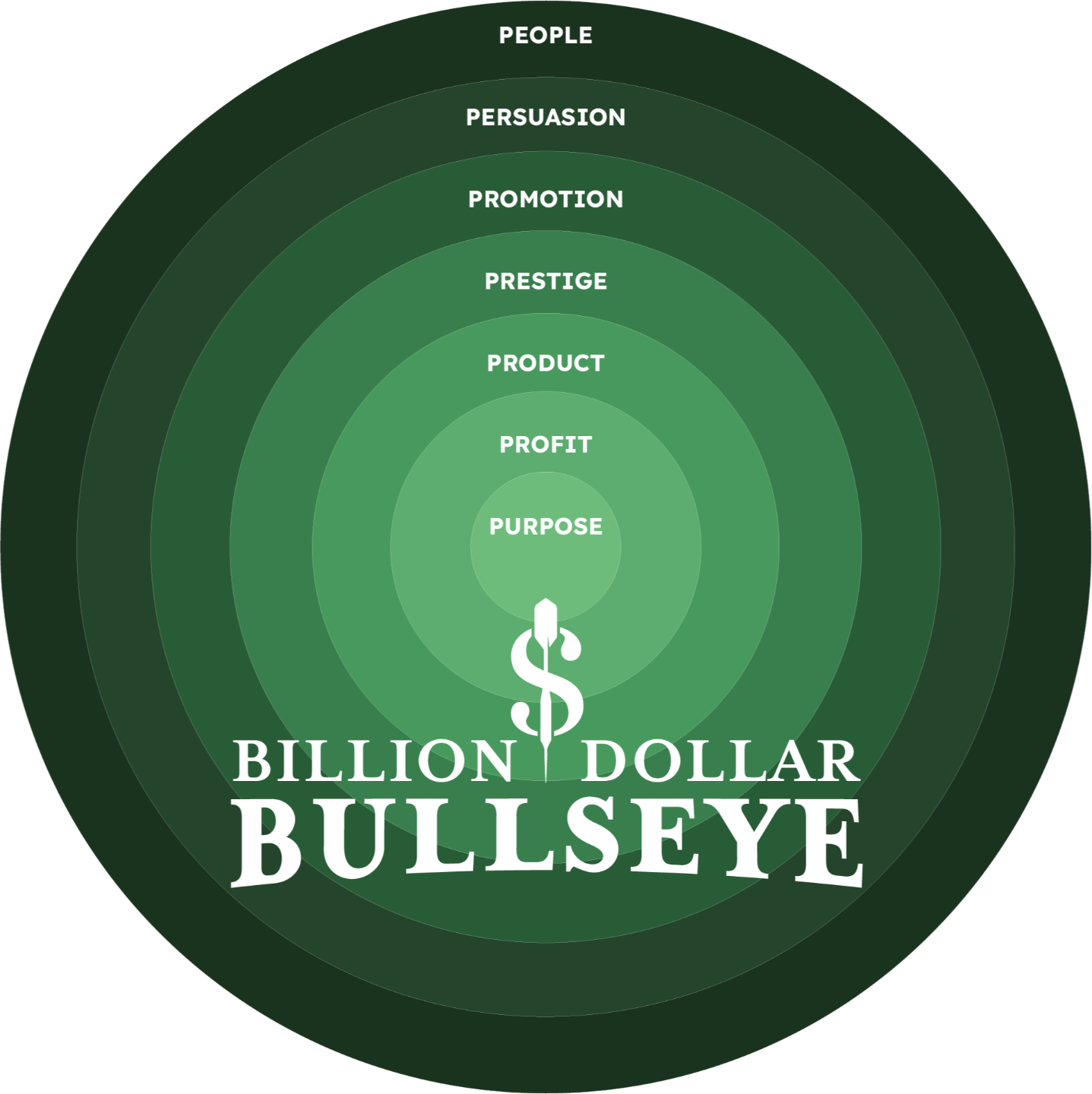
Jonathan outlines 7 key principles for building a great company with an incredible culture which form his “Billion Dollar Bullseye” concept, to help business owners visualize the order of operations that they need to implement to build a great, profitable company with a culture that will last and be able to grow to Unicorn status, which is defined as a company with a billion dollar valuation.
Obviously I’m planning on having at least one organization with a billion dollar valuation, so I payed close attention to the contents in the book. Knowing Jonathan made the concepts that much more impactful, as in reading them I could see where I’ve done things right and where I’ve done things wrong at different phases of the businesses that I’ve built. Knowing these concepts helps to outline a plan for how to build a company to an incredible future momentum, as conceptually, creating a billion dollar company is as simple as filling in your 7 rings of power.
If you already have a profitable SAAS business and want to work with Jonathan, he is currently taking on businesses that are already doing 7 figures plus as consulting projects. You can learn more about him at ====> https://www.jcron.com/
So What Are Jcron’s 7 Rings Of Power And How Can You Apply Them To Grow Your Profits?
These are principles that represent part of your future Unicorn business that when applied as a system help you grow a company from where you are to where you can potentially have a billion dollar valuation or higher and, if you choose, exit for a really big payday.
Here is an image of the 7 rings:

Building your Billion Dollar Bullseye starts by building a defined purpose for your enterprise and proceeding in an outwards fashion to build each ring successively. Think about the rings like the order of operations in solving mathematical formulas. If you do them in order, you always have a way to move to the next ring of power in a way that will cause your company to break through to the next level. As he says in the book:
“If you’re looking at a traditional dartboard, you may think you’d win by hitting the same bullseye multiple times, but you’d be wrong. There are four spots on a dartboard that are worth more than the bullseye. In our case, the dartboard is a metaphor for your business, and the goal isn’t just to hit the bullseye but to expand it.
“Let me explain.
“If you follow the Bullseye Formula correctly, you’ll see that moving from the center bullseye outward, then mastering each successive ring, will only increase the size of the bullseye, and in doing so, increase your odds of success.”
He then elaborates on the importance of filling the rings in order and how that impacts the possibilities of creating exponential outcomes in your business, when he says:
“The three inner rings, Purpose, Profit, and Product, are your core three. They are foundational. They are worth more than any of the outer rings that follow. If you master Purpose, your next area of focus is Profit. Once you’ve become profitable, your bullseye is not just the size of Purpose but the size of Purpose and Profit. Add in nailing Product, and you’ve tripled the size of the bullseye and tripled your odds of success.”
He then defines how expanding outward and filling the rings from the center outward increases the size of your bullseye and improves your odds of success:
The remaining rings—Prestige, Promotion, Persuasion, and People—are amplifiers. Imagine they’re like the spots on a traditional dartboard that double or triple the score. When you have your three core rings interlocked., and you hit the Prestige, Persuasion, or People ring—ding! ding!—that hit increases the size of your bullseye exponentially.
Now we’ll dive into each individual ring one by one and briefly cover the concepts. Obviously in a single blog post you’re not going to be able to fully grasp the contents of his book, so I would encourage you to pickup the book on Amazon so you can fully understand these principles.
Purpose: the first Billion Dollar Ring Of Power.
Purpose is a concept that is at the front of the teachings of most business trainings, so this idea is not going to be unique for a majority of my readers. Without a clearly defined purpose, the rest of a business is difficult to guide as there is no motivating reason for its existence.
Jonathan breaks purpose down into two keys. He says:
This is the first key piece of Purpose: Your internal driver. The mistake so many business owners make is to create mission, vision, and values for their employees at this stage. I’ll speak more on this later, but for now, understand that this first part is about you—no one else. Nobody will sacrifice what you will, so you need a purpose so personal that it will drive you through every single barrier.
There’s an old saying that says “if your ‘why’ doesn’t make you cry, then it isn’t strong enough. The key with your purpose is to find something that breaks you through your internal and external barriers and carries you along your action pathway to reach your goals with enough motivation to drive you towards the results that you’re looking to create. He says:
It’s important to understand the why behind your why if the money is your internal driver. For me, the vision I journaled about represented fulfillment, achievement, success, freedom, and stability. It meant being a provider for my family and not being chained to a desk or beholden to someone else’s whims or expectations.
Internal purpose is only one part of Jcron’s framework though, he elaborates on the second key:
This is the second key piece of Purpose: Your external driver. This is not for your team; this is for your customers. External purpose is the problem you solve for them. This is your customers’ why.
The way that I like to remember it, is that where your why meets your customers’ why, you can do business in the point of intersection through the vehicle that you create. Creating your why is about more than just making a mission statement or finding something exciting to talk about. You need to connect to something that is meaningful and truly motivates the people around you to put the kind of work, creativity, and energy into your vision that is really going to make your idea grow roots and begin to take off. Your staff want to feel intrinsically motivated from what is inside of themselves and if you are not connected to their internal drivers, then your vision may fall flat on its face before it ever has a chance to take off. Having a vision is one thing, but communicating it is another. Jonathan points out:
This is why your success with the Bullseye Formula hinges on your ability to publicize and promote your purpose.
He further clarifies:
Let people choose to engage with your purpose. Let people choose to be attracted to why you exist. For example, if you really dig what Elon Musk is doing and he asks you to board his rocket ship, you don’t care what seat you’re in.
You can pickup the book on Amazon where he elaborates on the Purpose principle in a lot more depth. For now, let’s move on to the second ring of power, which is Profit.
Profit: the second Billion Dollar Ring of Power.
This is where the order of Jcron’s ideas creates a different alignment from other business books, as most business books will focus on putting almost every element of the business together before an entrepreneur would ever get into profit. Those ideas might be ok if someone is already running a profitable, large business and they want to restructure it, but for a startup entrepreneur who is building a business from zero this concept doesn’t work at all. He quotes Felix Dennis when he says “Expansion is vanity. Profit is sanity. Overhead begs to walk on two legs” and then Jonathan further elaborates:
The quote at the beginning of this section is by a poet named Felix Dennis, who also built a billion-dollar fortune from scratch… His words remind me that profit is absolutely essential to any business. If you do’t have profit, you don’t control any aspect of your company. And if you don’t control your company, how can you control your destiny?
Profit is the next ring in the Bullseye Formula because it is an essential support to Purpose. Without profit, you’ll never fully actualize your purpose. Profit preserves the sanctity of your Purpose.
When I built my last company beginning in 2011, this is where the Bullseye model began to break down. I built a company that was wildly profitable for other people who were involved with it, but the enterprise itself actually never made money. It had a strong purpose, which was to provide a unique opportunity for others, but it did it in a way that the model itself had no capital that allowed it to scale and control its infrastructure. The vision was compelling and people joined it by the hundreds of thousands, but the business fundamentals of the model were broken at the core. When Jonathan came into the company and began working with us, the first thing that he did was audit the financials of the company and begin a long process of getting the economics in good working order. This took some time, as when he came into the company, we didn’t have well organized financials, and as he points out in the book:
If you’re not looking at a fully baked set of numbers, you might think you’re doing well and making up any losses with your volume only to find that your bottom line is less, your expenses are more, and now, you’ve got a whole set of headaches to deal with that you’re not prepared for.
Without profit, you cannot fund the creation of your purpose. Purpose is the tool that guides the direction of your profits. Ignorance as to the actual financial state of the company produces an environment where your destiny is taken out of your control, leaving the entrepreneur in a situation where they are tossed about by the whims of fate.
So if you have a business, whether you are an affiliate marketer, network marketer, traditional business owner or a SAAS entrepreneur… take the time and consult with proper expertise to get your financials correct so you can honestly evaluate the position of your business and make plans according to your purpose, guiding the vision towards greater levels of profitability and sustainability.
Do not simply rely on “making more money” to try to fix financial problems. As Jonathan points out in Billion Dollar Bullseye:
“Cash flow fixes everything” is easy to say, and while true, it also covers a multitude of sins. If the business doesn’t have cash flow, it’s likely not a business. If the business has a great cash flow, it may mean that it’s being run well or that it’s capable of far more and the false cash flow confidence is covering poorly run departments.
However, he also points out:
Bottom line – cash flow lets everything flow.
When money comes into your business, it should be directed towards activities that maximize the profitability and sustainability of the business.
All money that comes into your organization must have a job. Every dollar. And it must do that job from Day 1. To make sure it can do that, all income must be allocated the minute it comes through the door. Ideally, this should be automated.
Jcron goes into incredible amounts of detail about accounting methodologies and how they support different kinds of businesses. For example, he discusses investor funding and whether or not your business is appropriate for venture capital cash injections, or whether you should stay bootstrapped, and gives some hypothetical scenarios where you can utilize both approaches. Remember to focus your business on generating a profit. He says in the book:
Generating profit is the ultimate goal of any business because it lets you grow, expand, and ultimately, exit well. Profit gives you options. Any and all businesses need an emphasis on the Profit ring. Too many companies boast about what their value is while missing the only goal of all business—profit.
When your profit is maximized, you’re ready to focus on the 3rd ring of power, your Product.
Product: The third Billion Dollar Ring of Power.
Again the order of operations in Billion Dollar Bullseye are perhaps a bit out of order to what you might see in a typical business book, as normally you might see product placed before profits. But the rhetorical question is: without profits, how can you create the best product?
Remember that it takes a lot of work to make a great product along with investment and time. Without a profit engine to move your business forward, developing a true breakthrough product is going to be difficult at best and impossible at worst.
He points out a hypothetical scenario where the government outlaws all marketing and all there is left is your product. As unlikely as that scenario is, it is a useful mental exercise. He says:
And you’ll know you’ve nailed your product when you almost can’t constrain the growth. The referral engine, love engine, impact engine… you’ve nailed your product when you can’t stop people from wanting your product or buying it.
People talk about products that they like to people that they know and share the value of the product independent from any marketing that is involved. There’s a great saying that goes something like this:
Great products make marketing easy, and great marketing makes selling easy.
The more refined and superior your product experience becomes, the wider this area of your Billion Dollar Bullseye gets and the easier it becomes to hit your target. This is the overall concept that the book so majestically conveys—that the bigger your bullseye gets from developing one ring, and then the subsequent one, the easier it is to accomplish your purpose of creating a billion dollar company.
While great products definitely make the marketing more easy, making great products themselves is not an easy task. Jcron says:
Be warned, having a great product is incredibly hard.
This is why business owners go to every conference imaginable to find the ultimate social media ad hack, the next sales funnnel, or the supercool whiz-bang AI that builds your business for you.
Creating great products takes a lot of work, iterations, planning, investment, and time. It takes listening to your customers, continuously improving your user experience, and making sure that you deliver on your promises. When your product takes on a life of its own and people are referring it to others without any hype or overpromising involved, you’re starting to have the product ring of the formula built out in a sustainable way that can allow you to progress to the next ring of the formula. He gives an example where they turned off around $1 million of ad spend per month because the marketing did not align with their company values at Kajabi and their growth simply continued without it. At that point he knew that they had nailed the product.
We’ll get more into the marketing side of things later, but for now, understand that your marketing should amplify an already incredible product. Good marketing will multiply what your product does on its own, but the product needs to be good enough to stand on its own.
Creating great products comes from a strong iterative feedback loop. Listen to your customers, make another iteration of your product with the requested features, listen to your customers, and repeat the process. Don’t settle for second class products and try to prop up your company with over hyped marketing.
Jonathan goes into a strong set of case studies pointing out how superior product experiences drove various companies above the billion dollar growth mark, which you can read about in the book. When you’ve nailed the product ring, you’re ready to progress to the next ring of power, which is Prestige. Remember:
Your team will only perform as bright as the stage they’re on. Your job as the owner/entrepreneur is to build the best possible stage for your team by creating an incredible product. Another note that we’ll touch on in the People section is that A-players only want to be on stages where they can shine brightly. The whole theory of “just hire talent and they’ll fix everything” is true but flawed. No A-player is going to willingly jump onto a sinking ship and hope for the best.
With that, let’s proceed to Prestige.
Prestige: The fourth Billion Dollar Ring of Power.
He begins this section of the book quoting Maya Angelou, where she says:
I’ve learned that people will forget what you said, people will forget what you did, but people will never forget how you made them feel.
There is a reason that Jonathan marks out the order of operations the way that they are in the book. If you have a clear purpose, and you have sustainable profits, and a product experience that can drive growth on its own, then you have the ability to begin to build a prestigious user experience that they’ll always remember you for. You want to be aligned with the user experience that people are going through and know what your customers are experiencing so you can improve it. To make this happen, the future iterations of the product need to be co-created with the customer. In every moment of their experience, you want your customers to say “wow” — make every element of their experience prestigious.
He shares a strategy they use at Kajabi:
Now, Kajabi offers a free 30-minute call to anyone who signs up for our two week trial. We don’t outsource these calls, either. Each user is connected to one of our staff members. Oh, and this isn’t a sales call. The goal is simple: Give each customer our full and undivided attention to learn how we can set them up to absolutely crush it with their business.
When I read that, I wrote in the notes “WOW!” because of the extra effort put in to simply make the user experience prestigious. When a customer experiences service like this, they talk about the product without any incentive attached to it.
He emphasizes over and over again the importance of practices like listening to your customers, making sure that they are taken care of at every stage of the experience, making your user experience simple, and taking action on their feedback. He says:
When you listen, you develop an understanding of who specifically your customers are and what really matters to them. The more you know about what they need and want, what scares them, and what keeps them awake at night, the more able you’ll be to add that goodness to your solution.
When you listen, you’ll be able to respond quickly. People might have started the conversation feeling frustrated because something isn’t what they expected, but when you listen, respond, and fix things, they feel heard and valued.
You get the idea. There are a lot of benefits of simply listening to your customers and creating future iterations where their ideas are mapped into your product, pushing the benefits that one customer needs to give value to the rest of your customer base. You can see how if you are following this formula, you have both a way of tracking your results and seeing where you are in the development of your company and where you need to go in order to get to the next level of success.
He outlines 6 problems that prevent you from delivering a prestigious customer experience. They are:
- First, not revisiting and improving customer experience on an ongoing basis.
- Second, no differentiation.
- Third, Inadequate commuication.
- Fourth, Insufficient focus.
- Fifth, Failure to establish thought leadership.
- Sixth, Inability to build relationships.
How do you know when you’ve hit your Prestige target? Jonathan elaborates:
Hitting your target in the Prestige category means receiving reviews and comments that indicate surprise and delight from customers. The objective is to craft an experience with touchpoints that are exceptionally enjoyable and effortless, surpassing the expectations set by other providers.
Now that we’ve formed a basic understanding of Billion Dollar Bullseye’s concept of Prestige, let’s proceed to talk about the next ring of power, Promotion.
Promotion, the Fifth Billion Dollar Ring of Power
Jcron begins this chapter by clarifying:
To be clear, Promotion refers only to the world of marketing–not sales. It’s where you promote the promise of what you offer.
I have a lot of training from the world of marketing, and it’s important to distinguish the style and conceptual framework of Promotion as Jonathan describes in his book from the indiscriminate marketing tactics that are often used to move online businesses forward. Since the bullseye rings move in an order of operations (first purpose, then profit, then product, then prestige, the promotion) it is a natural series of assumptions that leads to the conclusion that at this point in a businesses lifecycle, it can actually grow without marketing. When a business can grow without promotion, adding the layer of promotion on top of your efforts can move your overall business exponentially forward. He utilizes a quote from Eugene Schwartz in one of my favorite marketing books, Breakthrough Advertising, where he says:
Let’s get to the heart of the matter. The power, the force, the overwhelming urge to own that makes advertising work, comes from the market itself, and not the copy. Copy cannot create desire for a product. It can only take the hopes, dreams ,fears, and desires that already exist in the hearts of millions of people and focus those already existing desires on a particular product. This is the copywriter’s task: not to create this mass desire, but to channel it, to direct it. Actually, it would be impossible for any one advertiser to spend enough money to actually create this mass desire. He can only exploit it. And he dies when he tries to run against it.
Keeping in mind that the key to marketing is exploiting pre-existing mass desires which already exist in the marketplace independently from the existence of your business, you cannot change these core desires, you can only align your solutions with the core desires of your customers. Because you have completed your order of operations in the proper sequential frame, you are already having a rockstar product and giving people a ‘WOW’ experience of prestige because you are already aligned with your customer’s needs. Because of this, putting together your promotion in a way that runs along the same river of desire is a much more simple task than it would be trying to put all of your energy into marketing a subpar product. Remember the saying ‘great products make marketing easy, and great marketing makes selling easy.’
Jonathan encourages his readers to not fall into the trap of pushing harder with more manipulative marketing if the product is not doing the job that it should be doing. One of the things that you can do if you are following the proper order of operations, is that if your customers are not having a great experience, go back and make the product better first, then make the experience prestigious, then focus your energy on promotion, and watch how your profits have the ability to now exponentially expand. I learned a long time ago that selling and marketing techniques work a lot better when they are utilized on the right prospects at the right time, with the right product offering.
He gives 5 key principles that will help you formulate a proper marketing strategy. They are:
- First, have a Clear Value Proposition, distinguishing your product from the competition.
- Second, create Personalization, making your offer custom to your prospective buyers.
- Third, have Emotional Appeal, speaking directly to your customer’s needs.
- Fourth, make sure that you are utilizing an Omnichannel Approach, appearing on every channel of advertising that your clients are on.
- Fifth, make sure to offer Incentives and Promotions to encourage your prospective buyers to take action.
Remember what he teaches when you are putting together your promotion strategies:
Numerous books delve into the realm of marketing, yet it’s essential to recognize that a one-size-fits-all approach won’t suffice without a deep understanding of your Purpose, Product, and audience. I strongly advise against adopting indiscriminate marketing tactics, as they could potentially harm your credibility and hinder your capacity for substantial scaling.
And:
Promotion is more than just bling, lights and free stuff. It’s about education. The more educated people are about what you do, how you do it, and how you can solve their problems, the more likely they are to jump in.
At this point, you’ve gotten acquainted with 5 of the 7 rings of power in Jonathan Cronstedt’s new book, Billion Dollar Bullseye. Since this is already long enough, I’m going to refer you to the book to cover Persuasion (which is really about sales) and People, which is about having the right staff, affiliates, and partners. You can pickup the book on Amazon and as I’ve mentioned, it is in my top 5 favorite business books of all time so the only way you can lose is by not buying it and therefore fumbling around in an improper order of operations in a way that will cost you time and money because you didn’t just buy the book, and read it.
I hope you enjoyed this review. What reading his book reminded me of is the Lord of the Rings, when it says:
One Ring to rule them all, One Ring to find them, One Ring to bring them all, and in the darkness bind them In the Land of Mordor where the Shadows lie.
In this case, rather than having a ring with magic powers, you have a Billion Dollar Bullseye and your one ring to rule them all is your Purpose, and if you have that nailed, your job is to search for the second ring, and so on. Only by finding the rings in order can you attain your magic billion dollar powers, and create your Billion Dollar Unicorn. Here’s a poem I made about the 7 rings of power. Like the Lord of the Rings, but to create a Billion Dollar Unicorn:
Seven rings to guide them all, in ventures bold and high,
In the realm where business dwells and unicorns touch sky.
One for Purpose, heart’s true north, to light the path ahead,
Two for Profit’s golden hearth, where enterprise is fed.
Three for Product, crafted well, the jewel of their domain,
Four for Prestige’s shining spell, to elevate their name.
Five for Promotion’s clarion call, to spread their story wide,
Six for Persuasion’s artful sway, where hearts and minds reside.
Seven for the People’s strength, united hand in hand,
Seven rings to forge the way, and in success they’ll stand.
Bind these rings with vision clear, let ambition be your guide,
Aim true upon the bullseye’s mark, where lasting legacies abide.
So now that you know the 7 secret keys (5 of them anyways), let’s do it.
What’s your purpose?
Love,
David Wood
P.S. You can get your copy of the Billion Dollar Bullseye here.
P.P.S. Leave me your thoughts in the comments.

![How To Avoid A Climate Disaster By Bill Gates [book review]](https://workwithdavidwood.com/wp-content/uploads/2024/10/DALL·E-2024-10-07-09.59.41-A-more-serene-depiction-of-a-climate-disaster-aftermath.-The-scene-shows-a-flooded-city-street-with-water-calmly-reflecting-the-overcast-sky.-Buildin-768x768.png)