How To Avoid A Climate Disaster By Bill Gates [book review]
I just finished reading Bill Gates’ book “How to Avoid A Climate Disaster – The Solutions We Have And The Breakthroughs We Need” and I wanted to share my thoughts about the book. Originally I picked this book up because Bill Gates is a well known billionaire and I have some kind of interest in environmentalism. I decided to read it recently as I was talking to my Dad about climate change and I realized that I don’t know much about it.
In addition, I was about to catch up with an old friend of mine, Jonathan Budd who owns “Powur” a Solar Energy Network Marketing company that did $359 million last year. I figured if I read a book about climate change it would better synchronize my mind to his before we talked as I hadn’t caught up with him in a few years.
Bill Gates starts off the book by saying:
There are two numbers you need to know about climate change. The first is 51 billion. The other is zero.
Fifty-one billion is how many tons of greenhouse gases the world typically adds to the atmosphere every year. Although the figure may go up or down a bit from year to year, it’s generally increasing. This is where we are today.
Zero is what what we need to aim for. To stop the warming and avoid the worst effects of climate change—and these effects will be very bad—humans need to stop adding greenhouse gases to the atmosphere.
I have to admit I still don’t know tons about climate change. I was talking to another friend of mine who’s a best selling author about it and he said “I think that climate change is a scam.” We discussed it a bit, and I said:
One thing a lot of reading has done, is shown me that I just don’t know much about most things. So where I don’t know much, I try to keep my opinion more observant and neutral until I do.
I don’t understand the climate stuff. I know the air stinks in big cities like New York and it snows less in Alaska than it did when I was a kid. The stinky air is pollution, not sure if that is causing the reduction in snow.
He agreed with that.
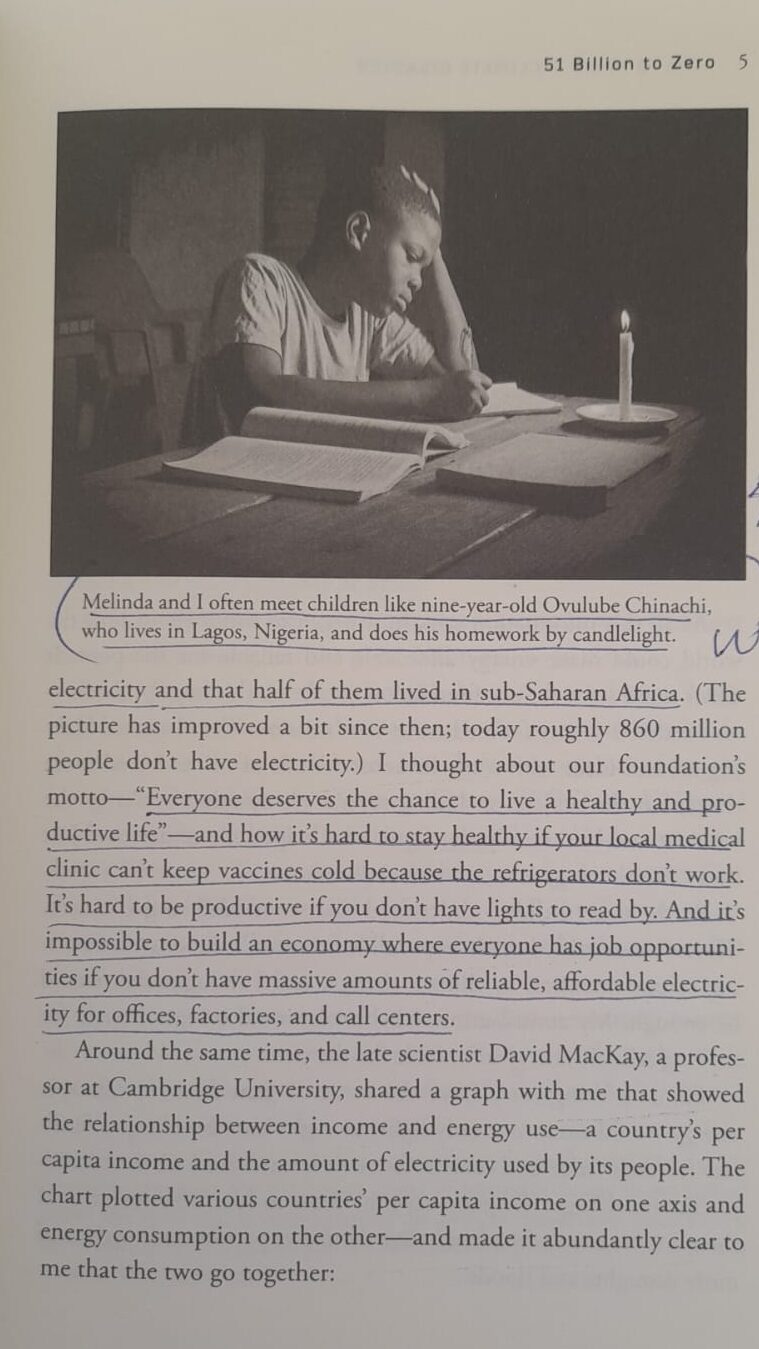
I definitely learned a lot in the book. For example, I learned that “a billion people didn’t have reliable access to electricity and that half of them lived in sub-Saharan Africa. He even had a photo of an African reading a book under candlelight at night. We take things like electricity for granted so much that it doesn’t really cross our minds that 1/8th of the world can’t flip on a light switch at night or refrigerate their food.
This of course creates an issue. Because more of the world needs access to good energy so they can thrive and prosper. However, we are already putting 51 billion tons of greenhouse gasses into the atmosphere every year. Bill comes to three main conclusions in the book:
- To avoid a climate disaster, we have to get to zero.
- We need to deploy the tools we already have, like solar and wind, faster and smarter.
- And we need to create ad roll out breakthrough technologies that can take us the rest of the way.
I had never really thought of the idea before of “getting to zero” which of course, is a big change. However, the only real way that something like that would be possible is through technological breakthroughs and engineering. I used to argue with my brother Jonny Wood about this idea. Jonny believed that humanity needed to return to the rivers and forests. I used to argue with him as we’d be hiking along a trail, basically that if we returned to the forests, we’d just cut them down and build cities there, and the problems could be solved via architectural and engineering breakthroughs. He’d then say “we need to stop doing that and live in nature” to which I would respond “that won’t work with 8 billion people” and so on our conversation would go.
One thing I have noticed is that certain demographic groups argue against climate change and think that it is some kind of massive scam to control the populace. I think that there is elements of this that might be true, as the world is so filled with propaganda that it is hard to decipher what is true from what is not without really getting into the details of it. However, the science that I have read so far talking about climate change is far superior to the arguments from the people tho think it is a scam. Some of both sides are useful to look at though.
For example, one of the main arguments that I’ve heard against the climate change philosophy is that the earth has been going in climate cycles since it has existed. During the Mesozoic era (250 to 66 million years ago) the world was between 6 and 9 degrees Celsius hotter than now. The last ice age was 5 degrees Celsius colder than it is now. What is to say that the earth won’t just flip into an ice age? Bill talks about some of the mechanics that made the earth cooler and hotter in this book but does not really resolve this common argument, which states that the world has been moving in heating and cooling cycles for millions of years, and this will happen regardless of what humans do.
One thing that I do agree with from the book is a statement that Bill Gates had:
The only solution I could imagine was to make clean energy so cheap that every country would choose it over fossil fuels.
Here is his argument for getting to zero emissions:
The reason we need to get to zero is simple. Greenhouse gases trap heat, causing the average surface temperature of the earth to go up. The more gases there are, the more the temperature rises. And once greenhouse gases are in the atmosphere, they stay there for a long time; something like one-fifth of the carbon dioxide emitted today will still be there in 10,000 years.
I must admit that I did not know the bit about one fifth of the carbon dioxide staying in the atmosphere for 10,000 years. I do know that it stinks in places like New York City and it would be nice if it didn’t. I also don’t think that people are going to stop doing what people do anytime soon. Whatever solutions that we come up with for healing the planet and removing pollutions have to be systemic and based in better, more efficient technology or they will never have the mass movement that they need in order to change fast enough to make any difference. I did learn in the book that the mean temperature has gone up about 1 degree Celsius since preindustrial times, and “some places have already started experiencing temperature increases of more than 2 degrees Celsius. These regions are home to between 20 and 40 percent of the world’s population.”
He also warns:
We’ve already raised the temperature at least 1 degree Celsius since preindustrial times, and if we don’t reduce emissions, we’ll probably have between 1.5 and 3 degrees Celsius of warming by mid-century, ad between 4 and 8 degrees Celsius by the end of the century.
Having the global temperature rise by minute amounts has catastrophic consequences. He also warns:
If the temperature rises by 2 degrees Celsius, coral reefs could vanish completely, destroying a major source of seafood for more than a billion people.
The problem with predicting the future is, of course, that there are so many variables that it is generally impossible to know with any kind of absolute accuracy what is going to happen. Stock market experts cannot predict what the market is going to do 5 minutes from now and we’ve all grown up watching weather forecasts and seen that in general, the weather experts don’t know what is going to happen later today with any kind of absolute certainty. However what I have also noticed is that it is generally easier to predict longer term trends if certain indicators can be quantified.
For example, certain human behaviors are predictable. If more of the world has access to energy, they are going to use it. People are going to use energy that is cheaper more than they will use energy that is cleaner. People are not going to stop building homes and infrastructure and they are not going to stop eating the foods that they like. The issues that face humanity are systemic issues and they are interwoven between political musings, economics, basic human desires and the current state of technological breakthroughs.
It’s not just the rich world. Almost everywhere, people are living longer and healthier lives. Standards of living are going up. There is rising demand for cars, roads, buildings, refrigerators, computers, and air conditioners and the energy to power them all. As a result, the amount of energy used per person will go up, and so will the amount of greenhouse gases emitted per person. Even building the infrastructure we’ll need to create all this energy—the wind turbines, solar panels, nuclear plants, electricity storage facilities, and so on–will itself involve releasing more greenhouse gases.
One thing I noticed about Bill Gates in reading How To Avoid A Climate Disaster is that he doesn’t just see a big picture, he sees things on a massive scale that is difficult for most people to grasp, which is one of the difficulties of solving such grande problems—people have a hard time understanding how they can do anything about it.
Human population is not declining, but growing and standards of living are not going down, but going up. Overall, we are going to continue to do what we have been doing and if there is a problem to be solved, it needs to be solved on a systemic scale, not an individual one.
Case in point, since we have been children we have heard about the values of practices such as recycling, but the fact is that the majority of people cannot be bothered. They will buy groceries and put the waste in the trash and throw it away, without any regard for ecology. Yes, some people will take forethought and organize their trash in such a way as to be ecologically balanced, but not enough people will do it to move the needle of the world. In order to recycle through the vast amount of human waste that is produced every day, automated systems need to be built that function on their own without the mass populace understanding how they work, or it will just never happen.
Many of these kinds of issues being solved from breakthroughs in robotics technologies, artificial intelligence, and properly formed legislation. The problem is in relying on humans to do it on their own as history has proven people will simply repeat their patterns and if they are destructive patterns, civilization will in the absence of technological and economic breakthroughs repeat their destructive patterns until the society has collapsed entirely.
For example, one of the biggest sources of greenhouse gas emissions is simply construction. We are not building less cities, but more. Bill Gates points out:
The world will be building the equivalent of another New York City every month for the next 40 years.
While some kinds of technology improves exponentially, some does not. It is not as fast to improve a coal plant as it is to improve computer chips. He also points out the following:
A computer chip made today has roughly one million times more transistors on it than one made in 1970, making it a million times more powerful… If computer chips can improve so much so quickly, can’t cars and solar panels? Unfortunately, no… Consider that the first Model T that rolled off Henry Ford’s production line in 1908 got no better than 21 miles to the gallon. As I write this, the top hybrid on the market gets 58 miles to the gallon. In more than a century, fuel economy has improved les than a factor of three.
Overall, the pattern that humanity is running is to grow bigger faster and more efficiently and we pollute as much as we are going to pollute along the way. The biggest breakthroughs we have had in this area have helped, but in the overall picture are barely making a dent in the problem. For example, my friend Jonathan Budd owns one of the top 10 solar companies in North America and as of writing this they have helped remove 3,115,991,119 lbs of carbon dioxide. However this works out to be 1,557,995 tons, or 0.00305% of the problem. Helpful? Absolutely. I would even say that he has moved the needle and he’s on track to move it much more.
Overall though, human pollution is simple expanding, and exponentially at that.
Many times we think of pollution and what comes to mind are things like cars (as there is obvious smoke coming out of them) and electricity. According to the book, 31% is caused by making things such as cement, steel, and plastic, 27% is caused by electricity, 19% is caused by growing things such as plants and taking care of animals, 16% is caused by getting around in cars and airplanes and 7% is caused by keeping warm and cool.
So you can see that the majority of solutions (companies such as Tesla and Powur) if they attained a 100% marketshare and all electricity and transportation became sustainable (which it won’t from these solutions although the solutions will make an impact) are only solving 43% of the problem as civilization continues to expand at a more rapid pace each year than it did the year before. In How To Avoid A Climate Disaster, he talks about Nuclear fission as a part of a solution to the problem of sustainable energy:
Here’s the one sentence case for nuclear power: It’s the only carbon-free energy source that can reliably deliver power day and night, through every season, almost anywhere on earth, that has been proven to work on a large scale.
No other energy source even comes close to what nuclear already provides today. (Here I mean nuclear fission—the process of getting energy by splitting atoms apart. I’ll get to its counterpart, nuclear fusion, in the next section.) The United States gets around 20 percent of its electricity from nuclear plants; France has the highest share int he world, getting 70 percent of its electricity from nuclear. Remember by comparison solar and wind together provide about 7 percent worldwide.
Nuclear has problems, but overall can be safely utilized today as a part of a global solution for power generation and energy distribution. Even if the entire world started driving electric cars, the electricity the cars are charged with is many times generated from burning coal or oil. So unless the electricity the cars are charged with is also sustainable, electric cars alone cannot solve the issues generated by transportation emissions.
Overall Bill’s Book “How to Avoid A Climate Disaster” is a good exposure to potential issues and solutions to the problem that we are going to have to solve in our age of the world, which is how human beings are going to move forward with technological progress and at the same time do so in a way where we are building a world that will thrive through the coming generations. Will the technological age end with the destruction of humanity? Or will we adapt and change to the point where we not only survive, but we thrive through the future ages of the world? One thing is for certain: these are real problems that need to be solved right now.
Bill Gates goes into an overview on many issues and their potential solutions in the book, but at the same time he is clear that the issues are not solved. The book is a call to action for humanity to work together with scientists and governments to solve the crisis of civilization destroying the planet as it grows and making it difficult to inhabit for the future generations.
Personally, I want my son to grow up in a world that has clean air and water and is habitable. So the book was a good introduction to these ideas, although I need to read perhaps 30 or 50 more books on the subject before I would consider myself educated on these ideas. Right now it has increased my general awareness of the subject as well as shown me some useful thinking frameworks to toss the problem around in my head as I meditate on these ideas.
Bill Gates is one of these people that gets a lot of blowback online. Some people think he is an evil supervillain who is out to wipe out humanity and others feel that he is a genuine philanthropist who is doing his best to fix issues that are beyond the grasp of most people. I tend to fall in the latter category as the only impression I get from reading the book is that this is a person who deeply cares about the future of humanity and wants to do his best to solve problems. Some of his ideas can help. He says:
…this isn’t primarily a technological problem. It’s a political and economic problem. People cut down trees not because people are evil; they do it when the incentives to cut down trees are stronger than the incentives to leave them alone. So we need political and economic solutions, including paying countries to maintain their forests, enforcing rules designed to protect certain areas, and making sure rural communities have different economic opportunities so they don’t have to extract natural resources just to survive.
The observation that people are simply doing what people do and that their intentions are generally not malicious is a good one. The issues are not individual, they are systemic and need to be solved on a systems level. One thing that people sometimes think is “if we are polluting more, just plant more trees to clean up the air.” While that is a good idea, he points out:
Taking all these factors into account, the math suggests you’d need somewhere around 50 acres’ worth of trees, planted in tropical areas, to absorb the emissions produced by an average American in her lifetime. Multiply that by the population of the United States, and you get more than 16 billion acres, or 25 million square miles, roughly half the landmass of the world. Those trees would have to be maintained forever. And that’s just for the United States—we haven’t accounted for any other country’s emissions.
Overall on this issue, I think that ignoring it is societal suicide, but at the same time I don’t think that we have the best solutions to solve it now. The solutions need to come through a combination of technological breakthroughs, political upheaval and a lot of work from many smart people. Can we solve it in time to avert the worst kinds of disasters? Yes. Will we? That’s a good question. From our history, the likelihood is that we won’t do anything about it of significant enough scale to solve it before the destruction is causing enough pain.
Unfortunately, that may be too late. What do you think about it? I would like to know your thoughts in the comments and let me know if you pickup a copy of the book. Do I think that this book has the solutions that humanity needs to move towards a sustainable future? Not all of them, but he definitely does a good job at outlining some of the challenges that we’ll have along the way. His views are deeply practical, he understands the challenges that we have on both a large vision scale and a practical local scale. The facts are that the breakthroughs that we need are simply not all developed yet, and then we face with the breakthroughs that we have the fact that political systems are not unified and move far slower than technology and are often driven by personal agendas and vendettas.
Can a bunch of disconnected national governments who often feud over resources work together for the betterment of humanity in a way that maintains autonomy and individual liberty? Not likely with the way that things are now. However, I tend to believe in the future of humanity and our ability to solve major world problems if we work together. But what do you think?
Love,
David Wood
P.S. You can pickup a copy of How To Avoid A Climate Disaster here.
![The Billion Dollar Bullseye and The Seven Rings Of Power [Jcron Book Review]](https://workwithdavidwood.com/wp-content/uploads/2024/10/75831a-75e7-c83d-56ea-bf77f7a6c018_1-BDB-768x770.webp)